Appreciate It vs Appreciated It: What’s the Difference? 🤔
Understanding Appreciate It vs Appreciated It can be confusing for many English learners because both phrases sound similar but are used in different situations. The difference mainly depends on timing—whether you are expressing gratitude in the present or referring to something you felt thankful for in the past. Many people mix them up in emails, conversations, and social media messages without realizing the subtle grammar rule behind them.
Have you ever typed a message like “I appreciate it” and then paused, wondering if “I appreciated it” would sound better instead? You are not alone. Since both expressions come from the same verb appreciate, they often create uncertainty even for native speakers.
In this guide, you will clearly understand the difference between Appreciate It vs Appreciated It, when to use each one, and how to avoid common mistakes. Whether you’re writing professionally or casually, mastering this small grammar detail will instantly improve your communication skills.
Quick Answer: Appreciate It vs Appreciated It ✅
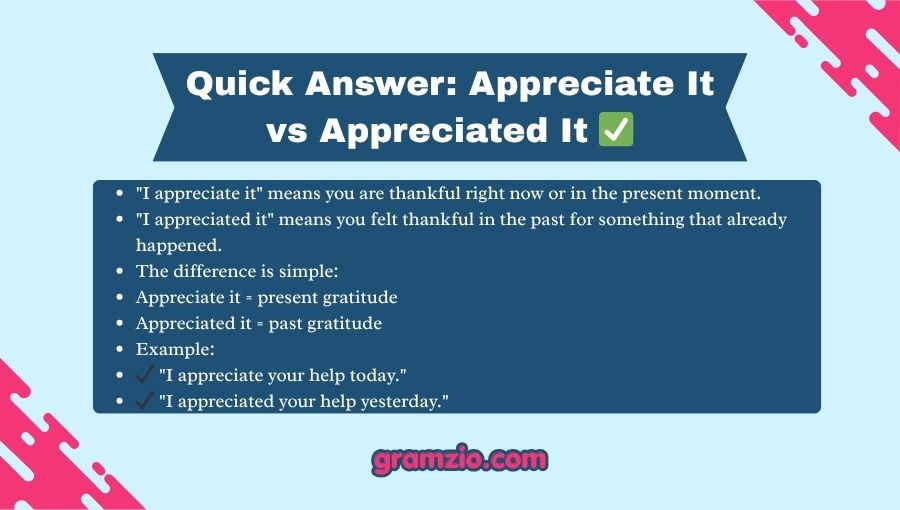
“I appreciate it” means you are thankful right now or in the present moment.
“I appreciated it” means you felt thankful in the past for something that already happened.
The difference is simple:
- Appreciate it = present gratitude
- Appreciated it = past gratitude
Example:
✔ “I appreciate your help today.”
✔ “I appreciated your help yesterday.”
Understanding the Basics: Appreciate It vs Appreciated It
The primary distinction comes down to verb tense.
The verb appreciate changes form based on when an action occurs.
| Form | Type | Meaning | Example | Correct/Incorrect |
|---|---|---|---|---|
| Appreciate it | Present tense | Feeling gratitude now | “I appreciate your support.” | ✔ Correct |
| Appreciated it | Past tense | Felt gratitude earlier | “I appreciated your support during the meeting.” | ✔ Correct |
| Appreciate it yesterday | Tense mismatch | Present verb with past time | “I appreciate it yesterday.” | ❌ Incorrect |
| Appreciated it now | Tense mismatch | Past verb with present time | “I appreciated it now.” | ❌ Incorrect |
The timeline matters ⏰.
Present situation → appreciate it
Past situation → appreciated it
Correct Meanings & Uses
When to Use “I Appreciate It” 😊
“I appreciate it” expresses current gratitude.
You use it when someone helps you, gives support, or does something meaningful.
Examples:
✔ “I appreciate your honesty.”
Sentence breakdown:
- I = subject
- appreciate = present-tense verb
- your honesty = object
Meaning:
You feel grateful now.
More examples:
✔ “I appreciate your time.”
✔ “I appreciate your understanding.”
✔ “I appreciate everything you do.”
Test Tip 🎯
Ask yourself:
Am I thankful right now?
If yes → use appreciate it
When to Use “I Appreciated It” 📖
“I appreciated it” refers to gratitude you felt in the past.
Examples:
✔ “I appreciated your advice during college.”
Breakdown:
- I = subject
- appreciated = past tense
- your advice = object
Meaning:
You felt thankful at that earlier time.
Additional examples:
✔ “I appreciated your kindness last week.”
✔ “I appreciated your support after the event.”
✔ “I appreciated your patience yesterday.”
Test Tip 🎯
Ask:
Did the appreciation happen earlier?
If yes → use appreciated it
Sentence Comparison
Read these carefully:
Present:
✔ “I appreciate your help.”
Past:
✔ “I appreciated your help.”
Present:
✔ “I appreciate your concern.”
Past:
✔ “I appreciated your concern.”
Tiny change. Big difference.
Case Study Section 📚
Imagine a workplace situation.
Sarah sends a message after receiving help from her coworker.
Incorrect Email:
“I appreciated your quick help today.”
Why is this awkward?
The word today signals present timing, but appreciated indicates the past.
Correct Version:
“I appreciate your quick help today.”
Now imagine Sarah writes the next day:
“I appreciated your help during yesterday’s presentation.”
That works perfectly because the event already happened.
Real communication depends heavily on matching tense with time.
Also Read This: Wish You vs Wishing You
Grammar Rules Explanation
Grammar authorities such as dictionaries and style references explain that appreciate functions as a regular verb.
Verb forms:
| Verb Form | Example |
|---|---|
| Base | appreciate |
| Present | appreciate |
| Past | appreciated |
| Past participle | appreciated |
| Present participle | appreciating |
According to standard English grammar usage, present tense describes actions or feelings occurring now, while past tense describes completed actions.
Examples:
Present:
✔ “I appreciate your effort.”
Past:
✔ “I appreciated your effort.”
The timing determines the verb.
Why One Form Is Correct and the Other Can Be Incorrect
The issue is not whether appreciate or appreciated is wrong.
Both are grammatically correct.
The problem occurs when writers mismatch the tense.
Incorrect:
❌ “I appreciate your help yesterday.”
Reason:
Yesterday = past
Appreciate = present
Correct:
✔ “I appreciated your help yesterday.”
Common Mistakes 🚫
People confuse these phrases for several reasons:
Fast typing
People write quickly and forget tense consistency.
Autocorrect
Phones sometimes change words unexpectedly.
Lack of grammar knowledge
Many users focus on vocabulary rather than verb tense.
Similar Grammar Confusions
| Confusing Pair | Correct Difference |
|---|---|
| It’s / Its | Contraction vs possession |
| Your / You’re | Possession vs “you are” |
| Then / Than | Time vs comparison |
| Affect / Effect | Verb vs noun |
| Appreciate it / Appreciated it | Present vs past |
These small differences create major clarity issues.
Usage in Different Contexts 🌎
Everyday Conversation
People frequently use I appreciate it in daily speech.
Examples:
✔ “Thanks, I appreciate it.”
✔ “I really appreciate your help.”
Past situations:
✔ “I appreciated your kindness.”
Professional Writing 📧
Work communication often includes appreciation statements.
Examples:
Present:
✔ “I appreciate your prompt response.”
Past:
✔ “I appreciated your assistance during the project.”
Professional writing values tense accuracy.
Creative Writing ✍
Writers use both forms depending on narrative timing.
Example:
“Years later, he appreciated the advice his father had given him.”
or:
“I appreciate what you are trying to do.”
Social Media and Texting 📱
Text messages often shorten phrases:
“Appreciate it 🙌”
This casual form drops “I” but keeps the present meaning.
Past versions appear less often in short messaging.
Why It Matters ⭐
Tiny grammar choices affect communication quality.
Correct tense improves:
Clarity
Readers instantly understand timing.
Professionalism
Good grammar builds trust.
Writing accuracy
Precise language prevents misunderstanding.
Digital communication
Emails, texts, and online messages depend on clear wording.
Remember this quote:
“Good communication begins with correct expression.”
A single tense choice can shape how readers perceive your message.
Special Exception 🔍
There are rare situations where context changes interpretation.
Example:
“At first I did not understand your advice, but later I appreciated it.”
In this case, appreciation occurred after reflection.
The timing shifted naturally.
Another note:
Some informal speech removes subjects:
✔ “Appreciate it!”
This is conversational shorthand and acceptable in casual communication.
Quick Recap Checklist ✅
| Question | If Yes → Use |
|---|---|
| Am I thankful right now? | Appreciate it |
| Did it happen earlier? | Appreciated it |
| Am I discussing yesterday or last week? | Appreciated it |
| Is gratitude happening currently? | Appreciate it |
Practice examples:
- I _____ your support yesterday.
Answer:
appreciated
- I _____ your help right now.
Answer:
appreciate
- We _____ your assistance during the event.
Answer:
appreciated
FAQs
Is “I appreciate it” grammatically correct?
Yes. It is completely correct and expresses gratitude happening now.
Is “I appreciated it” wrong?
No. It is correct when discussing appreciation in the past.
Which is more common in everyday speech?
“I appreciate it” is more common because people frequently express present gratitude.
Can I say “Appreciate it” without “I”?
Yes. In casual speech and texting, people often shorten it.
Example:
“Appreciate it! 👍”
Why does “I appreciate it yesterday” sound wrong?
Because “yesterday” indicates past time while “appreciate” is present tense.
Correct:
“I appreciated it yesterday.”
Can both phrases appear in one conversation?
Absolutely.
Example:
“I appreciated your help yesterday, and I still appreciate your support today.”
Conclusion
Understanding Appreciate It vs Appreciated It is easier than many people think. The difference is based entirely on time. If gratitude exists in the present, use I appreciate it. If gratitude happened earlier, use I appreciated it.
Many grammar mistakes happen because writers focus on the words themselves and ignore tense consistency. However, once you connect verb tense with timing, the choice becomes simple.
Remember this quick rule:
🟢 Present gratitude → I appreciate it
🔵 Past gratitude → I appreciated it
Small grammar improvements create stronger communication, clearer writing, and more confidence. Master the tense, and your message instantly becomes more natural and professional.
Also Read This: Myself vs My Self

Hi, I’m Elara Quinn. Working at gramzio.com, I use my 8 years of experience in linguistics to simplify difficult English rules, making them accessible and easy to learn for our global community.