Soo vs So: Which One Is Correct? 🤔 A Complete Grammar Guide
Have you ever typed a message like “I’m soo excited!” and paused for a second wondering whether it should actually be “so excited”? You are not alone. In today’s digital world, many people use extra letters in texts and social media posts for emphasis. That is why the confusion around Soo vs So keeps growing.
At first glance, both words may look acceptable because people regularly write things like “sooo cute,” “sooo funny,” or “soo happy.” But are these forms grammatically correct? Or are they just informal internet habits? 🤔
Understanding the difference matters because writing styles change depending on context. Something that works in a text message may look unprofessional in an email or academic paper.
In this complete guide, we will explore Soo vs So, explain the grammar rules, examine real-life examples, discuss common mistakes, and show you exactly when each form should—or should not—be used.
Quick Answer: Soo vs So
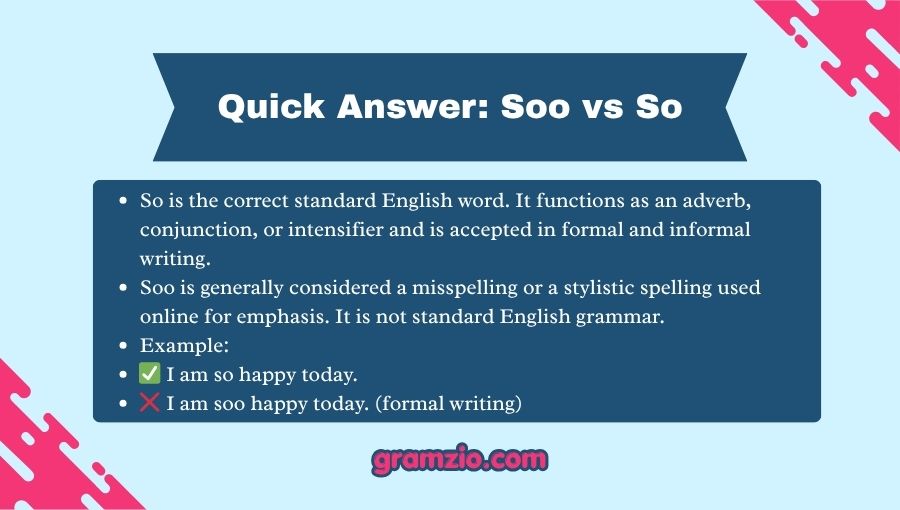
So is the correct standard English word. It functions as an adverb, conjunction, or intensifier and is accepted in formal and informal writing.
Soo is generally considered a misspelling or a stylistic spelling used online for emphasis. It is not standard English grammar.
Example:
✅ I am so happy today.
❌ I am soo happy today. (formal writing)
Understanding the Basics of Soo vs So
The difference between Soo vs So is simple:
- So = standard English and grammatically correct
- Soo = informal exaggeration or typo
People often stretch words online to show emotion. For example:
- I’m sooo excited!!! 🎉
- That movie was sooo good!
This style imitates speech. People naturally extend sounds while speaking, so they do the same while typing.
Comparison Table
| Form | Type | Meaning | Example | Correct/Incorrect |
|---|---|---|---|---|
| So | Adverb/Conjunction | To a great degree or therefore | I am so tired. | ✅ Correct |
| Soo | Nonstandard spelling | Informal emphasis | I am soo tired. | ❌ Incorrect in formal writing |
| Sooo | Extended spelling | Emotional emphasis online | I’m sooo excited! | ⚠ Informal only |
Correct Meanings & Uses
Using “So” as an Intensifier
One of the most common uses of so is adding intensity.
Examples:
- The pizza was so delicious. 🍕
- She is so kind.
- The weather is so beautiful today.
Sentence breakdown:
Subject + be verb + so + adjective
Example:
The weather + is + so + beautiful.
Test Tip 📝
If replacing so with very still makes sense, so is probably correct.
Example:
- She is so talented.
- She is very talented.
Both work.
Using “So” to Show a Result
So can connect causes and results.
Examples:
- I was tired, so I went to bed.
- It started raining, so we canceled the picnic.
Sentence breakdown:
Cause + so + result
Using “So” for Agreement
People also use so in responses.
Examples:
- I love coffee.
- So do I. ☕
This use is extremely common in conversations.
Test Tip 📝
If the word connects ideas or agreement, use so, not soo.
Why “Soo” Appears Online
People type soo because they want stronger emotion.
Examples:
- I’m soo hungry!
- That puppy is soo cute! 🐶
This style imitates spoken exaggeration.
However:
Formal writing:
❌ I am soo interested in the position.
Correct:
✅ I am so interested in the position.
Also Read This: Appreciate It vs Appreciated It
Case Study Section 📚
Imagine an employee writing a work email:
Incorrect:
“Hello Sarah, I am soo excited to join the team next week.”
Although the excitement sounds genuine, the spelling looks unprofessional.
Correct:
“Hello Sarah, I am so excited to join the team next week.”
Now imagine a text message:
“OMG I’m soo excited!!!”
Here it feels natural because texting allows more personality.
This example shows how context changes acceptable usage.
Grammar Rules Explanation
Traditional dictionaries and grammar authorities such as Merriam-Webster recognize so as a standard English word used as:
- an adverb
- a conjunction
- an intensifier
- a substitute expression
Examples:
- She runs so quickly.
- I was tired, so I slept.
There is no standard dictionary definition for soo as an English grammatical word.
Instead, it is viewed as:
- intentional stretching
- internet slang
- nonstandard spelling
- typo variation
Therefore, grammar rules support so, not soo.
Common Mistakes 🚫
Why do people confuse Soo vs So?
Several reasons cause this mistake.
Fast typing
People type quickly and accidentally repeat letters.
Example:
Intended:
so
Typed:
soo
Autocorrect habits
Phones sometimes preserve previous typing styles.
Social media influence
Online communication encourages expressive spelling.
Examples:
- sooo
- yessss
- noooo
- pleassee
Lack of grammar knowledge
Many writers assume that if everyone uses a form online, it must be correct.
Unfortunately, internet popularity does not always equal grammatical correctness.
Similar Grammar Confusions Table
| Incorrect Pair | Correct Usage |
|---|---|
| Its / It’s | Possession vs contraction |
| Your / You’re | Ownership vs “you are” |
| Than / Then | Comparison vs time |
| Affect / Effect | Verb vs noun |
| Soo / So | Nonstandard vs standard |
Usage in Different Contexts
Everyday Conversation 🗣️
People often stretch words while texting.
Examples:
“I’m soo tired.”
Friends usually understand this.
Professional Writing 💼
Professional environments require standard spelling.
Correct:
I am so pleased to accept your offer.
Avoid:
I am soo pleased.
Creative Writing ✍️
Authors occasionally use extended spellings to capture speech patterns.
Example:
“I am sooo nervous,” Jake whispered.
This is a stylistic choice.
Social Media and Texting 📱
Social media encourages emotional emphasis.
Examples:
- I’m sooo excited
- That concert was sooo amazing
- This cake is soo good
These spellings are acceptable in casual communication.
Why It Matters ⭐
You might wonder:
“If people understand me anyway, why does Soo vs So matter?”
The answer is clarity and credibility.
Proper grammar matters because:
Clarity in communication
Readers immediately understand your meaning.
Professionalism
Correct spelling creates a stronger impression.
Accuracy in digital writing
Small spelling choices affect how people view your writing.
Remember this quote:
“Good writing is clear thinking made visible.”
Using standard forms improves communication.
Special Exception
There are a few situations where Soo may appear correctly.
Names and brands
Some people have names containing Soo.
Examples:
- Soo Kim
- Soo Lee
In these cases, Soo is a proper noun, not a grammar form.
Also, fictional characters or company names might include it.
Example:
“Soo Bakery”
These are exceptions.
Quick Recap Checklist ✅
| Question | If Yes → Use |
|---|---|
| Are you writing an email? | So |
| Is it formal writing? | So |
| Is it a school paper? | So |
| Are you texting friends casually? | Soo or Sooo can work stylistically |
| Are you following grammar rules? | So |
Practice Examples
Choose the correct option:
- I am ___ happy today.
Answer: so
- The movie was ___ funny.
Answer: so
- OMG I’m ___ excited!!! 🎉
Answer:
Casual texting: soo/sooo
Formal writing: so
Frequently Asked Questions (FAQs)
Is “soo” a real English word?
No. Soo is not a standard English grammar word. It is usually a stylistic spelling or typo.
Which is correct: “soo much” or “so much”?
So much is grammatically correct.
Example:
✅ Thank you so much.
Why do people write “sooo”?
People use sooo to express strong emotion or excitement online.
Can I use “soo” in emails?
No. Professional emails should use so.
Is “soo” acceptable on social media?
Yes, in casual contexts. Social media often allows expressive spelling.
Is “so” always an adverb?
No. So can function as:
- adverb
- conjunction
- intensifier
- response word
Conclusion
Understanding Soo vs So is easier than it first appears. So is the correct and standard English form used in everyday grammar, professional writing, and academic communication. It works as an adverb, conjunction, and intensifier, making it an important word in English.
Meanwhile, soo belongs mostly to internet culture and casual texting. People use it to express excitement or emotion, but it is not considered standard grammar.
The key rule is simple: if grammar matters, use so. If you are joking with friends or emphasizing feelings online, soo may appear stylistically.
Small spelling choices create big differences. Write clearly, write confidently, and remember this simple rule:
✨ When in doubt, keep it so, not soo.
Also Read This: Wish You vs Wishing You

Hi, I’m Dexter Rhodes. At gramzio.com, I apply my 10 years of experience in copy-editing to ensure every guide we publish is accurate, professional, and follows the highest editorial standards.