Affect vs Effect: The Complete Grammar Guide You Need (100% Clear Explanation) 📘✨
If you’ve ever paused while writing a sentence like “This will affect me” or “This will have an effect on me,” you are not alone. The confusion between affect vs effect is one of the most common grammar struggles in the English language—even for native speakers. 😵💫
These two words look similar, sound slightly related, and even come from the same Latin root. But in modern US English grammar, they serve very different purposes. One is mostly used as a verb, and the other is mostly used as a noun. Yet, there are exceptions that make things even trickier.
Understanding affect vs effect is important not only for exams or grammar tests but also for professional writing, emails, academic papers, and everyday communication. A small mistake can completely change the meaning of your sentence or make your writing look less professional.
In this guide, you’ll learn the difference in the simplest way possible—with clear rules, tables, examples, real-life usage, and memory tricks that will make it stick forever. Let’s finally clear the confusion once and for all! 🚀
Quick Answer: Affect vs Effect
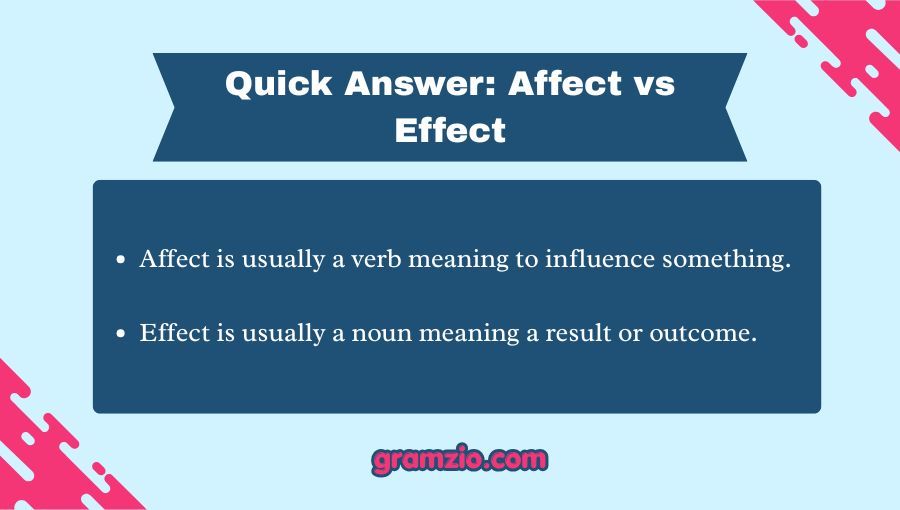
Affect is usually a verb meaning to influence something.
Effect is usually a noun meaning a result or outcome.
👉 Example:
- The weather can affect your mood.
- The weather has a strong effect on your mood.
In simple terms:
- Affect = Action (Verb)
- Effect = Result (Noun)
Understanding the Basics of Affect vs Effect
The main difference between affect vs effect lies in their grammatical role and meaning in a sentence.
- Affect (Verb): To influence or make a change
- Effect (Noun): The result of a change
Comparison Table: Affect vs Effect
| Feature | Affect | Effect | Correct Example | Incorrect Example |
|---|---|---|---|---|
| Part of Speech | Verb | Noun | The news affected him. | The news effected him. ❌ |
| Meaning | To influence | A result or outcome | The effect was surprising. | The affect was surprising. ❌ |
| Usage | Action word | Thing/result word | Exercise affects health. | Exercise effects health. ❌ |
| Memory Tip | Action = Affect | End result = Effect | Cause affects effect | Confusing them ❌ |
Correct Meanings & Uses of Affect vs Effect
1. “Affect” as a Verb (Most Common Usage) ⚡
“Affect” means to influence or change something.
Examples:
- Stress can affect your sleep quality. 😴
- The cold weather affects plant growth. 🌱
- Social media can affect teenagers’ behavior. 📱
Sentence Breakdown:
- Subject: Stress
- Verb: affects
- Object: sleep quality
👉 Meaning: Stress influences sleep quality.
Test Tip 🧠:
If you can replace the word with “influence”, then affect is correct.
2. “Effect” as a Noun (Most Common Usage) 📊
“Effect” refers to the result or consequence of something.
Examples:
- The medicine had a strong effect. 💊
- Pollution has a negative effect on health. 🌍
- The new law created a positive effect on society. ⚖️
Sentence Breakdown:
- Subject: Pollution
- Result: effect
👉 Meaning: Pollution causes a result on health.
Test Tip 🧠:
If you can replace it with “result”, then effect is correct.
3. Special Case: “Effect” as a Verb (Rare Usage) 🔄
In rare cases, effect can be a verb meaning to bring about or cause something to happen.
Examples:
- The president effected major reforms. 🏛️
- The manager effected changes in the policy. 📑
👉 This usage is formal and less common in daily writing.
Case Study: Real-Life Usage of Affect vs Effect 💼
Workplace Email Example
❌ Incorrect:
The new system will effect employee productivity.
✔ Correct:
The new system will affect employee productivity.
Now consider:
✔ Correct:
The new system had a positive effect on productivity.
Explanation:
- “Affect” = action (system influencing productivity)
- “Effect” = result (productivity improvement)
This simple difference is critical in professional communication.
Grammar Rules Explanation 📚
According to standard grammar sources like Merriam-Webster and Oxford Dictionary:
- Affect is primarily used as a verb meaning to influence.
- Effect is primarily used as a noun meaning result or consequence.
Why the Confusion Happens 😵
- Similar spelling
- Similar pronunciation
- Shared origin (Latin afficere)
- Rare crossover usage of “effect” as a verb
👉 But in 95% of cases:
- Use affect = verb
- Use effect = noun
Common Mistakes with Affect vs Effect 🚫
Why People Get It Wrong
- Fast typing without thinking ⌨️
- Autocorrect errors 📱
- Lack of grammar awareness 📖
- Similar pronunciation confusion 🎧
Common Grammar Confusions Table
| Confused Words | Correct Usage Example | Incorrect Usage |
|---|---|---|
| it’s / its | It’s raining today. | Its raining today. ❌ |
| your / you’re | You’re amazing. | Your amazing. ❌ |
| affect / effect | The effect was strong. | The affect was strong. ❌ |
| there / their | Their house is big. | There house is big. ❌ |
Usage in Different Contexts 🌍
1. Everyday Conversation 🗣️
- The cold affects my mood.
- The medicine had no effect.
2. Professional Writing 💼
- Market trends affect business growth.
- The policy had a significant effect on sales.
3. Creative Writing ✍️
- The silence affected her deeply.
- The emotional effect was powerful.
4. Social Media/Texting 📱
- That movie really affected me 😢
- Wow, what an effect!
Why It Matters (Important Section) 🎯
Using affect vs effect correctly is important because:
- It improves communication clarity ✨
- It enhances professional credibility 💼
- It avoids misunderstanding in writing 📩
- It shows strong language control 🧠
“Good grammar is credibility, especially in written communication.”
Special Exception Section ⚠️
- Effect (Verb) is rarely used in formal writing:
- “to effect change” = to bring change into existence
- This is mostly found in legal, academic, or formal documents.
Quick Recap Checklist ✅
| Question | If Yes → Use |
|---|---|
| Is it showing influence? | Affect |
| Is it showing result? | Effect |
| Is it an action word? | Affect |
| Is it a thing/result? | Effect |
Practice Examples:
- Stress can ___ sleep quality.
- The ___ of stress is poor sleep.
- The weather ___ farming.
✔ Answers:
- affect
- effect
- affects
FAQs: Affect vs Effect ❓
1. What is the easiest way to remember affect vs effect?
Think: Affect = Action, Effect = End result. This simple trick works in most cases.
2. Can “effect” be a verb?
Yes, but rarely. It means to bring about change, mostly in formal writing.
3. Which is more commonly used: affect or effect?
“Affect” is more commonly used as a verb in everyday English.
4. What is a simple example of effect?
“The medicine had a strong effect on the patient.”
5. Why do people confuse affect and effect?
Because they sound similar and are closely related in meaning and spelling.
6. Is affect always a verb?
Mostly yes, but in psychology it can also be a noun meaning emotion or feeling.
Conclusion
Understanding affect vs effect is essential for clear and confident English writing. While both words are closely related, their roles in grammar are very different. “Affect” is generally used as a verb meaning to influence something, while “effect” is mostly used as a noun meaning the result of that influence.
Once you remember the simple rule—Affect = Action, Effect = Result—you can avoid most common mistakes instantly. This small improvement can make your writing more professional, polished, and easier to understand.
Whether you’re writing emails, academic papers, blog posts, or social media captions, using these words correctly builds credibility and clarity.
Mastering this difference is not just about grammar—it’s about communication power. And now, you have that power in your hands. 💡✨
Also read: In Process vs In Progress

Hi, I’m Dexter Rhodes. At gramzio.com, I apply my 10 years of experience in copy-editing to ensure every guide we publish is accurate, professional, and follows the highest editorial standards.