Further vs Farther: The Complete Grammar Guide You Need 📘✨
Have you ever paused mid-sentence and wondered whether to use further vs farther? You’re not alone. Even experienced writers, teachers, and professionals sometimes hesitate when choosing between these two words. At first glance, they seem identical, and in many modern contexts, they are used interchangeably. However, there are subtle differences that can improve the clarity, precision, and professionalism of your writing.
The confusion around further vs farther comes from their shared origin and overlapping meanings. While both words relate to distance or extent, they are not always used in the same way. Understanding when to use each one can make your communication more accurate and polished.
In this detailed guide, you’ll learn the exact difference between further vs farther, supported by examples, tables, grammar rules, common mistakes, real-life usage, and expert tips. By the end, you’ll never hesitate again when choosing between these two commonly confused words. Let’s break it down step by step 🧠✨
Quick Answer: Further vs Farther
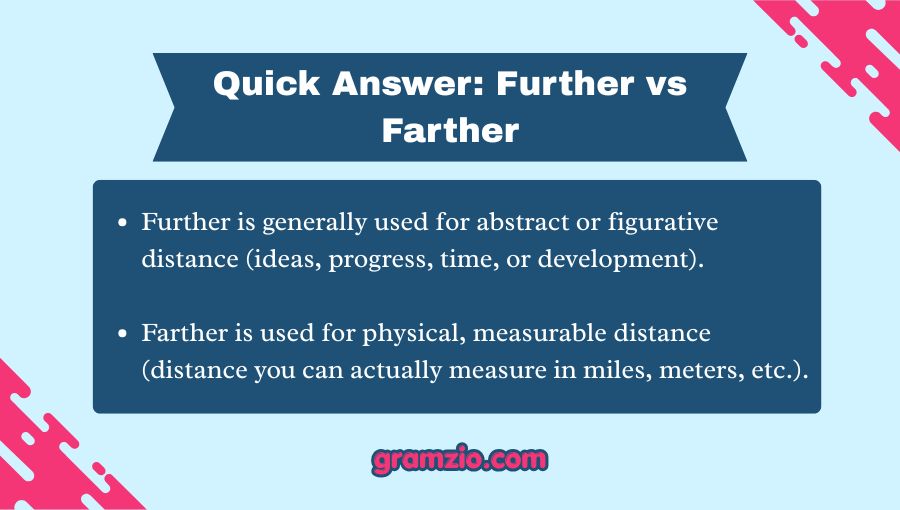
Further is generally used for abstract or figurative distance (ideas, progress, time, or development).
Farther is used for physical, measurable distance (distance you can actually measure in miles, meters, etc.).
👉 Example:
- I need to study further to improve my grades.
- The store is farther down the road.
In simple terms:
- Farther = Physical distance 🛣️
- Further = Figurative or extended meaning 💡
Understanding the Basics: Further vs Farther
Although both words originate from the Old English word “further,” modern usage has created a subtle distinction.
Key Idea
- Farther = measurable distance (literal)
- Further = additional extent or degree (abstract or figurative)
Comparison Table: Further vs Farther
| Feature | Further 💡 | Farther 🛣️ |
|---|---|---|
| Form | Adverb/Adjective | Adverb/Adjective |
| Type | Figurative/Abstract | Physical/Distance |
| Meaning | More, additional, beyond | More distance physically |
| Example | Let’s discuss this further | The park is farther away |
| Correct Usage | Ideas, time, progress | Miles, kilometers, physical space |
Correct Meanings & Uses
1. Using “Farther” for Physical Distance 🛣️
“Farther” refers to measurable or literal distance.
Examples:
- The school is farther than I expected.
- She ran farther than anyone else in the race.
- How much farther do we need to travel?
Sentence Breakdown:
👉 “The school is farther than I expected.”
- “Farther” = physical distance between speaker and school
- “Expected” = comparison of distance perception
Test Tip 🧪
If you can measure it in miles, kilometers, or meters, use farther.
2. Using “Further” for Abstract Ideas 💡
“Further” is used when referring to non-physical concepts like progress, time, or additional information.
Examples:
- We need further discussion before deciding.
- She wants to pursue further studies.
- For further details, contact support.
Sentence Breakdown:
👉 “We need further discussion.”
- “Further” = additional discussion (not physical distance)
- Implies continuation or extension
Test Tip 🧪
If it involves ideas, time, or metaphorical extension, use further.
Case Study: Real-Life Usage Example 🧑💼
Workplace Email Example
❌ Incorrect:
We need to go farther into this report.
✅ Correct:
We need to go further into this report.
Explanation:
The report is not a physical distance. It involves analysis and depth, so “further” is correct.
Travel Example
❌ Incorrect:
The hotel is further down the highway.
✅ Correct:
The hotel is farther down the highway.
Explanation:
Highway distance is measurable → physical space → “farther”
Grammar Rules Explanation 📚
Traditional grammar rules separate these words based on type of distance:
- Farther → Physical distance
- Further → Figurative or abstract distance
However, modern English usage (including dictionaries like Merriam-Webster) notes that:
👉 In many cases, especially informal writing, both can be interchangeable.
Still, for academic, professional, and SEO writing, it is best to maintain the distinction for clarity.
Common Mistakes with Further vs Farther ⚠️
Many learners mix these words due to:
- Similar spelling
- Overlapping meanings
- Lack of grammar awareness
- Fast typing and autocorrect errors
Common Confusion Table
| Mistake Pair | Correct Form | Why It Happens |
|---|---|---|
| it’s / its | It’s = it is | Apostrophe confusion |
| your / you’re | You’re = you are | Sound similarity |
| further / farther | Depends on context | Meaning overlap |
| affect / effect | Different grammar roles | Similar pronunciation |
Usage in Different Contexts 🌍
1. Everyday Conversation 🗣️
- How much farther is the beach?
- Let’s discuss this further later.
2. Professional Writing 💼
- Further analysis is required before approval.
- The office is farther than the previous location.
3. Creative Writing ✍️
- She walked farther into the dark forest.
- His thoughts drifted further into imagination.
4. Social Media & Texting 📱
- Can’t walk any farther 😂
- We’ll talk further later 👍
Why It Matters: Further vs Farther Importance 💡
Using the correct word improves:
- Clarity in communication
- Professional credibility
- Academic accuracy
- Reader trust and engagement
“Good writing is clear thinking made visible.”
Choosing the right word helps your audience understand exactly what you mean without confusion.
Special Exception Section ⚠️
In modern English usage, especially in American English:
- “Further” is often used for both physical and figurative distance.
- “Farther” is becoming more limited to physical distance.
However, formal writing still prefers the traditional distinction.
Quick Recap Checklist ✔️
| Question | If Yes → Use |
|---|---|
| Is it physical distance? | Farther 🛣️ |
| Is it about ideas or progress? | Further 💡 |
| Is it measurable in units? | Farther 🛣️ |
| Is it abstract or general? | Further 💡 |
Practice Examples 🧠
- The mountains are ______ away than I thought.
→ Farther - We need ______ discussion on this topic.
→ Further - She walked ______ into the cave.
→ Farther
FAQs: Further vs Farther ❓
1. What is the main difference between further and farther?
Farther refers to physical distance, while further refers to abstract or additional concepts.
2. Can further and farther be used interchangeably?
In modern English, sometimes yes. However, formal writing prefers the traditional distinction.
3. Is farther only used for distance?
Mostly yes. It is mainly used for measurable physical distance.
4. Is further more common than farther?
Yes. “Further” is more commonly used in everyday English.
5. Which is correct: “further down the road” or “farther down the road”?
Both are acceptable, but “farther” is more precise for physical distance.
6. How can I easily remember the difference?
Think:
- Farther = Far (physical distance 🛣️)
- Further = Further ideas 💡
Conclusion
Understanding the difference between further vs farther may seem small, but it plays a big role in clear and effective communication. The simplest way to remember is this:
- Use farther when talking about physical distance you can measure.
- Use further when referring to abstract ideas, progress, or additional information.
While modern English sometimes allows flexibility, maintaining this distinction makes your writing more precise, professional, and easy to understand.
Whether you are writing an email, an essay, or a blog post, choosing the right word shows attention to detail and strong language skills. So next time you pause between further and farther, you’ll know exactly what to do—and your writing will instantly sound more confident and polished ✨📘
Also read: Affect vs Effect

Hi, I’m Elara Quinn. Working at gramzio.com, I use my 8 years of experience in linguistics to simplify difficult English rules, making them accessible and easy to learn for our global community.