Nighttime vs Night Time: Which One Is Correct? 🌙
Introduction
Nighttime vs night time is a common grammar confusion that many writers face. 🤔 At first glance, both forms seem correct because they refer to the hours after sunset. However, modern English grammar prefers one spelling over the other in most situations. Whether you are writing a blog post, school essay, business email, or social media caption, using the correct form can improve your writing clarity and professionalism.
This confusion exists because English constantly evolves, especially when it comes to compound words. Some expressions that once appeared as two separate words eventually became a single accepted term. The same thing happened with “nighttime.” Many people still write “night time,” but grammar experts and dictionaries usually recommend the one-word version.
In this complete guide, you will learn the difference between nighttime vs night time, the correct grammar rules, real-life examples, common mistakes, and easy memory tricks to help you use the right form every time. 🌙
Quick Answer: Nighttime vs Night Time 🌃
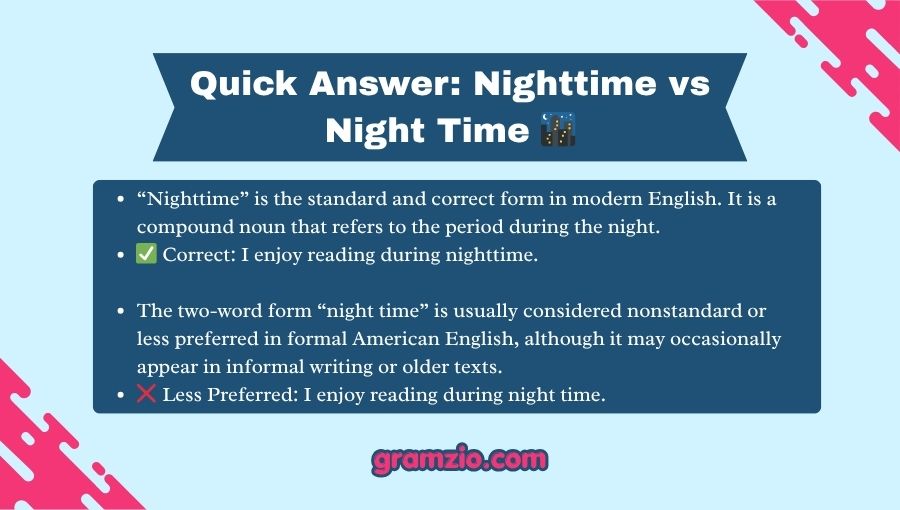
“Nighttime” is the standard and correct form in modern English. It is a compound noun that refers to the period during the night.
✅ Correct: I enjoy reading during nighttime.
The two-word form “night time” is usually considered nonstandard or less preferred in formal American English, although it may occasionally appear in informal writing or older texts.
❌ Less Preferred: I enjoy reading during night time.
Understanding the Basics of Nighttime vs Night Time
The confusion between these terms comes from compound word formation in English grammar. Over time, certain words become combined into a single accepted term.
Core Difference
- Nighttime → Correct and widely accepted compound noun
- Night time → Informal, outdated, or less standard variation
Here is a simple comparison table:
| Form | Type | Meaning | Example | Correct/Incorrect |
|---|---|---|---|---|
| Nighttime | Compound noun | The period during the night | We traveled during nighttime. | ✅ Correct |
| Night time | Two-word phrase | Same meaning but less standard | We traveled during night time. | ⚠️ Less Preferred |
Correct Meanings & Uses
What Does “Nighttime” Mean? 🌙
“Nighttime” refers to the hours of darkness between sunset and sunrise. It is commonly used as a noun or adjective.
Examples
- Nighttime is my favorite part of the day.
- The city looks beautiful during nighttime.
- Nighttime temperatures can become very cold.
Sentence Breakdown
In the sentence:
Nighttime is peaceful.
“Nighttime” acts as a noun because it names a period of time.
Is “Night Time” Ever Correct?
The two-word version is not technically wrong in every situation, but it is much less common in modern US English. Most grammar experts and dictionaries prefer the single-word form.
Example
- Night time activities were limited.
Although readers understand the meaning, professional editors would usually change it to:
✅ Nighttime activities were limited.
Test Tip ✅
If you are unsure which form to use, remember this simple rule:
If you are referring to the general period after dark, use “nighttime” as one word.
Case Study: Real-Life Usage 📧
Imagine you are writing a workplace email:
❌ Incorrect Example:
“Please avoid making deliveries during night time.”
✅ Correct Example:
“Please avoid making deliveries during nighttime.”
Why the Second Version Works Better
The compound form looks cleaner, more professional, and grammatically standard. In business communication, polished writing improves credibility and readability.
Grammar Rules Explanation 📚
English grammar often combines two related words into one compound word over time. According to standard dictionary references like Merriam-Webster and Cambridge Dictionary, “nighttime” is the preferred spelling.
Why “Nighttime” Is Correct
“Nighttime” follows the same pattern as:
- daytime ☀️
- bedtime 🛏️
- lunchtime 🍔
- nighttime 🌙
These words evolved into closed compound nouns because they are frequently used together.
Why “Night Time” Sounds Natural to Some People
Many people separate the words because English contains phrases like:
- night shift
- night sky
- night walk
Since “night” often appears beside another word, writers may mistakenly think “night time” should also stay separated.
However, dictionaries and style guides generally accept nighttime as the standard spelling.
Common Mistakes Section ❌
Why Do People Confuse Nighttime vs Night Time?
Several reasons explain the confusion:
1. Fast Typing ⌨️
People often separate compound words accidentally while typing quickly.
2. Autocorrect Issues 📱
Some devices fail to flag “night time” as incorrect.
3. Lack of Grammar Knowledge 📖
Many writers simply do not know that “nighttime” is a closed compound noun.
Similar Grammar Confusions Table
| Confusing Words | Correct Form | Common Mistake |
|---|---|---|
| It’s vs Its | It’s = it is | Using apostrophe incorrectly |
| Your vs You’re | You’re = you are | Mixing ownership and contraction |
| Everyday vs Every Day | Everyday = adjective | Confusing phrase vs adjective |
| Anytime vs Any Time | Anytime preferred informally | Separating unnecessarily |
| Nighttime vs Night Time | Nighttime preferred | Writing as two words |
Usage in Different Contexts 🌍
Everyday Conversation 🗣️
In casual speech, both forms sound almost identical because pronunciation does not change much.
Example
- I love nighttime walks.
This sounds natural and modern.
Professional Writing 💼
Professional communication should use the standard form.
Example
- Nighttime security procedures must be followed.
Using the correct compound word improves professionalism.
Creative Writing ✨
Authors often use “nighttime” to create atmosphere and imagery.
Example
- The nighttime sky shimmered with stars.
The single-word version flows more smoothly in literature.
Social Media & Texting 📱
People sometimes write “night time” informally online. However, “nighttime” still appears more polished and grammatically correct.
Example
✅ Nighttime vibes 🌙
Why It Matters 🚨
You might wonder:
“Does one small space really matter?”
Yes, it does.
Correct grammar affects how readers perceive your writing. Even tiny mistakes can reduce credibility, especially in professional or academic settings.
Benefits of Using the Correct Form
Clarity in Communication
Readers instantly recognize the standard spelling.
Professionalism
Correct grammar creates a polished impression.
Writing Accuracy
Accurate spelling improves overall writing quality.
Better Digital Communication
Search engines and grammar tools recognize standard forms more effectively.
“Good grammar is credibility in written form.”
Special Exception Section ⚠️
There are rare situations where “night time” may appear intentionally.
1. Older Publications
Some older books or regional writing styles may use the separated form.
2. Creative Styling
A poet, songwriter, or brand may intentionally separate the words for artistic effect.
Example:
- Night Time Dreams Café
In branding, grammar rules are sometimes ignored intentionally.
However, for normal writing, “nighttime” remains the preferred choice.
Quick Recap Checklist ✅
| Question | If Yes → Use |
|---|---|
| Referring to the general period after dark? | Nighttime |
| Writing professionally or academically? | Nighttime |
| Want modern standard English? | Nighttime |
| Using a creative brand name intentionally? | Night Time possible |
Practice Examples ✍️
Choose the correct form:
- I enjoy reading during ________.
- ✅ nighttime
- The park closes at ________.
- ✅ nighttime
- ________ photography requires special lighting.
- ✅ Nighttime
Deep Dive: Compound Words in English 📘
To fully understand nighttime vs night time, it helps to understand compound words.
What Is a Compound Word?
A compound word forms when two separate words combine to create one meaning.
Examples include:
| Compound Word | Original Words |
|---|---|
| Bedroom | Bed + room |
| Sunlight | Sun + light |
| Notebook | Note + book |
| Nighttime | Night + time |
Over time, commonly paired words merge into a single accepted form.
Types of Compound Words
Closed Compounds
Written as one word.
Examples:
- nighttime
- football
- keyboard
Open Compounds
Written as separate words.
Examples:
- post office
- high school
- full moon
Hyphenated Compounds
Connected with a hyphen.
Examples:
- mother-in-law
- well-known
- part-time
“Nighttime” belongs to the closed compound category.
Nighttime in American vs British English 🇺🇸🇬🇧
In both American and British English, “nighttime” is widely accepted. However, some British publications occasionally use “night-time” with a hyphen.
Examples
American English
✅ nighttime
British English
✅ nighttime
✅ night-time
The separated version “night time” remains much less common in standard writing.
Examples of Nighttime in Sentences 🌌
Here are additional examples to help reinforce correct usage.
As a Noun
- Nighttime can feel peaceful and relaxing.
- Children usually sleep during nighttime.
As an Adjective
- Nighttime traffic is lighter.
- Nighttime photography requires patience.
Incorrect Usage Examples ❌
Understanding mistakes helps prevent them.
| Incorrect Sentence | Correct Sentence |
|---|---|
| I work during night time. | I work during nighttime. |
| Night time driving is difficult. | Nighttime driving is difficult. |
| We love night time adventures. | We love nighttime adventures. |
Memory Tricks to Remember the Correct Form 🧠
Trick #1: Think of “Daytime”
Most people naturally write “daytime” as one word.
Since “nighttime” follows the same pattern, keep it together too.
Trick #2: Use Dictionary Logic
If major dictionaries combine the words, you should too.
Trick #3: Visual Connection
Imagine nighttime as one complete period, not two separate ideas.
🌙 + ⏰ = nighttime
Expert Writing Advice ✍️
Professional writers and editors usually follow consistency rules. If you choose “nighttime,” keep that spelling throughout your document.
Avoid Mixing Forms
❌ Incorrect Style:
- Nighttime activities are popular.
- Many people enjoy night time walks.
Consistency matters in polished writing.
Cultural and Literary Use 🌌
Writers often use “nighttime” to create emotional imagery.
Example in Fiction
- The quiet nighttime streets felt mysterious.
The single-word form creates smoother reading flow and stronger rhythm.
Final Comparison Table 📊
| Feature | Nighttime | Night Time |
|---|---|---|
| Modern Standard English | ✅ Yes | ❌ No |
| Professional Writing | ✅ Recommended | ⚠️ Avoid |
| Dictionary Preferred | ✅ Yes | ❌ Rarely |
| Common in US English | ✅ Very Common | ❌ Less Common |
| Easy to Read | ✅ Yes | ⚠️ Less Smooth |
FAQs: Nighttime vs Night Time ❓
1. Is “nighttime” one word or two?
“Nighttime” is generally written as one word in modern English.
2. Is “night time” grammatically wrong?
It is not completely wrong, but it is considered less standard and less preferred in modern US English.
3. Which form should I use in professional writing?
Use “nighttime” because it is the accepted standard spelling.
4. Do dictionaries recognize “nighttime”?
Yes. Dictionaries like Merriam-Webster and Cambridge Dictionary list “nighttime” as the standard form.
5. Is “night-time” correct?
Yes, “night-time” appears mainly in British English. However, American English usually prefers “nighttime.”
6. Why do people still write “night time”?
People often separate the words because of typing habits, older writing styles, or misunderstanding compound word rules.
Conclusion 🌙
The debate over nighttime vs night time becomes simple once you understand compound word rules. In modern English, “nighttime” is the correct and preferred spelling. It appears in dictionaries, professional writing, academic content, and everyday communication. While “night time” may occasionally appear in informal or older texts, it is far less standard and should usually be avoided.
Using the proper form improves clarity, professionalism, and writing accuracy. Whether you are creating blog posts, emails, essays, captions, or creative stories, choosing “nighttime” helps your writing look polished and credible. ✍️
The next time you pause before typing these words, remember this simple rule:
If you mean the period after dark, write it as one word — “nighttime.” 🌌
Also read: Respond vs Response

Hi, I’m Grayson Finch. I’m part of the gramzio.com team with 9 years of experience in grammar education. I am dedicated to teaching professional communication and helping you master the art of writing.