Linchpin vs Lynchpin: Meaning, Difference, Usage, and Grammar Guide 📚✨
The confusion between “linchpin vs lynchpin” is one of the most common English spelling doubts, especially for writers, students, and professionals. At first glance, both words look correct, and many people even use them interchangeably without realizing that one form is more accepted in modern English. This small spelling difference often leads to uncertainty in writing, editing, and SEO content creation.
In today’s digital communication, where clarity and correctness matter more than ever, understanding linchpin vs lynchpin is important for producing accurate and professional writing. Both versions refer to something or someone essential to a system’s success or stability, but only one spelling is widely preferred in modern usage.
In this article, we will break down everything you need to know about linchpin vs lynchpin, including meanings, differences, grammar rules, examples, and common mistakes so you can confidently use the correct form in any context. 🚀
Quick Answer: Linchpin vs Lynchpin
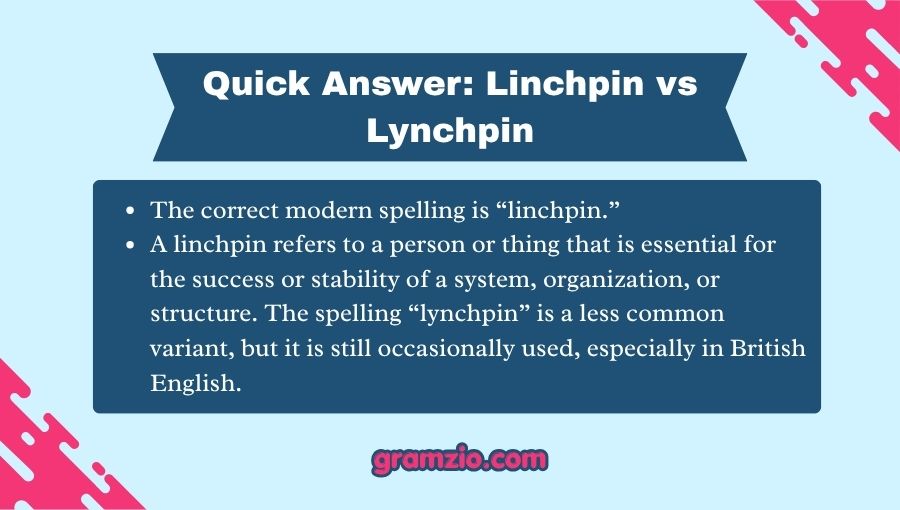
The correct modern spelling is “linchpin.”
A linchpin refers to a person or thing that is essential for the success or stability of a system, organization, or structure. The spelling “lynchpin” is a less common variant, but it is still occasionally used, especially in British English.
👉 In simple terms:
- Linchpin (preferred spelling) = Correct, standard modern usage
- Lynchpin = Variant spelling, less preferred, but still understood
Both words mean the same thing, but “linchpin” is the grammatically and lexically accepted form in most dictionaries today.
Understanding the Basics: Linchpin vs Lynchpin
To fully understand the difference, we need to break down meaning, origin, and usage patterns.
What Does “Linchpin” Mean?
A linchpin is something or someone that is central and essential to the functioning of a system.
✔ It can refer to:
- A key person in an organization
- A critical component in a machine
- A central idea holding a system together
💡 Example:
- “She is the linchpin of the entire marketing team.”
What About “Lynchpin”?
The word “lynchpin” is simply a spelling variation of “linchpin.” It is less common in modern American English but still appears in some British texts.
✔ Meaning remains the same:
- Essential support or central element
💡 Example:
- “He became the lynchpin of the project’s success.”
Comparison Table
| Feature | Linchpin | Lynchpin |
|---|---|---|
| Form | Standard spelling | Variant spelling |
| Type | Noun | Noun |
| Meaning | Essential support element | Same as linchpin |
| Usage | Modern English (preferred) | Less common, older usage |
| Example | She is the linchpin of success | He is the lynchpin of success |
| Correctness | ✔ Correct and preferred | ✔ Acceptable but outdated |
Correct Meanings & Uses of Linchpin
1. Linchpin as a Person 👩💼
A linchpin person is someone who holds a team, organization, or system together.
💡 Example:
- “The manager is the linchpin of the company’s operations.”
✔ Sentence breakdown:
- Subject: Manager
- Verb: is
- Complement: linchpin of operations
👉 Meaning: The manager is essential for success.
2. Linchpin as a Thing ⚙️
It can also refer to a physical or conceptual component.
💡 Example:
- “Innovation is the linchpin of modern business growth.”
👉 Meaning: Innovation is the central element driving growth.
Test Tip 🧠
Ask yourself:
👉 “Is this thing essential or holding everything together?”
If yes → Use linchpin
Case Study: Real-Life Usage Example 🏢
Workplace Scenario:
In a tech company, a senior software engineer is responsible for coordinating all development teams.
💬 Email Example:
“Without John, the project would slow down significantly. He is truly the linchpin of our development process.”
✔ Why it works:
- Shows importance
- Highlights central role
- Uses professional tone
👉 This is exactly how “linchpin” is used in real communication.
Grammar Rules Explanation 📖
According to standard English dictionaries such as Merriam-Webster, the correct and preferred spelling is linchpin.
Why Two Spellings Exist
The confusion comes from historical language variation:
- “Linchpin” comes from older English spelling evolution
- “Lynchpin” developed as a phonetic variant over time
However:
✔ Modern English standardization favors “linchpin”
✔ Most academic, business, and editorial guidelines recommend it
Important Grammar Insight:
There is no meaning difference between the two words. The difference is purely orthographic (spelling-based).
Common Mistakes ❌
Many learners mix up “linchpin” and “lynchpin” due to:
Why Mistakes Happen:
- Fast typing ⌨️
- Autocorrect suggestions
- Hearing pronunciation without seeing spelling
- Lack of exposure to written English
Similar Grammar Confusions Table
| Incorrect | Correct | Reason |
|---|---|---|
| your | you’re | contraction confusion |
| its | it’s | apostrophe misuse |
| affect | effect | verb vs noun |
| linchpin | lynchpin | spelling variation confusion |
Usage in Different Contexts 🌍
1. Everyday Conversation 🗣️
- “My mother is the linchpin of our family.”
2. Professional Writing 💼
- “Data security is the linchpin of modern IT systems.”
3. Creative Writing ✍️
- “Hope became the linchpin of her survival story.”
4. Social Media 📱
- “Consistency is the linchpin of success 💡”
Why It Matters 💡
Using the correct spelling improves:
✔ Clarity
Readers instantly understand your message.
✔ Professionalism
Correct grammar builds credibility.
✔ Communication Accuracy
Avoids confusion in formal writing.
📌 Quote:
“Clear writing is clear thinking made visible.” – Unknown
Special Exception ⚠️
There are no brand-specific or legal exceptions requiring the use of “lynchpin.” However:
- Some British publications may still use “lynchpin”
- Both forms are understood globally
👉 But for SEO, academic writing, and business content:
✔ Always use linchpin
Quick Recap Checklist ✅
| Question | If Yes → Use |
|---|---|
| Is it something essential? | linchpin |
| Is it modern English writing? | linchpin |
| Is it British informal usage? | lynchpin (optional) |
Practice Examples ✏️
- Leadership is the ______ of success.
- She is the ______ of the organization.
- Communication acts as a ______ in teamwork.
✔ Answers:
- linchpin
- linchpin
- linchpin
FAQs: Linchpin vs Lynchpin ❓
1. What is the correct spelling, linchpin or lynchpin?
Linchpin is the correct and preferred modern spelling.
2. Do linchpin and lynchpin mean the same thing?
Yes, both mean an essential or central supporting element.
3. Is lynchpin wrong?
No, it is not wrong, but it is less commonly used in modern English.
4. Why are there two spellings?
It is due to historical language variation and spelling evolution.
5. Can I use lynchpin in formal writing?
It is better to use linchpin in formal, academic, and professional writing.
6. What is an example of linchpin in a sentence?
“She is the linchpin of the entire operation.”
Conclusion 🧾
The confusion between linchpin vs lynchpin is common, but the rule is simple and clear. Both words carry the same meaning, referring to something or someone essential to stability and success. However, in modern English usage, “linchpin” is the correct and widely accepted spelling, while “lynchpin” is considered a secondary variant.
If you are writing for SEO, academics, business, or professional communication, always choose linchpin to ensure clarity, accuracy, and credibility.
In short:
👉 Linchpin = Correct, standard, modern English
👉 Lynchpin = Acceptable but outdated variant
Mastering this small detail can significantly improve the quality of your writing and professionalism. Keep practicing, stay consistent, and your grammar will always stand strong—just like a true linchpin in language mastery. 💪📚
Also read: Hassle vs Hastle

Hi, I’m Axton Vane. I work at gramzio.com and bring over 11 years of experience in professional grammar. I specialize in refining complex syntax to help writers achieve perfect clarity in every sentence.