Hassle vs Hastle: What’s the Difference and Which One Is Correct? 🤔
Hassle vs Hastle is a common spelling confusion that affects many English learners and even native speakers. 😅 If you have ever wondered whether “hassle” or “hastle” is correct, you are definitely not alone. These two words sound similar when spoken quickly, which often causes people to type the wrong version without noticing.
The confusion usually happens during fast texting, casual conversations, social media posting, or simple typing mistakes. However, only one spelling is officially correct in standard English. Using the wrong form can make your writing appear careless, especially in emails, professional documents, academic assignments, and online communication.
Understanding the difference between hassle vs hastle can improve your spelling accuracy, writing confidence, and overall communication skills. In this guide, you will learn the correct meaning, grammar rules, practical examples, common mistakes, and easy memory tricks to help you use the correct word every time. 📚
Quick Answer: Hassle vs Hastle ✅
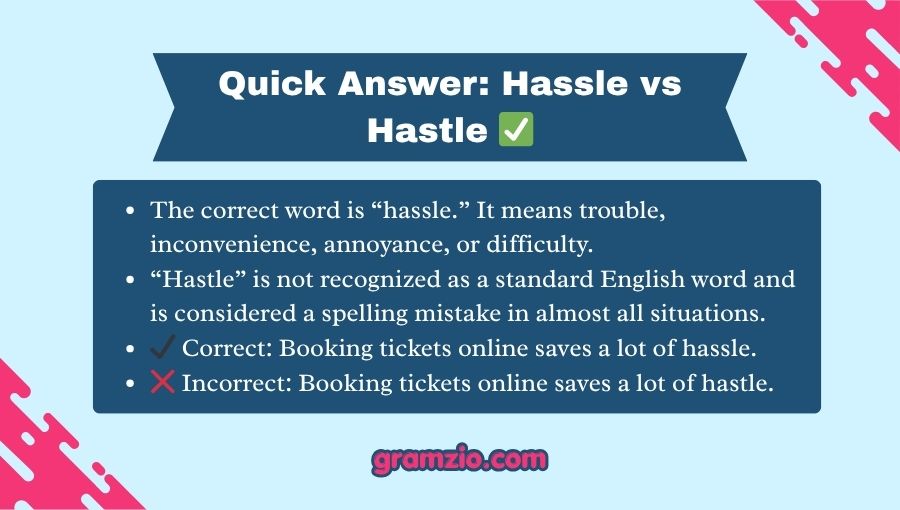
The correct word is “hassle.” It means trouble, inconvenience, annoyance, or difficulty.
“Hastle” is not recognized as a standard English word and is considered a spelling mistake in almost all situations.
✔ Correct: Booking tickets online saves a lot of hassle.
❌ Incorrect: Booking tickets online saves a lot of hastle.
Understanding the Basics of Hassle vs Hastle
The confusion between hassle and hastle comes from pronunciation and typing habits. Since English spelling can be tricky, people sometimes add an extra “t” by mistake.
Here is a simple comparison table:
| Form | Type | Meaning | Example | Correct/Incorrect |
|---|---|---|---|---|
| Hassle | Noun/Verb | Trouble, inconvenience, or bother | “Traveling during holidays is a hassle.” | ✅ Correct |
| Hastle | Misspelling | No standard meaning in English | “This process is a hastle.” | ❌ Incorrect |
Key Point 📌
If you are writing formal or standard English, always use “hassle.”
Correct Meanings and Uses of “Hassle”
“Hassle” as a Noun
As a noun, hassle refers to a problem, annoyance, inconvenience, or difficulty.
Examples
- Getting a visa can be a huge hassle.
- I want a hassle-free experience.
- Parking downtown is always a hassle.
Sentence Breakdown
In the sentence:
Parking downtown is always a hassle.
- Parking downtown = the situation
- is = linking verb
- a hassle = inconvenience or annoyance
Test Tip 📝
If you can replace the word with:
- trouble
- inconvenience
- annoyance
then “hassle” is correct.
“Hassle” as a Verb
“Hassle” can also function as a verb. In this case, it means to bother, annoy, or trouble someone repeatedly.
Examples
- The salesperson kept hassling customers.
- Stop hassling me about the report.
- He was hassled by reporters outside the building.
Sentence Breakdown
Stop hassling me about the report.
- Stop = command
- hassling = bothering repeatedly
- me = object
Test Tip 📝
If the word means “to annoy” or “to pressure,” then “hassle” works as a verb.
Why “Hastle” Is Incorrect ❌
“Hastle” is not accepted in dictionaries such as:
The correct spelling has always been “hassle.”
People mistakenly write “hastle” because:
- the pronunciation sounds similar
- English spelling patterns can be confusing
- fingers naturally add a “t” during typing
However, grammatically and officially, “hastle” is considered an error.
Case Study: Real-Life Usage 💼
Workplace Email Example
Imagine an employee writing this email:
❌ Incorrect:
“Sorry for the hastle caused during the software update.”
This sentence immediately looks unprofessional because of the spelling mistake.
✔ Correct:
“Sorry for the hassle caused during the software update.”
The corrected sentence appears polished, professional, and trustworthy.
Why This Matters
In professional environments:
- spelling mistakes reduce credibility
- clients may notice errors
- communication becomes less polished
Even a small typo can affect how people view your attention to detail.
Grammar Rules Explanation 📖
According to standard English grammar and major dictionaries, “hassle” is the accepted spelling.
Origin of the Word
The word “hassle” became popular in American English during the 20th century. It likely developed from informal speech referring to disorder, argument, or inconvenience.
Grammar Facts
| Word | Accepted in Standard English? | Dictionary Recognized? |
|---|---|---|
| Hassle | Yes | Yes |
| Hastle | No | No |
Important Rule
If a spelling does not appear in recognized dictionaries, it should not be used in formal writing.
Common Mistakes Section ⚠️
Why Do People Write “Hastle”?
There are several reasons behind this common spelling mistake.
1. Fast Typing ⌨️
People type quickly and accidentally insert a “t.”
2. Pronunciation Confusion 🔊
In some accents, “hassle” may sound similar to “hastle.”
3. Autocorrect Problems 📱
Sometimes autocorrect fails to catch uncommon misspellings.
4. Lack of Spelling Awareness 📚
Many writers simply assume both versions are acceptable.
Similar Grammar and Spelling Confusions
| Incorrect/Confusing Pair | Correct Usage |
|---|---|
| Its vs It’s | “It’s” = it is |
| Your vs You’re | “You’re” = you are |
| Affect vs Effect | Different meanings |
| Loose vs Lose | Different spellings and meanings |
| Hassle vs Hastle | “Hassle” is correct |
Usage in Different Contexts 🌎
Everyday Conversation
“Hassle” is extremely common in daily speech.
Examples
- Cooking tonight feels like too much hassle.
- Let’s avoid unnecessary hassle.
The word sounds natural and conversational.
Professional Writing
In business communication, “hassle” often describes inconvenience or complications.
Examples
- We provide hassle-free customer service.
- The company simplified the process to reduce hassle.
Professional writing should always avoid the incorrect spelling “hastle.”
Creative Writing ✍️
Authors use “hassle” to describe stressful or annoying situations.
Example
The journey across the city became a complete hassle after the storm.
This adds realism and emotion to storytelling.
Social Media and Texting 📱
People frequently use “hassle” online.
Examples
- No hassle, no stress 😎
- That app saves so much hassle!
Unfortunately, social media is also where the misspelling “hastle” commonly appears.
Why It Matters ✨
Using the correct spelling matters more than many people realize.
1. Clarity in Communication
Correct spelling helps readers understand your message instantly.
2. Professionalism
Accurate spelling improves credibility in:
- emails
- resumes
- presentations
- reports
3. Writing Accuracy
Small spelling errors can damage the overall quality of your writing.
4. Digital Communication
In today’s online world, people judge writing quickly. Correct spelling creates a better impression.
“Good writing is clear thinking made visible.”
That is why mastering small distinctions like hassle vs hastle is valuable.
Special Exception Section 🔍
There are almost no legitimate situations where “hastle” is correct.
However, there are two rare exceptions:
1. Brand Names
A company or product could intentionally use “Hastle” as a unique brand spelling.
Example:
- fictional brand names
- usernames
- creative titles
2. Personal Usernames
Someone may intentionally spell their online identity as “Hastle.”
But these are not standard English grammar usages.
In normal writing, always choose “hassle.”
Quick Recap Checklist ✅
Simple Decision Table
| Question | If Yes → Use |
|---|---|
| Are you talking about trouble or inconvenience? | Hassle |
| Are you writing formal English? | Hassle |
| Are you tempted to add a “t”? | Don’t |
| Is the word in a dictionary? | Hassle |
Practice Examples
Example 1
❌ This paperwork is such a hastle.
✔ This paperwork is such a hassle.
Example 2
❌ Traveling with heavy bags can be a hastle.
✔ Traveling with heavy bags can be a hassle.
Example 3
❌ Stop hastling your brother.
✔ Stop hassling your brother.
Memory Tricks to Remember the Correct Spelling 🧠
Trick #1: Think of “No Stress, No Hassle”
The phrase “no hassle” is common in advertisements and customer service.
Example:
- Hassle-free returns
- Hassle-free shopping
You rarely see “hastle-free” because it is incorrect.
Trick #2: Double “S” = Stress
“Hassle” contains a double “s,” which can remind you of stress or struggle.
Trick #3: Dictionary Check
If you are unsure, quickly search a trusted dictionary.
Reliable dictionary habits improve spelling accuracy over time.
Hassle in Common English Expressions 📚
The word “hassle” appears in many popular phrases.
Hassle-Free
Meaning:
- easy
- convenient
- without difficulty
Example
- We offer hassle-free installation.
Don’t Hassle Me
Meaning:
- stop bothering me
Example
- I’m busy right now. Don’t hassle me.
A Lot of Hassle
Meaning:
- many complications or problems
Example
- Moving houses is a lot of hassle.
Synonyms of “Hassle”
Learning synonyms improves vocabulary and writing variety.
| Synonym | Meaning |
|---|---|
| Trouble | Difficulty or problem |
| Annoyance | Irritation |
| Inconvenience | Something causing difficulty |
| Bother | Mild irritation |
| Problem | Something difficult to handle |
Example
Original:
- Traveling during storms is a hassle.
Alternative:
- Traveling during storms is an inconvenience.
Antonyms of “Hassle”
| Antonym | Meaning |
|---|---|
| Ease | Simplicity |
| Comfort | Freedom from stress |
| Convenience | Easy usefulness |
| Simplicity | Lack of difficulty |
Example
- Online banking adds convenience instead of hassle.
Expert Writing Tips ✍️
1. Proofread Carefully
Small spelling errors are easier to catch during slow rereading.
2. Use Spellcheck
Modern tools can detect “hastle” instantly.
3. Read More English Content
Frequent reading improves natural spelling memory.
4. Learn Commonly Misspelled Words
English contains many confusing words, so awareness matters.
FAQs: Hassle vs Hastle ❓
Is “hastle” ever correct?
No. “Hastle” is generally considered a misspelling of “hassle” in standard English.
What does “hassle” mean?
“Hassle” means trouble, inconvenience, annoyance, or difficulty.
Can “hassle” be a verb?
Yes. As a verb, “hassle” means to annoy or bother someone repeatedly.
Example:
- The reporters hassled the actor.
Why do people spell it as “hastle”?
People often confuse the spelling because of pronunciation, fast typing, and spelling habits.
Is “hassle-free” a real phrase?
Yes. “Hassle-free” is a very common English phrase meaning easy and without inconvenience.
Which spelling should I use in professional writing?
Always use “hassle.” Never use “hastle” in formal or professional communication.
Conclusion 🎯
The difference between hassle vs hastle is actually very simple once you understand the rule. ✅
- Hassle is the correct English word.
- Hastle is a misspelling and should be avoided in standard writing.
Whether you are writing emails, academic papers, social media posts, or professional documents, using the correct spelling improves clarity, professionalism, and communication quality.
Remember this simple rule:
If the word means trouble, inconvenience, or annoyance, always spell it as “hassle.”
Mastering small spelling details like this can make a big difference in your writing confidence and accuracy. Great communication begins with correct words — and in this case, the correct word is definitely “hassle.” ✨
Also read: Nighttime vs Night Time

Hi, I’m Elara Quinn. Working at gramzio.com, I use my 8 years of experience in linguistics to simplify difficult English rules, making them accessible and easy to learn for our global community.