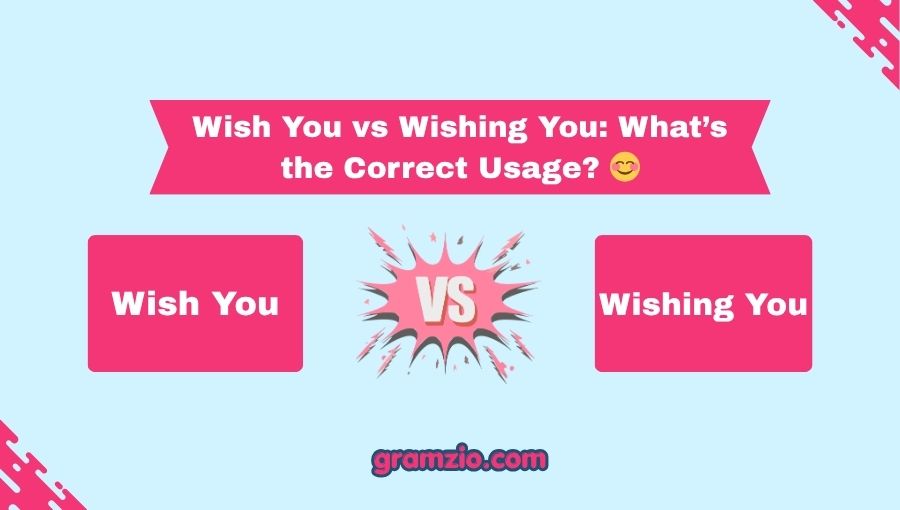
Wish You vs Wishing You: What’s the Correct Usage? 😊
Have you ever paused while writing a birthday message, holiday greeting, or professional email and wondered whether to write “Wish You vs Wishing You”? 🤔 You are not alone. This is one of the most common grammar confusions in everyday English, especially in text messages, greeting cards, emails, and social media captions.
People often write phrases like “Wish you a happy birthday” or “Wishing you a happy birthday,” assuming both mean exactly the same thing. While they may seem similar, their grammar, sentence structure, and usage are different.
Understanding Wish You vs Wishing You matters because using the wrong form can make your writing sound incomplete or awkward. Small grammar details can affect how natural your message feels.
In this guide, you’ll learn the difference between these two expressions, discover grammar rules, see practical examples, avoid common mistakes, and confidently know when to use each phrase. 🎉
Quick Answer: Wish You vs Wishing You
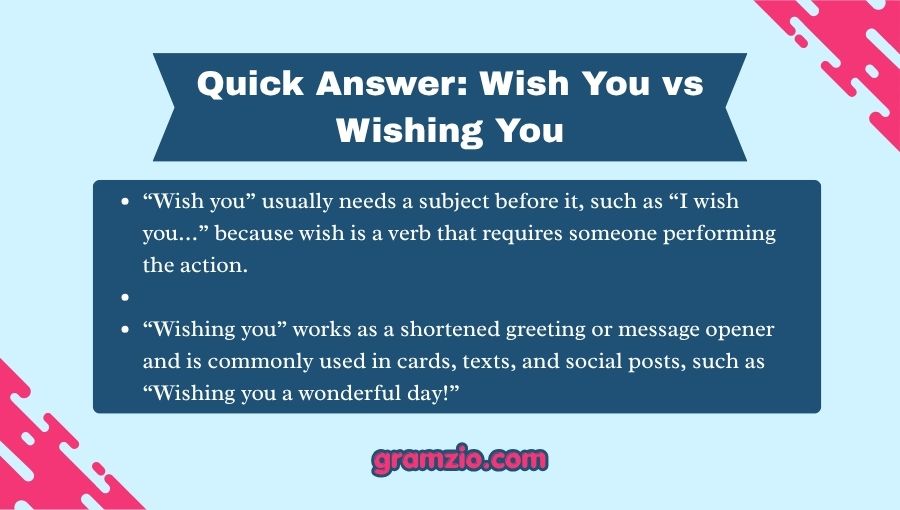
“Wish you” usually needs a subject before it, such as “I wish you…” because wish is a verb that requires someone performing the action.
“Wishing you” works as a shortened greeting or message opener and is commonly used in cards, texts, and social posts, such as “Wishing you a wonderful day!”
Understanding the Basics: Wish You vs Wishing You
The core difference is simple:
- Wish you often needs a complete sentence.
- Wishing you acts as a present participle phrase and can stand as a greeting expression.
Comparison Table
| Form | Type | Meaning | Example | Correct/Incorrect |
|---|---|---|---|---|
| Wish you | Verb phrase | Expressing a desire toward someone | I wish you success. | ✅ Correct |
| Wish you | Incomplete phrase | Missing subject | Wish you success. | ❌ Usually incorrect |
| Wishing you | Participial greeting | Sending greetings or positive thoughts | Wishing you happiness. | ✅ Correct |
| Wishing you | Greeting opener | Used in cards and texts | Wishing you a great weekend. | ✅ Correct |
The biggest issue occurs because people drop the subject I and assume Wish you sounds complete.
Correct Meanings & Uses
Using “I Wish You”
The phrase I wish you is a complete sentence because it includes:
- Subject: I
- Verb: wish
- Object: you
Examples:
✅ I wish you good luck.
✅ I wish you success in your career.
✅ I wish you a happy birthday.
Sentence breakdown:
I → subject
wish → action verb
you → receiver
Without the subject, the sentence often sounds unfinished.
Test Tip 🎯
Ask yourself:
Who is doing the wishing?
If nobody is identified, add a subject.
Using “Wishing You”
“Wishing” is the present participle form of wish. It often appears in greetings.
Examples:
✅ Wishing you joy and happiness.
✅ Wishing you success in your new role.
✅ Wishing you a wonderful holiday season.
This structure works because English allows shortened expressions in greetings.
Think of it as:
(I am) wishing you happiness.
The subject and helping verb are simply omitted.
Test Tip 🎯
If the phrase appears in:
- greeting cards
- social captions
- email openings
- holiday messages
“Wishing you” often fits naturally.
Why “Wish You” Sometimes Sounds Acceptable
People frequently write:
✅ Wish you luck
✅ Wish you a happy birthday
Especially in texting.
Technically, these are shortened forms of:
✅ I wish you luck
✅ I wish you a happy birthday
In casual communication, people remove words for speed.
However, in formal grammar, complete structure is preferred.
Case Study Section 📚
Imagine Sarah writing an office farewell email.
She writes:
“Wish you success in your future career.”
Her manager notices something sounds slightly off.
The improved version:
“Wishing you success in your future career.”
Or:
“I wish you success in your future career.”
Why?
The original sentence lacked a subject and felt incomplete.
The revised versions sound smoother and grammatically stronger.
Professional writing values complete and natural phrasing.
Grammar Rules Explanation
Traditional grammar treats wish as a regular verb.
Structure:
Subject + wish + object
Examples:
- I wish you peace.
- We wish you happiness.
- They wish you success.
Meanwhile:
Wishing is a participle.
Participles often appear in shortened expressions:
- Looking forward to seeing you
- Hoping for the best
- Wishing you good luck
Major dictionaries and grammar authorities explain that participial phrases commonly function in greetings and informal expressions.
This explains why Wishing you… feels complete even without I am.
Also Read This: Myself vs My Self
Common Mistakes ❌
People confuse these forms for several reasons:
Fast typing
Texting culture encourages shortcuts.
Example:
“Wish you happy birthday”
instead of
“I wish you a happy birthday.”
Autocorrect habits
Phones often learn common patterns and preserve shortened forms.
Lack of grammar awareness
Many people know what sounds right but not why.
Similar Grammar Confusions
| Confusion | Correct Form | Common Mistake |
|---|---|---|
| It’s vs Its | It’s raining | Its raining |
| Your vs You’re | You’re welcome | Your welcome |
| Then vs Than | Better than before | Better then before |
| Affect vs Effect | The effect was huge | The affect was huge |
| Wish You vs Wishing You | Wishing you joy | Wish you joy |
Usage in Different Contexts
Everyday Conversation 🗣️
People often shorten expressions.
Examples:
“Wish you luck!”
“Wishing you the best!”
Both may appear in casual speech.
Professional Writing 💼
Professional communication requires clearer structure.
Better:
✅ I wish you success.
✅ Wishing you continued growth.
Avoid:
❌ Wish you success.
Creative Writing ✍️
Writers sometimes intentionally shorten phrases.
Example:
“Wish you were here.”
This works because context supports it.
Social Media and Texting 📱
Short forms dominate online communication.
Examples:
🎉 Wishing you endless happiness
❤️ Wishing you love and joy
✨ Wish you all the best
Social platforms often prioritize brevity.
Why It Matters ⭐
Many people think this difference is tiny.
It isn’t.
Correct grammar improves:
Clarity in communication
Readers instantly understand your meaning.
Professionalism
Well-structured language creates stronger impressions.
Writing accuracy in digital communication
Messages today travel quickly through:
- social media
- business platforms
- messaging apps
Small grammar choices influence perception.
As the saying goes:
“Clear writing creates clear thinking.”
When your language sounds natural, your message feels stronger.
Special Exception
Some phrases become accepted because they are extremely common.
Examples:
🎵 Wish You Were Here
Titles, songs, and creative works sometimes intentionally break standard grammar patterns.
Writers may prioritize emotion, rhythm, or style.
This does not mean the structure becomes universally correct in every context.
Always separate stylistic usage from standard grammar.
Quick Recap Checklist ✅
| Question | If Yes → Use |
|---|---|
| Is there a subject like I, we, or they? | Wish you |
| Is this a greeting card or caption? | Wishing you |
| Is this formal writing? | I wish you |
| Is this a short social message? | Wishing you |
| Does the sentence sound incomplete? | Add a subject |
Practice:
- ___ a wonderful holiday season.
Answer: Wishing you
- ___ success in your new job.
Answer: I wish you
- ___ all the happiness in the world.
Answer: Wishing you
FAQs: Wish You vs Wishing You
Is “Wish you” grammatically incorrect?
Not always. It often becomes incomplete when the subject is omitted. I wish you is fully correct.
Why is “Wishing you” acceptable alone?
Because it acts as a shortened participial expression where I am is implied.
Which sounds more natural in greeting cards?
“Wishing you” sounds more natural.
Example:
Wishing you peace and happiness.
Can I use “Wish you” in text messages?
Yes. Casual texting often drops subjects.
However, formal writing should avoid it.
Is “Wish you a happy birthday” wrong?
In formal grammar, I wish you a happy birthday is stronger.
In casual use, many people shorten it.
Which form is better for business emails?
Use:
✅ I wish you success.
or
✅ Wishing you success.
Avoid incomplete phrasing.
Conclusion
The debate around Wish You vs Wishing You becomes simple once you understand the grammar. Wish usually needs a subject because it functions as a standard verb. Wishing, however, works naturally as a shortened greeting phrase commonly used in cards, emails, and social media.
Remember this easy rule:
If you write a complete sentence, use I wish you.
If you are sending a greeting or warm message, Wishing you often sounds more natural. 😊
Tiny grammar choices create a big difference. The next time you send birthday wishes, holiday greetings, or professional messages, you’ll know exactly which form fits best.
And great writing starts with small details done correctly. ✨
Also Read This: Drove vs Driven

Hi, I’m Grayson Finch. I’m part of the gramzio.com team with 9 years of experience in grammar education. I am dedicated to teaching professional communication and helping you master the art of writing.