Myself vs My Self: The Complete Grammar Guide You Need
Have you ever paused while writing a sentence like “I made this myself” and suddenly wondered whether it should be “myself” or “my self”? 🤔 You are not alone. The confusion around Myself vs My Self is extremely common among English learners, students, writers, and even native speakers. The reason is simple: both forms look similar, but only one is correct in standard English grammar.
The word “myself” is widely used as a reflexive pronoun and is perfectly correct in many situations. However, “my self” appears in certain philosophical, psychological, or stylistic contexts where “self” is treated as a noun. This subtle difference creates confusion in writing, especially in academic and professional communication.
In this article, we will break down the difference between Myself vs My Self in a simple, clear, and practical way. You will learn the correct usage, grammar rules, common mistakes, real-life examples, and expert tips to avoid errors forever. By the end, you will confidently know when to use each form without second-guessing yourself. ✍️
Quick Answer: Myself vs My Self
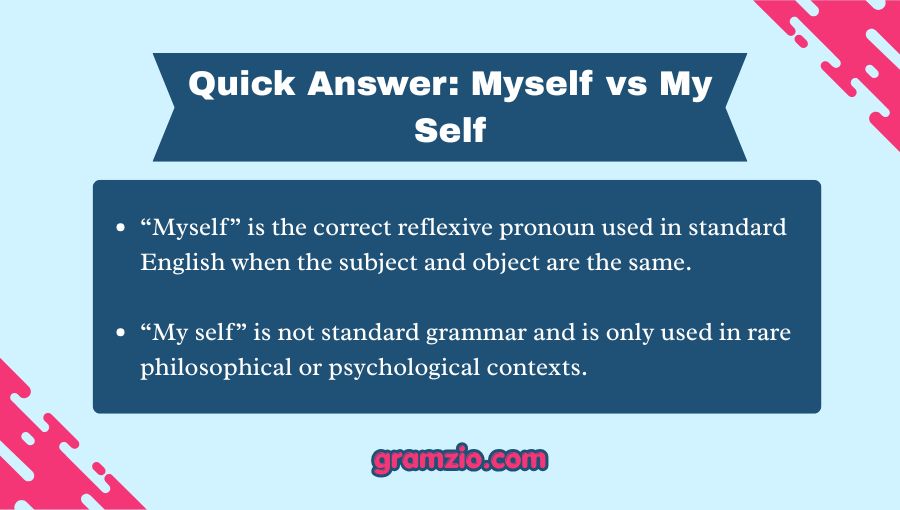
The correct standard English word is “myself”, which is a reflexive pronoun used when the subject and object are the same person (e.g., I taught myself).
On the other hand, “my self” is not a standard grammar form. It is rarely used in formal English and usually appears in philosophical or psychological writing where “self” is treated as a concept or identity rather than a pronoun.
Understanding the Basics of Myself vs My Self
To fully understand Myself vs My Self, we must first break down the structure of each term.
What is “Myself”?
“Myself” is a reflexive pronoun. It is used when the subject of the sentence is also the receiver of the action.
✔ Example:
- I prepared myself for the exam.
Here, “I” and “myself” refer to the same person.
What is “My Self”?
“My self” is not a standard grammatical pronoun. Instead, it is a combination of:
- “my” (possessive adjective)
- “self” (noun referring to identity or consciousness)
It is sometimes used in philosophical or psychological contexts.
✔ Example:
- I need to understand my self better (rare/interpretive usage)
However, in modern grammar, this is generally replaced with:
- “myself”
- or “my identity”
Comparison Table: Myself vs My Self
| Feature | Myself | My Self |
|---|---|---|
| Form | Single word | Two-word phrase |
| Type | Reflexive pronoun | Noun phrase (rare usage) |
| Meaning | Refers back to subject | Refers to identity or inner self |
| Example | I hurt myself | I reflect on my self |
| Correct Usage | ✔ Standard English | ❌ Non-standard in grammar |
Correct Meanings & Uses of “Myself”
1. Reflexive Use
“Myself” is used when the subject performs an action on itself.
✔ Example:
- I taught myself English.
✔ Breakdown:
- Subject: I
- Action: taught
- Object: myself (same person)
2. Emphasis Use
“Myself” can also add emphasis.
✔ Example:
- I built this house myself.
Here, it emphasizes that I alone did it.
3. Safety or Responsibility Context
✔ Example:
- I locked the door myself.
This highlights personal responsibility.
Test Tip ✔
If you can replace the word with “me” in meaning, but the subject is the same person, use “myself.”
Understanding “My Self” in Rare Contexts
Although not grammatically standard, “my self” appears in specific fields:
1. Philosophical Writing
✔ Example:
- I search for my self beyond physical identity.
Here, “self” refers to identity or soul.
2. Psychological Context
✔ Example:
- Therapy helps me reconnect with my self.
This refers to internal awareness.
Important Note ⚠️
In modern grammar and exams:
- “my self” is usually marked incorrect
- “myself” is preferred
Case Study: Real-Life Usage
Email Example (Professional Context)
❌ Incorrect:
- I will handle the project by my self.
✔ Correct:
- I will handle the project myself.
Workplace Conversation
Manager: Who fixed the issue?
Employee: I fixed it myself.
✔ This shows responsibility and clarity.
Social Media Example
❌ Wrong:
- Learning to love my self ❤️
✔ Better:
- Learning to love myself ❤️
Grammar Rules Explanation
According to standard English grammar references like Merriam-Webster, reflexive pronouns such as myself, yourself, himself are used when the subject and object are the same.
Why “Myself” is Correct
- It is a reflexive pronoun
- It follows grammatical structure
- It is accepted in formal English
Why “My Self” is Usually Incorrect
- “Self” is a noun, not a pronoun
- English does not commonly separate reflexive pronouns
- It breaks standard sentence structure
✔ Conclusion: In almost all writing, “myself” is correct, and “my self” is non-standard
Common Mistakes in Myself vs My Self
Why People Get Confused
- Fast typing ⌨️
- Autocorrect errors
- Influence of philosophy/Instagram captions
- Lack of grammar knowledge
Common Grammar Confusions Table
| Incorrect | Correct |
|---|---|
| my self | myself |
| your self | yourself |
| him self | himself |
| it’s | its |
| your | you’re |
Usage in Different Contexts
1. Everyday Conversation
✔ I made dinner myself.
2. Professional Writing
✔ I completed the report myself.
3. Creative Writing
✔ She found strength within herself (not “her self”).
4. Social Media/Texting
✔ Treat yourself, love yourself 💖
Why It Matters (Important Section)
Correct usage of Myself vs My Self matters because:
- It improves communication clarity
- It shows professionalism in writing
- It enhances academic performance
- It prevents misunderstandings
As the famous writing principle says:
“Clear writing reflects clear thinking.”
Special Exception Section
In modern English, there are no official exceptions where “my self” replaces “myself” in grammar rules.
However:
- Philosophy books may use it stylistically
- Psychology texts may refer to “self” as identity
Still, in exams, business writing, and daily communication → use “myself” only
Quick Recap Checklist
| Question | If Yes → Use |
|---|---|
| Is it reflexive (same subject/object)? | myself |
| Is it formal writing? | myself |
| Is “self” used as identity noun? | my self (rare) |
Practice Examples
- I did it ______. → myself
- She made the cake ______. → herself
- I understand ______ better now. → myself
FAQs: Myself vs My Self
1. Is “my self” grammatically correct?
In standard English, no. “Myself” is the correct reflexive pronoun. “My self” is only used in rare philosophical contexts.
2. What is the difference between myself and my self?
“Myself” is a pronoun used in grammar. “My self” refers to identity or consciousness in non-standard writing.
3. Can I use “my self” in essays?
No, unless your essay is philosophical. In academic writing, always use “myself.”
4. Why do people write “my self”?
Mostly due to typing errors, autocorrect, or misunderstanding of the word “self.”
5. Is “myself” formal or informal?
“Myself” is both formal and informal. It is widely accepted in all English contexts.
6. Which is more common in English?
“Myself” is extremely common. “My self” is very rare.
Conclusion
Understanding the difference between Myself vs My Self is essential for clear and correct English writing. The word “myself” is a standard reflexive pronoun used in everyday communication, professional writing, and academic English. It follows proper grammar rules and helps maintain clarity in sentences.
On the other hand, “my self” is not commonly used in modern English grammar. It appears only in rare philosophical or psychological contexts where “self” represents identity or consciousness.
To avoid mistakes, always remember this simple rule: if you are referring back to yourself in a sentence, use “myself.” This small detail can significantly improve your writing accuracy and professionalism.
Mastering such differences strengthens your English foundation and helps you communicate with confidence. Keep practicing, stay aware of common errors, and your grammar will naturally improve over time. ✍️
Also read: Drove vs Driven

Hi, I’m Willa Sterling. I work at gramzio.com as a senior editor. With 15 years of experience in academic and formal grammar, I provide the expert insights you need to make your writing flawless.