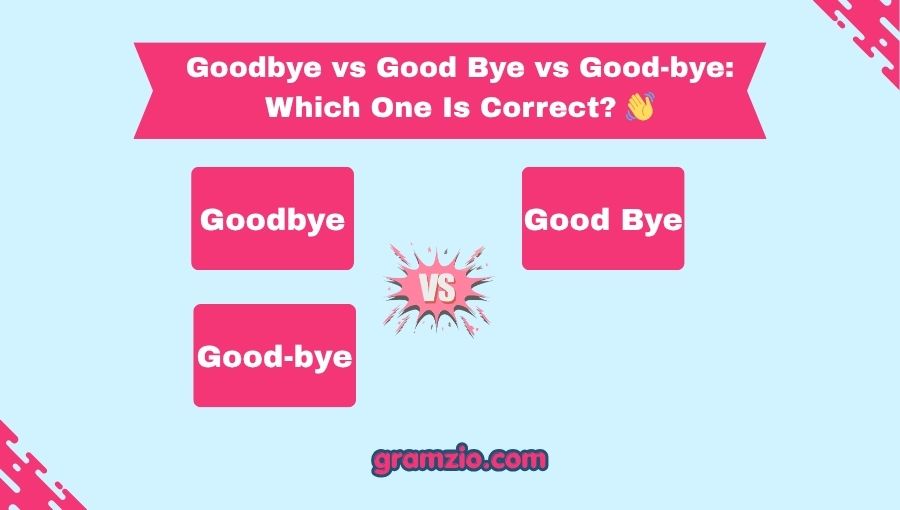
Goodbye vs Good Bye vs Good-bye: Which One Is Correct? 👋
Have you ever paused while typing a message and wondered: Should I write “goodbye,” “good bye,” or “good-bye”? 🤔 This confusion around Goodbye vs Good Bye vs Good-bye is more common than you think, especially in emails, texts, school writing, and professional communication.
The confusion around Goodbye vs Good Bye vs Good-bye happens because English spelling has evolved over time. Some expressions started as two separate words, later became hyphenated, and eventually turned into a single modern word. This natural change in language is similar to words like e-mail → email and on-line → online.
Today, people still use all three forms, but only one is widely accepted in modern American English. The others appear mainly in older writing or stylistic contexts. Understanding Goodbye vs Good Bye vs Good-bye helps you write more clearly, avoid common mistakes, and maintain a professional tone in everyday communication.
Quick Answer: Goodbye vs Good Bye vs Good-bye
Goodbye is the standard and correct spelling in modern American English. ✅
Good bye was once acceptable as two separate words but is now considered outdated in most situations.
Good-bye was commonly used in older writing but has become less common over time.
For modern writing, choose goodbye almost every time.
Understanding the Basics: Goodbye vs Good Bye vs Good-bye
The difference is simple:
- Goodbye → modern standard spelling ✅
- Good bye → old two-word version ⚠️
- Good-bye → traditional hyphenated form ⚠️
English often evolves through stages:
Two words → Hyphenated → One word
Example:
- To day → To-day → Today
- E-mail → Email
- Good bye → Good-bye → Goodbye
Comparison Table
| Form | Type | Meaning | Example | Correct/Incorrect |
|---|---|---|---|---|
| Goodbye | Single word | Farewell expression | Goodbye, see you tomorrow. | ✅ Correct |
| Good bye | Two words | Old-fashioned farewell | Good bye, my friend. | ⚠️ Outdated |
| Good-bye | Hyphenated | Traditional farewell form | Good-bye and take care. | ⚠️ Mostly historical |
Correct Meanings & Uses
Goodbye ✅
“Goodbye” is the preferred modern spelling.
It functions as an expression used when leaving someone.
Examples:
- Goodbye, everyone! 👋
- I said goodbye before leaving the office.
- She waved goodbye from the train.
Sentence breakdown:
Subject: She
Verb: waved
Object/Expression: goodbye
Here, goodbye acts as a noun-like expression.
Test Tip 🎯
Ask yourself:
“Would this appear in modern news articles, emails, or business writing?”
If yes, use goodbye.
Good Bye ⚠️
“Good bye” as two words appeared frequently in older English writing.
Examples:
- Good bye, dear friend.
- We said good bye before the journey.
Although readers understand it, modern style guides prefer one word.
Test Tip 🎯
If the phrase feels old-fashioned or resembles something from a historical novel, it may be an older form.
Good-bye ⚠️
The hyphenated version existed during a transitional stage in English.
Examples:
- Good-bye, Captain.
- She whispered good-bye.
This version still appears in:
- older books
- classic literature
- historical documents
Modern usage strongly favors goodbye.
Test Tip 🎯
If you see a hyphen, ask whether the source is older or formal historical writing.
Case Study Section 📚
Imagine an employee writing an office email:
Incorrect:
“Good bye everyone, thank you for your support.”
Better:
“Goodbye everyone, thank you for your support.”
Why?
Professional communication values modern standard spelling. Small details affect perception.
Now consider a historical novel:
“Good-bye, my love,” she cried as the ship departed.
Here, the author intentionally uses historical style.
Context matters.
Grammar Rules Explanation
Language experts and major dictionaries recognize goodbye as the preferred modern form.
Traditional grammar development often follows a pattern:
- Words begin separately
- Writers combine them with hyphens
- The combined form becomes standard
The farewell expression “goodbye” originated from a longer phrase:
“God be with ye.”
Over centuries, pronunciation changed:
God be with ye → God b’w’ye → goodbye
That evolution explains why spellings changed over time.
Standard dictionaries now list:
goodbye
as the primary spelling.
The older forms remain recognizable but less common.
Why Did Goodbye Change Over Time? 🕰️
English constantly evolves.
People prefer shorter and simpler spellings.
Consider these changes:
| Old Form | Transitional Form | Modern Form |
|---|---|---|
| To-day | To-day | Today |
| Good bye | Good-bye | Goodbye |
The same linguistic pattern happened with goodbye.
Common Mistakes
Many people accidentally use outdated forms.
Reasons include:
Fast typing ⌨️
People separate words automatically.
Autocorrect 📱
Devices sometimes suggest uncommon versions.
Lack of knowledge 📚
Many writers simply learned different spellings from books or older sources.
Similar Grammar Confusions
| Confusing Pair | Correct Use |
|---|---|
| It’s / Its | It’s = it is; Its = possession |
| Your / You’re | You’re = you are |
| Affect / Effect | Verb vs noun difference |
| Everyday / Every day | Adjective vs phrase |
| Goodbye / Good bye | Goodbye preferred |
Usage in Different Contexts
Everyday Conversation 😊
People almost always use:
Goodbye!
Examples:
- Goodbye, Mom.
- Goodbye and drive safely.
Professional Writing 💼
Business communication should use:
Goodbye
Examples:
- Goodbye and thank you for your assistance.
- Goodbye for now.
Avoid:
- Good bye
- Good-bye
These can look outdated.
Creative Writing ✍️
Creative writers sometimes choose style intentionally.
Examples:
Historical fiction:
“Good-bye, soldier.”
Modern fiction:
“Goodbye, Jake.”
Writers may use older forms for atmosphere.
Social Media and Texting 📱
People often shorten expressions:
- Bye 👋
- Bye-bye
- Cya
- Goodbye!
Modern users rarely type:
- Good bye
- Good-bye
Why It Matters ⭐
Small spelling differences influence communication quality.
Correct usage helps with:
Clarity
Readers instantly recognize the intended meaning.
Professionalism
Accurate writing builds trust.
Digital communication accuracy
Search engines and modern platforms favor standardized language.
As writer William Strunk Jr. famously suggested:
“Omit needless words.”
One modern word works better than two outdated ones.
Special Exception
There are situations where older versions still appear.
Examples include:
Historical books 📖
Classic literature may contain:
- Good-bye
- Good bye
Brand names
Occasionally businesses or artistic works intentionally use unusual spellings.
Examples:
- song titles
- vintage magazines
- artistic branding
These are stylistic choices rather than grammar rules.
Quick Recap Checklist ✅
| Question | If Yes → Use |
|---|---|
| Writing a modern email? | Goodbye |
| Writing a business letter? | Goodbye |
| Writing a text message? | Goodbye |
| Writing historical fiction? | Good-bye may work |
| Copying an old document? | Preserve original style |
Practice Examples
Choose the correct option:
- ______ everyone, have a wonderful weekend.
Answer: Goodbye ✅
- She whispered ______ before boarding the train.
Answer: goodbye ✅
- In a historical novel, “______ Captain” may appear.
Answer: Good-bye ⚠️
Frequently Asked Questions (FAQs)
Is goodbye one word or two?
Modern English treats goodbye as one word. This is the preferred spelling.
Is “good bye” wrong?
It is not completely wrong, but it is outdated and uncommon today.
Is “good-bye” acceptable?
Yes. However, it is mostly found in older writing and historical contexts.
Which form should I use in business emails?
Use goodbye because it follows current grammar standards.
Why do old books use “good-bye”?
English spelling evolved gradually. Hyphenated forms were common during earlier stages of language development.
Did goodbye come from “God be with ye”?
Yes. The expression evolved from the phrase “God be with ye” over many centuries.
Final Comparison Table
| Situation | Best Choice |
|---|---|
| Modern writing | Goodbye |
| Workplace communication | Goodbye |
| Texting | Goodbye |
| Historical fiction | Good-bye |
| Older literature | Good bye / Good-bye |
Conclusion
Understanding Goodbye vs Good Bye vs Good-bye is easier once you know the history behind the words. English naturally evolves, and farewell expressions changed along with it.
Today, goodbye is the clear winner. It is modern, professional, and widely accepted in American English. While good bye and good-bye still appear in older texts or stylistic writing, they no longer serve as the standard choice.
The next time you write an email, message a friend, or finish a letter, remember the simple rule:
✅ Modern writing = goodbye
Language changes, but clear communication never goes out of style. So until next time… goodbye! 👋
Also read: Soo vs So

Hi, I’m Axton Vane. I work at gramzio.com and bring over 11 years of experience in professional grammar. I specialize in refining complex syntax to help writers achieve perfect clarity in every sentence.