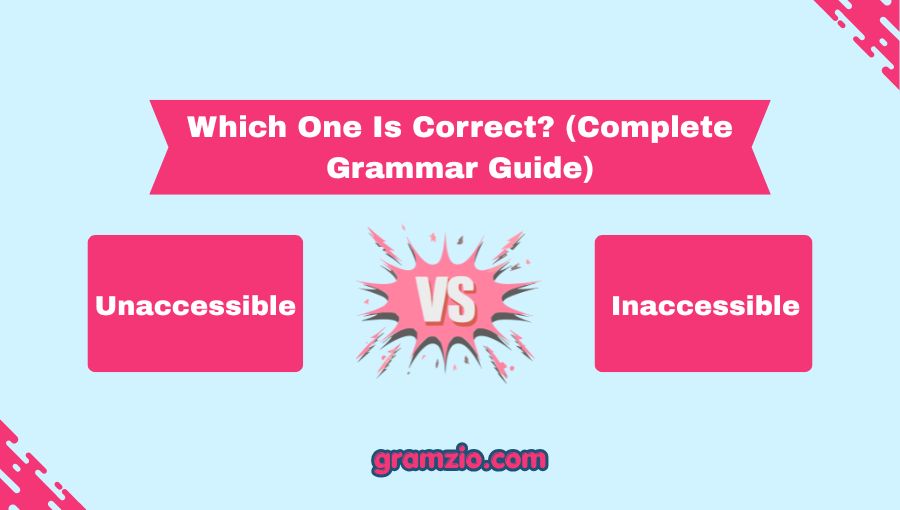
Unaccessible vs Inaccessible: Which One Is Correct? (Complete Grammar Guide)
Have you ever typed “unaccessible” in a sentence, only to see that annoying red underline appear? You pause and wonder: Is it wrong, or is my spellchecker just being picky? This confusion between “unaccessible vs inaccessible” is more common than you might think.
English is full of tricky prefixes like un- and in-, and they often create similar-looking words. Because of this, many writers assume both forms are acceptable. After all, if “unhappy” and “unclear” are correct, why not “unaccessible”?
The truth is a bit more specific—and understanding it can instantly improve your writing accuracy and professionalism. In this guide, you’ll learn exactly which word is correct, why the confusion exists, and how to avoid making this mistake in everyday communication.
By the end, you’ll never hesitate again when choosing between unaccessible vs inaccessible.
Quick Answer: Unaccessible vs Inaccessible
“Inaccessible” is the correct and standard word.
“Unaccessible” is considered incorrect in modern standard English.
Use inaccessible whenever you want to describe something that cannot be reached, entered, or understood.
Understanding the Basics: Unaccessible vs Inaccessible
At first glance, both words seem logical. They both attempt to mean “not accessible.” However, only one follows standard English usage.
Core Difference
- Inaccessible → Correct, widely accepted
- Unaccessible → Nonstandard, rarely used, considered incorrect
Comparison Table
| Form | Type | Meaning | Example Sentence | Correct/Incorrect |
|---|---|---|---|---|
| Inaccessible | Adjective | Not able to be reached or understood | The mountain village is inaccessible in winter. | ✅ Correct |
| Unaccessible | Adjective | Intended to mean “not accessible” | The file is unaccessible. | ❌ Incorrect |
Simple Explanation
English does not always allow both un- and in- prefixes interchangeably. In this case, “inaccessible” is the established and accepted form, while “unaccessible” is not recognized in standard dictionaries.
Correct Meanings & Uses
1. What Does “Inaccessible” Mean?
Inaccessible means something cannot be reached, entered, used, or understood.
Examples with Breakdown
- Physical access
The road became inaccessible after the storm.
→ The road cannot be reached or used. - Information or data
The website is currently inaccessible.
→ Users cannot access it. - Abstract meaning (understanding)
His writing style is inaccessible to beginners.
→ Difficult to understand.
2. Why “Unaccessible” Is Incorrect
Although “unaccessible” might seem logical, it is not standard usage.
Example (Incorrect)
The building is unaccessible.
✔ Correct version:
The building is inaccessible.
Test Tip ✅
If your sentence means “not able to be accessed,” always use “inaccessible.”
If you feel tempted to write *“unaccessible,” replace it immediately—it’s almost always wrong.
Case Study Section
Real-Life Workplace Example
Incorrect Email
Subject: System Issue
Hi Team,
The server is currently unaccessible due to maintenance.
Please wait until further notice.
Correct Email
Subject: System Issue
Hi Team,
The server is currently inaccessible due to maintenance.
Please wait until further notice.
Why This Matters
Using “unaccessible” in a professional setting can:
- Reduce credibility
- Make writing look unpolished
- Create confusion for readers
Grammar Rules Explanation
The difference comes down to prefix usage rules in English.
Why “Inaccessible” Is Correct
- The word “accessible” comes from Latin roots.
- The prefix “in-” is commonly used with Latin-based words.
- Therefore, “inaccessible” is the grammatically correct form.
Why “Unaccessible” Fails
- The prefix “un-” is usually used with simpler, Germanic-origin words.
- It does not combine naturally with accessible.
- As a result, major dictionaries (like Merriam-Webster) do not recognize “unaccessible” as standard English.
Common Mistakes Section
Why Do People Use “Unaccessible”?
- Fast typing
- Autocorrect confusion
- Lack of grammar knowledge
- Overgeneralization of the prefix “un-”
Similar Grammar Confusions Table
| Confusion Pair | Correct Form | Incorrect Form | Reason |
|---|---|---|---|
| It’s vs Its | It’s (it is) | Its (possessive) | Apostrophe confusion |
| Your vs You’re | You’re (you are) | Your (possessive) | Sound similarity |
| Then vs Than | Than (comparison) | Then (time) | Misuse in context |
| Inaccessible vs Unaccessible | Inaccessible | Unaccessible | Prefix rule violation |
Usage in Different Contexts
1. Everyday Conversation
- That area is inaccessible by car.
- The file is inaccessible right now.
2. Professional Writing
- The data remains inaccessible due to system errors.
- Certain features are inaccessible without a subscription.
3. Creative Writing
- The castle stood on an inaccessible cliff.
- Her thoughts were inaccessible to others.
4. Social Media / Texting
- Site’s down—totally inaccessible 😩
- Why is this link inaccessible again?
Why It Matters (Important Section)
Using the correct word is more than just grammar—it shapes how others perceive your communication.
Key Benefits
- Clarity in Communication
Readers instantly understand your message. - Professionalism
Correct grammar builds trust and credibility. - Accuracy in Digital Writing
Especially important in emails, blogs, and reports.
“Good grammar is the foundation of clear thinking and clear communication.”
Even a small mistake like “unaccessible” can distract readers and weaken your message.
Special Exception Section
There are no widely accepted exceptions where “unaccessible” is preferred.
However:
- You might see it in very old texts or non-native usage
- Some people use it informally, but it is not correct in standard English
Always stick with inaccessible.
Quick Recap Checklist
Decision Table
| Question | If Yes → Use |
|---|---|
| Does it mean “cannot be accessed”? | Inaccessible |
| Are you writing formally or professionally? | Inaccessible |
| Are you unsure which form is correct? | Inaccessible |
Practice Examples
- The website is ______ due to maintenance.
→ Answer: inaccessible - The island is ______ during winter storms.
→ Answer: inaccessible - The data became ______ after the system crash.
→ Answer: inaccessible
FAQs (Featured Snippet Optimized)
1. Is “unaccessible” ever correct?
No, “unaccessible” is not considered correct in standard English. You should always use “inaccessible.”
2. Why is “inaccessible” correct instead of “unaccessible”?
Because “accessible” comes from Latin roots, and the prefix “in-” is the correct grammatical match.
3. What does “inaccessible” mean?
“Inaccessible” means something cannot be reached, entered, used, or understood.
4. Can I use “unaccessible” in informal writing?
It’s best to avoid it entirely, even in informal writing, as it is widely considered incorrect.
5. Is “inaccessible” used in professional writing?
Yes, “inaccessible” is the correct and preferred term in professional and academic contexts.
6. How can I remember the correct word?
Remember: “Accessible” pairs with “in-,” not “un-.” Always choose “inaccessible.”
Conclusion
The confusion between unaccessible vs inaccessible is easy to understand—but the solution is simple. “Inaccessible” is the only correct and standard form, while “unaccessible” should be avoided in all types of writing.
By learning this rule, you eliminate a common grammar mistake and instantly improve your clarity and professionalism. Whether you’re writing an email, a blog post, or a social media caption, using the correct word ensures your message is taken seriously.
So next time you’re about to type “unaccessible,” pause for a second—and confidently replace it with “inaccessible.”
Clear writing starts with correct choices.
Also read: Run or Ran

Hi, I’m Grayson Finch. I’m part of the gramzio.com team with 9 years of experience in grammar education. I am dedicated to teaching professional communication and helping you master the art of writing.