Next Friday vs This Friday 📅: Clear Meaning, Correct Usage, and Real-Life Examples
Have you ever made plans for a meeting or event, only to realize later that everyone understood the date differently? This is a common issue when using phrases like “Next Friday vs This Friday.” These two expressions seem simple, but they often cause confusion in everyday communication.
The problem lies in interpretation. For some people, “this Friday” means the upcoming Friday, while others may interpret “next Friday” as the same day—or even the Friday after that. This misunderstanding can lead to missed meetings, delayed plans, and unnecessary frustration.
Understanding the difference between Next Friday vs This Friday is essential for clear communication, especially in professional and formal settings.
In this guide, you’ll learn exactly what each phrase means, how to use them correctly, and how to avoid common mistakes.
Quick Answer Section: Next Friday vs This Friday
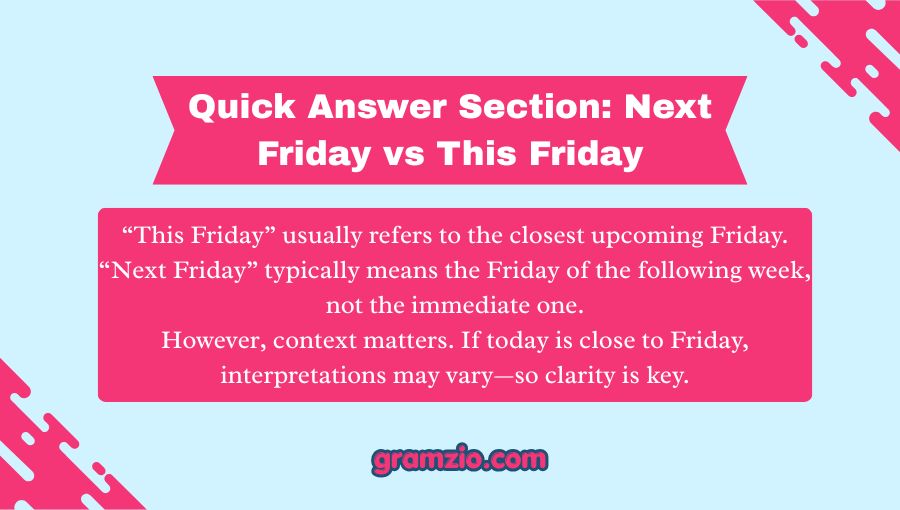
“This Friday” usually refers to the closest upcoming Friday.
“Next Friday” typically means the Friday of the following week, not the immediate one.
However, context matters. If today is close to Friday, interpretations may vary—so clarity is key.
Understanding the Basics: Next Friday vs This Friday
The confusion between Next Friday vs This Friday comes from how people interpret time references. Let’s break it down simply.
- This Friday = the nearest Friday coming up
- Next Friday = the Friday after “this Friday”
Comparison Table
| Form | Type | Meaning | Example Sentence | Correct/Incorrect |
|---|---|---|---|---|
| This Friday | Time phrase | Closest upcoming Friday | “Let’s meet this Friday at 3 PM.” | Correct |
| Next Friday | Time phrase | Friday of the following week | “The event is next Friday.” | Correct |
| This Friday (wrong use) | Time phrase | Used for a distant Friday | “The event is this Friday” (when it’s next week) | Incorrect |
| Next Friday (ambiguous) | Time phrase | Used without context | “See you next Friday” (unclear timing) | Risky |
Correct Meanings & Uses
What Does “This Friday” Mean?
“This Friday” refers to the nearest Friday that has not yet occurred.
Example:
- Today is Monday → “This Friday” = 4 days away
- Today is Thursday → “This Friday” = tomorrow
Sentence Breakdown:
- “We have a meeting this Friday.”
- Subject: We
- Verb: have
- Time phrase: this Friday (nearest upcoming Friday)
What Does “Next Friday” Mean?
“Next Friday” usually means the Friday after the upcoming one.
Example:
- Today is Monday →
- This Friday = in 4 days
- Next Friday = in 11 days
Sentence Breakdown:
- “The project deadline is next Friday.”
- Subject: The project deadline
- Verb: is
- Time phrase: next Friday (following week)
Test Tip ✅
If you can replace the phrase with a specific date and it matches your intention, your usage is correct.
Example: If “next Friday” = May 10 (not May 3), then you’re using it correctly.
Case Study Section
Workplace Scenario
Email Example:
“Hi team,
Let’s finalize the report this Friday.”
Problem:
Some team members think it’s the upcoming Friday, while others assume it’s next week.
Improved Version:
“Let’s finalize the report on Friday, May 3.”
Lesson:
Always use exact dates in professional communication to avoid confusion.
Grammar Rules Explanation
From a grammar perspective, both “this” and “next” are determiners used to modify time expressions.
- “This” refers to something close in time
- “Next” refers to something after the current period
According to standard dictionary guidance (like Merriam-Webster):
- “This” indicates immediacy or proximity
- “Next” indicates sequence or the following instance
So grammatically:
- “This Friday” = current week’s Friday
- “Next Friday” = the Friday of the next week
Common Mistakes Section
Why Do Mistakes Happen?
- Fast typing
- Autocorrect errors
- Lack of clarity in time references
- Cultural differences in interpretation
Similar Grammar Confusions
| Confusing Pair | Meaning Difference |
|---|---|
| It’s vs Its | Contraction vs possession |
| Your vs You’re | Possession vs “you are” |
| Then vs Than | Time vs comparison |
| Affect vs Effect | Verb vs noun |
| This Friday vs Next Friday | Immediate vs following week |
Usage in Different Contexts
1. Everyday Conversation
- “Let’s hang out this Friday.”
- “I’m busy this week—maybe next Friday?”
2. Professional Writing
- Better: “Meeting scheduled for Friday, June 14.”
- Avoid ambiguity in emails and reports.
3. Creative Writing
Writers may intentionally use ambiguity for realism:
- “I’ll see you next Friday,” she said, leaving him unsure.
4. Social Media / Texting
- “Party this Friday 🎉”
- “Can’t make it—maybe next Friday!”
👉 Tip: Short messages increase misunderstanding—be clear.
Why It Matters (Important Section)
Using Next Friday vs This Friday correctly ensures:
- Clear communication
- Professional credibility
- Accurate scheduling
- Fewer misunderstandings
💬 “Clear language leads to clear thinking—and better results.”
In digital communication, where tone and context are limited, clarity becomes even more important.
Special Exception Section
In some dialects or regions, “next Friday” may still refer to the immediate upcoming Friday, especially in casual speech.
Because of this variation:
- Always confirm the date if it matters
- Use exact dates in formal communication
Quick Recap Checklist
| Question | If Yes → Use |
|---|---|
| Is it the closest upcoming Friday? | This Friday |
| Is it the Friday after this week? | Next Friday |
| Could someone misunderstand? | Use exact date |
Practice Examples
- Today is Tuesday. You mean the coming Friday → ✅ This Friday
- Today is Monday. You mean the Friday after this week → ✅ Next Friday
- Important meeting → ✅ Use a specific date
FAQs: Next Friday vs This Friday
1. What is the difference between “this Friday” and “next Friday”?
“This Friday” refers to the nearest upcoming Friday, while “next Friday” usually means the Friday of the following week.
2. Can “next Friday” mean the upcoming Friday?
Yes, in casual conversation, some people use “next Friday” to mean the immediate Friday. However, this is ambiguous and should be avoided in formal communication.
3. Which is more correct: “this Friday” or “next Friday”?
Both are correct, but they serve different meanings. The correct choice depends on timing and context.
4. How can I avoid confusion when mentioning dates?
Use the full date, such as “Friday, June 14,” especially in professional or important communication.
5. Is “this coming Friday” better than “this Friday”?
Yes, “this coming Friday” can add clarity and reduce confusion, especially in spoken English.
6. Why do people misunderstand “next Friday”?
Because interpretations vary based on region, context, and personal habits, making the phrase inherently ambiguous.
Conclusion
Understanding the difference between Next Friday vs This Friday is essential for clear and effective communication. While “this Friday” typically refers to the nearest upcoming Friday, “next Friday” usually points to the following week’s Friday. The confusion arises because people interpret these phrases differently, especially in casual conversations.
To avoid misunderstandings, always consider your context and audience. When accuracy matters—such as in professional settings—use specific dates instead of relying on relative time expressions.
In the end, clarity is more important than convenience. When in doubt, spell it out—because one small phrase can make a big difference in communication.
Also read: Impatient vs Inpatient

Hi, I’m Axton Vane. I work at gramzio.com and bring over 11 years of experience in professional grammar. I specialize in refining complex syntax to help writers achieve perfect clarity in every sentence.