Passerbyers vs Passersby: Which One Is Correct? (Complete Grammar Guide)
The confusion around passerbyers vs passersby often catches people off guard, especially when writing quickly or speaking casually. Have you ever paused mid-sentence and wondered which one is actually correct? You are not alone. Many English speakers assume passerbyers sounds right because it follows common plural patterns, but English grammar does not always follow simple rules.
At first glance, adding “-ers” might feel natural, yet this situation involves a special type of word structure called a compound noun. That is where most mistakes happen. Without understanding the rule, it is easy to rely on instinct and end up using the wrong form.
In this guide, you will learn exactly why passersby is correct and passerbyers is not. We will break down the grammar rules, provide real-life examples, and give you practical tips so you never make this mistake again. By the end, you will be fully confident using the correct form in any context.
Quick Answer Section: Passerbyers vs Passersby
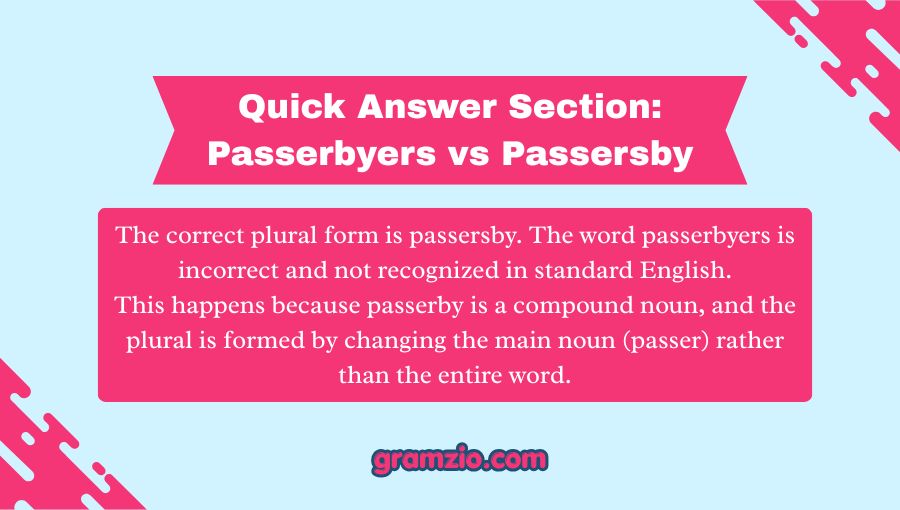
The correct plural form is passersby. The word passerbyers is incorrect and not recognized in standard English.
This happens because passerby is a compound noun, and the plural is formed by changing the main noun (passer) rather than the entire word.
Understanding the Basics: Passerbyers vs Passersby
To fully understand passerbyers vs passersby, you need to look at how compound nouns behave in English.
A compound noun is made up of two or more words that function as a single unit. In passerby, the core noun is passer (a person who passes), and by acts as a modifier.
Key Rule
👉 When forming plurals of compound nouns, you usually pluralize the main noun, not the modifier.
Comparison Table
| Form | Type | Meaning | Example Sentence | Correct/Incorrect |
|---|---|---|---|---|
| Passerby | Singular | A person walking past | A passerby helped me with directions. | Correct |
| Passersby | Plural | Multiple people walking past | Several passersby witnessed the accident. | Correct |
| Passerbyers | Incorrect | Not a valid English word | Many passerbyers were present. | ❌ Incorrect |
Correct Meanings & Uses
What Does “Passerby” Mean?
A passerby is a person who is walking past a place, often without stopping.
Example:
- A passerby noticed the lost dog.
Breakdown:
- Passer = person who passes
- By = indicates movement past something
What Does “Passersby” Mean?
Passersby is the plural form, referring to more than one person passing by.
Examples:
- Several passersby stopped to watch the street performance.
- The police questioned passersby after the incident.
Sentence Breakdown:
- “Several” indicates plural
- “Passers” is pluralized correctly
- “By” remains unchanged
✅ Test Tip
If you are unsure, try this trick:
👉 Replace passerby with person.
- One person → One passerby
- Many people → Many passersby
If your sentence refers to multiple people, use passersby, not passerbyers.
Case Study Section
Real-Life Example: Workplace Email
Incorrect Version:
Several passerbyers reported the issue near the office entrance.
Correct Version:
Several passersby reported the issue near the office entrance.
Why This Matters
In a professional setting, using incorrect grammar like passerbyers can:
- Reduce credibility
- Confuse readers
- Make writing appear unpolished
Correct usage (passersby) ensures clarity and professionalism.
Grammar Rules Explanation
The reason passersby is correct lies in compound noun pluralization rules.
According to standard grammar authorities such as Merriam-Webster, compound nouns typically form plurals by modifying the principal noun.
Structure of “Passerby”
- Main noun: passer
- Modifier: by
Plural Formation
- Passer → Passers
- By → remains unchanged
✔ Final plural: Passersby
❌ Why “Passerbyers” Is Wrong
- It incorrectly treats passerby as a single unit
- It adds “-ers” unnecessarily
- It ignores the internal structure of the compound
Common Mistakes Section
Why Do People Say “Passerbyers”?
Several reasons explain this error:
- Fast typing – People don’t stop to analyze the structure
- Autocorrect – May not catch uncommon words
- Lack of knowledge – Compound noun rules are not widely understood
Similar Grammar Confusions
| Confusion | Correct Form | Reason |
|---|---|---|
| Its vs It’s | Depends | Possessive vs contraction |
| Your vs You’re | Depends | Possessive vs “you are” |
| Attorneys general vs Attorney generals | Attorneys general | Plural noun comes first |
| Mothers-in-law vs Mother-in-laws | Mothers-in-law | Main noun pluralized |
| Passerbyers vs Passersby | Passersby | Compound noun rule |
Usage in Different Contexts
1. Everyday Conversation
- “A few passersby helped me carry the boxes.”
2. Professional Writing
- “Witnesses, including several passersby, provided statements.”
3. Creative Writing
- “The lonely street had only a handful of passersby under the dim lights.”
4. Social Media / Texting
- “Shoutout to the kind passersby who helped me today 🙌”
Why It Matters (Important Section)
Using correct grammar like passersby instead of passerbyers is more than a small detail—it directly affects communication quality.
Key Benefits
- Clarity in communication
Your message becomes easier to understand. - Professionalism
Correct grammar builds trust and authority. - Accuracy in digital writing
Proper usage improves readability and credibility online.
“Good grammar is the foundation of clear thinking and effective communication.”
Special Exception Section
There are no standard exceptions where passerbyers is considered correct. However:
- In creative writing or fictional dialogue, an author might intentionally use incorrect grammar to reflect a character’s speech.
- Even then, it is stylistic—not grammatically correct.
Quick Recap Checklist
Decision Table
| Question | If Yes → Use |
|---|---|
| Are you referring to one person passing by? | Passerby |
| Are you referring to multiple people? | Passersby |
| Are you adding “-ers” at the end? | ❌ Avoid it |
Practice Examples
- Many ______ stopped to watch the parade.
✔ Answer: Passersby - A ______ found my lost wallet.
✔ Answer: Passerby - Several passerbyers were present.
✔ Answer: ❌ Incorrect → Passersby
FAQs: Passerbyers vs Passersby
1. Is “passerbyers” ever correct?
No, passerbyers is not a correct word in standard English. Always use passersby as the plural form.
2. Why is the plural “passersby” instead of “passerbys”?
Because passer is the main noun in the compound. English pluralization rules require changing the main noun, not the modifier.
3. What type of word is “passerby”?
It is a compound noun consisting of a noun (passer) and an adverb (by).
4. How can I remember the correct form?
Think of it like this:
- One person → passer
- Many people → passers
Then simply add “by” at the end.
5. Are there similar words with the same rule?
Yes, examples include:
- Mothers-in-law
- Attorneys general
- Runners-up
6. Can I use “passersby” in formal writing?
Yes, passersby is completely correct and appropriate for both formal and informal writing.
Conclusion (150 words)
The debate around passerbyers vs passersby comes down to one simple grammar rule: always pluralize the main noun in a compound word. In this case, the correct plural is passersby, while passerbyers is incorrect and should never be used in standard English.
Understanding this rule not only helps you avoid a common mistake but also strengthens your overall grasp of English grammar. Whether you are writing an email, crafting a story, or posting online, using the correct form ensures your message is clear and professional.
Remember the key takeaway:
👉 Focus on the main noun, not the entire word.
Once you apply this principle, you will never confuse passerbyers vs passersby again. Clear grammar leads to confident communication—and that is always worth mastering.
Also read: Next Friday vs This Friday

Hi, I’m Dexter Rhodes. At gramzio.com, I apply my 10 years of experience in copy-editing to ensure every guide we publish is accurate, professional, and follows the highest editorial standards.