Brief vs Debrief: Complete Grammar, Meaning & Usage Guide (2026)
Have you ever heard someone say “Let’s brief the team” or “We’ll debrief after the meeting” and felt slightly confused about what they actually mean? 🤔 You’re not alone. The confusion between Brief vs Debrief is very common in both professional and casual English communication. These two terms look similar, sound related, and are often used in workplace environments—but their meanings are quite different.
Many English learners and even native speakers mix them up because both words come from the same root: “brief,” which relates to short and clear communication. However, the addition of the prefix “de-” completely changes the meaning. One refers to giving instructions, while the other refers to reviewing or discussing afterward.
In business meetings, military discussions, project management, and even casual teamwork, understanding the correct use of brief vs debrief is essential for clarity and professionalism. Using the wrong term can lead to confusion, miscommunication, or even incorrect actions.
In this article, we’ll break down everything you need to know about Brief vs Debrief, including meanings, grammar rules, real-life examples, mistakes, comparisons, and practical usage tips. By the end, you’ll confidently know when to use each term correctly. 🚀
Quick Answer: Brief vs Debrief
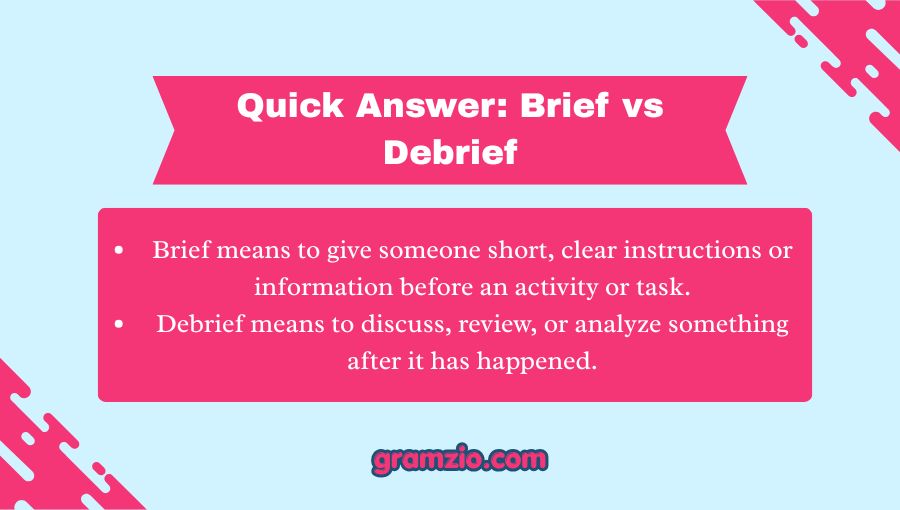
The difference between brief and debrief is based on timing and purpose.
- Brief means to give someone short, clear instructions or information before an activity or task.
- Debrief means to discuss, review, or analyze something after it has happened.
👉 In simple words:
- Brief = Before (instructions/information)
- Debrief = After (discussion/review)
Understanding Brief vs Debrief
To fully understand brief vs debrief, we must look at how each word functions in English grammar and real-life communication.
What Does “Brief” Mean?
The word brief is both a noun and a verb.
- As a verb: It means to give information or instructions in a short and clear way.
- As a noun: It refers to instructions or information given before a task.
Examples:
- The manager will brief the team before the project starts. 📋
- She gave a quick brief about the event schedule.
👉 Meaning: Information is given before action begins.
What Does “Debrief” Mean?
The word debrief is a verb and noun used mainly in formal contexts.
- As a verb: It means to question or discuss something after an event.
- As a noun: It refers to the session where discussion happens after completion.
Examples:
- The soldiers were debriefed after the mission. 🎖️
- We will have a debrief after the presentation.
👉 Meaning: Information is discussed after the action is completed.
Comparison Table: Brief vs Debrief
| Feature | Brief | Debrief |
|---|---|---|
| Form | Verb / Noun | Verb / Noun |
| Type | Instruction phase | Review phase |
| Meaning | To give instructions before a task | To discuss after a task |
| Timing | Before event | After event |
| Example | The coach briefed the team | The coach debriefed the team |
| Correct Usage | Before action | After action |
Correct Meanings & Uses
1. Using “Brief” in Context
Brief is used when someone is preparing another person before action.
Example Sentence:
- The project manager will brief the developers before coding starts.
Breakdown:
- Subject: Project manager
- Action: Brief
- Purpose: Give instructions
- Time: Before task begins
💡 Test Tip:
If the action hasn’t started yet → use brief.
2. Using “Debrief” in Context
Debrief is used when reviewing or analyzing something after it happens.
Example Sentence:
- The team debriefed after completing the marketing campaign.
Breakdown:
- Subject: Team
- Action: Debrief
- Purpose: Review and analyze
- Time: After task completion
💡 Test Tip:
If the action is finished → use debrief.
Case Study: Real-Life Workplace Example
Imagine a digital marketing agency launching a new campaign.
Before Launch:
The manager gathers the team and says:
“Let me brief you on the campaign strategy.”
He explains goals, deadlines, and roles.
After Launch:
Once the campaign ends, the team meets again:
“Let’s debrief and analyze the results.”
They discuss what worked and what didn’t.
👉 This shows how brief vs debrief works in real professional environments.
Grammar Rules Explanation
According to standard English grammar references like Merriam-Webster, both brief and debrief are accepted verbs and nouns, but their usage depends on context and timing.
Why “Brief” is Correct:
- It is rooted in the adjective brief meaning “short and concise.”
- As a verb, it evolved to mean “to instruct concisely.”
Why “Debrief” is Correct:
- The prefix de- means “removal” or “reverse action.”
- So “debrief” literally means “remove briefing by reviewing it afterward.”
👉 Grammar Insight:
- Brief = deliver information
- Debrief = extract information after completion
Common Mistakes
Many learners confuse brief vs debrief due to similarity in spelling and pronunciation.
Why Mistakes Happen:
- Fast typing ⌨️
- Autocorrect errors 📱
- Lack of understanding of prefixes
- Similar sound patterns
Common Confusion Table
| Incorrect Usage | Correct Form | Reason |
|---|---|---|
| We will debrief before the meeting | We will brief before the meeting | Debrief is after |
| Let’s brief after the project | Let’s debrief after the project | Brief is before |
| He was briefed after completion | He was debriefed after completion | Wrong timing |
Usage in Different Contexts
1. Everyday Conversation
- “I’ll brief you before we go shopping.”
- “Let’s debrief after the trip.”
2. Professional Writing
- “The manager will brief the staff on safety protocols.”
- “A debrief session will follow the event.”
3. Creative Writing
- Writers often use brief for setup scenes and debrief for reflective scenes.
4. Social Media / Texting
- “Quick brief before the meeting 👇”
- “Time for a debrief! What went wrong? 🤔”
Why It Matters
Understanding brief vs debrief is not just grammar—it improves communication clarity, especially in professional settings.
Benefits:
- Better teamwork 🤝
- Clear instructions 📌
- Improved decision-making 🧠
- Professional communication 📈
“Clarity is the foundation of effective communication.”
Using the correct term ensures your message is understood exactly as intended.
Special Exception
In military, aviation, and emergency services, briefing and debriefing are formal procedures:
- Mission Briefing → Instructions before operation
- Mission Debriefing → Analysis after operation
These terms are standardized and widely used in global organizations.
Quick Recap Checklist
| Question | If Yes → Use |
|---|---|
| Are you giving instructions before an event? | Brief |
| Are you discussing after an event? | Debrief |
Practice Examples:
- The pilot will ___ the crew before takeoff.
- The team will ___ after the match.
- We need a quick ___ before starting.
FAQs: Brief vs Debrief
What is the main difference between brief and debrief?
Brief is used before an event to give instructions, while debrief is used after an event to review or analyze it.
Is debrief a real English word?
Yes, debrief is a standard English word used in professional, military, and business contexts.
Can brief be used after an event?
No, brief is typically used before an event. After an event, you should use debrief.
Are brief and debrief formal words?
Yes, both are formal and commonly used in workplaces, military, and professional communication.
What is a debrief session?
A debrief session is a meeting held after an activity to discuss results, performance, and outcomes.
Why do people confuse brief and debrief?
Because they sound similar and share the same root word, but their timing and meaning are opposite.
Conclusion
Understanding brief vs debrief is essential for clear, accurate, and professional communication. While both words come from the same root, their meanings are completely opposite in terms of timing and purpose.
A brief prepares you before action, giving clear instructions and expectations. A debrief, on the other hand, helps you reflect after the action, analyzing results and outcomes for improvement.
Whether you are in a classroom, office, military environment, or everyday conversation, using these terms correctly will make your communication more effective and professional.
Mastering this small but powerful difference can significantly improve how clearly you express ideas and understand others. Remember:
👉 Brief before action. Debrief after action.
Also read: Quaff vs Coif

Hi, I’m Axton Vane. I work at gramzio.com and bring over 11 years of experience in professional grammar. I specialize in refining complex syntax to help writers achieve perfect clarity in every sentence.