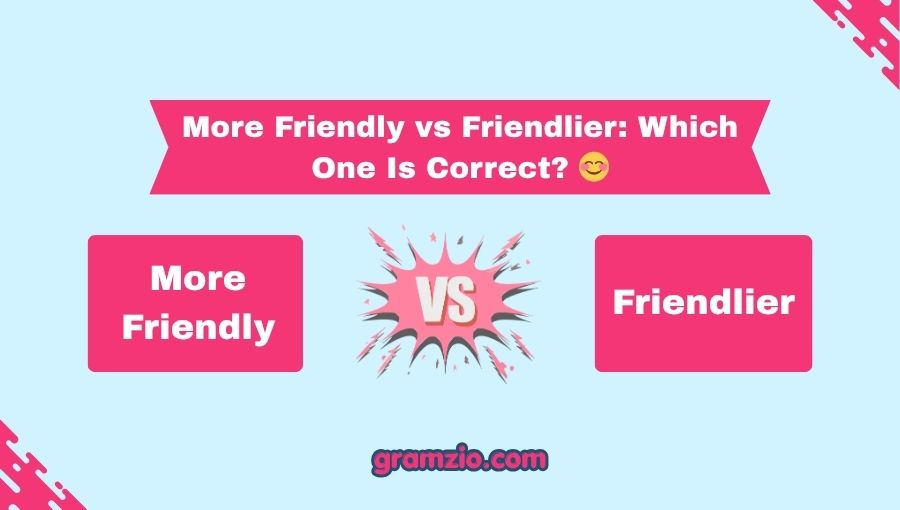
More Friendly vs Friendlier: Which One Is Correct? 😊
More Friendly vs Friendlier is a common grammar confusion that many English learners and even native speakers face every day. 🤔 If you’ve ever stopped mid-sentence wondering which one sounds right, you’re definitely not alone. Both forms appear correct, and in many cases, they actually are—but choosing the best one depends on understanding how English comparatives work.
In modern communication, where clarity and correctness matter more than ever, using the right form can improve your writing instantly. Whether you’re sending an email, writing an essay, or posting on social media, small grammar choices like this can make a big difference. ✍️
So, should you say “friendlier” or “more friendly”? Is one more correct than the other, or are they interchangeable? In this complete guide, we’ll break down the difference between More Friendly vs Friendlier, explain the grammar rules, and help you confidently use the right form in any situation.
Quick Answer: More Friendly vs Friendlier
The correct and more common comparative form of friendly is “friendlier.” 👍
However, “more friendly” is also grammatically correct and can be used in formal or stylistic contexts.
👉 In most everyday situations, use friendlier because it is shorter, smoother, and more natural.
Understanding the Basics: More Friendly vs Friendlier
To understand this better, let’s look at how comparatives work.
- Short adjectives (1–2 syllables) → usually take “-er”
- Longer adjectives → use “more”
The adjective friendly has two syllables, so it can follow both patterns.
Comparison Table
| Form | Type | Meaning | Example Sentence | Correct/Incorrect |
|---|---|---|---|---|
| Friendlier | Comparative (-er) | More kind or pleasant | She is friendlier than her sister. | ✅ Correct |
| More friendly | Comparative (more) | More kind or pleasant | She is more friendly than her sister. | ✅ Correct |
| Most friendly | Superlative | The kindest | He is the most friendly person here. | ✅ Correct |
| Friendliest | Superlative (-est) | The kindest | He is the friendliest person here. | ✅ Correct |
📌 Key takeaway: Both forms are correct, but “friendlier” is more commonly used in everyday English.
Correct Meanings & Uses
✔️ Using “Friendlier”
“Friendlier” is the standard comparative form of friendly. It is widely used in both spoken and written English.
Examples:
- This teacher is friendlier than the last one.
- Dogs are usually friendlier than cats.
- He became friendlier after the meeting.
Sentence Breakdown:
- Subject: This teacher
- Comparative adjective: friendlier
- Comparison: than the last one
👉 The structure is clear and concise.
Test Tip 🧠:
If the sentence sounds smooth when spoken aloud, “friendlier” is likely the best choice.
✔️ Using “More Friendly”
“More friendly” is also correct but slightly more formal or stylistic.
Examples:
- The new policy is more friendly toward employees.
- This software is more friendly for beginners.
- The environment here feels more friendly.
Sentence Breakdown:
- Subject: The new policy
- Modifier: more
- Adjective: friendly
👉 This form may sound a bit longer but can fit formal writing styles.
Test Tip 🧠:
Use “more friendly” when you want a slightly formal tone or when clarity matters in complex sentences.
Case Study Section 📘
Workplace Email Example
Incorrect Version:
Our new manager is more friendly than the previous one.
Corrected Version:
Our new manager is friendlier than the previous one.
Why?
- “Friendlier” is more concise and natural in professional communication.
Conversation Example
Casual Dialogue:
- Person A: I like the new café.
- Person B: Yeah, the staff is friendlier than before!
👉 In real-life conversation, “friendlier” sounds more natural and fluent.
Grammar Rules Explanation
According to standard grammar authorities like Merriam-Webster, adjectives with two syllables that end in “-y” typically form comparatives by:
👉 Changing -y → -ier
So:
- Friendly → Friendlier
- Happy → Happier
- Busy → Busier
This rule explains why “friendlier” is preferred.
However, English allows flexibility, so “more friendly” is not wrong—it’s just less common.
Common Mistakes Section 🚫
Why Do People Get Confused?
- Fast typing ⌨️
- Autocorrect suggestions 📱
- Lack of grammar knowledge 📚
- Overthinking formal vs informal usage
Similar Grammar Confusions Table
| Confusion | Correct Form | Reason |
|---|---|---|
| Its vs It’s | It’s = it is | Apostrophe usage confusion |
| Your vs You’re | You’re = you are | Pronoun vs contraction |
| Then vs Than | Than = comparison | Misused in comparisons |
| Affect vs Effect | Effect (noun) | Verb vs noun confusion |
| More friendly vs Friendlier | Friendlier preferred | Comparative form rule |
Usage in Different Contexts 🌍
Everyday Conversation
- “She’s much friendlier today.”
👉 Natural and common
Professional Writing
- “Our service is more friendly toward clients.”
👉 Slightly formal tone
Creative Writing
- “The new world felt friendlier than the old one.”
👉 Smooth and expressive
Social Media/Texting
- “This update is way friendlier 😊”
👉 Short and engaging
Why It Matters ✨
Choosing between more friendly vs friendlier may seem small, but it has a big impact.
- ✅ Improves clarity
- ✅ Shows professionalism
- ✅ Enhances writing quality
- ✅ Builds confidence in communication
💬 “Good grammar is the foundation of clear thinking and effective communication.”
Special Exception Section ⚠️
There are no strict exceptions, but:
- Some writers prefer “more friendly” in formal documents.
- Certain brands or styles may intentionally choose one form over the other.
👉 Always consider tone and audience.
Quick Recap Checklist ✅
| Question | If Yes → Use |
|---|---|
| Is it casual or everyday speech? | Friendlier |
| Do you want a shorter, smoother sentence? | Friendlier |
| Is the tone formal or stylistic? | More friendly |
Practice Examples
- This app is ______ than the old version.
👉 Friendlier - The new system is ______ for beginners.
👉 More friendly - She became ______ after the discussion.
👉 Friendlier
FAQs: More Friendly vs Friendlier
Is “more friendly” grammatically correct?
Yes, it is correct. However, “friendlier” is more commonly used.
Which one should I use in everyday English?
Use friendlier. It sounds more natural and fluent.
Is “friendlier” informal?
No, it is acceptable in both formal and informal contexts.
Why do both forms exist?
Because friendly is a two-syllable adjective, English allows both comparative forms.
Which form is better for writing?
“Friendlier” is usually better due to clarity and brevity.
Can I use both in the same document?
Yes, but consistency is important. Stick to one style if possible.
Conclusion
Understanding the difference between more friendly vs friendlier is simpler than it first appears. Both forms are grammatically correct, but “friendlier” is the preferred choice in most situations because it is shorter, clearer, and more natural.
When in doubt, choose friendlier for everyday communication, emails, and casual writing. Use more friendly only when aiming for a formal tone or stylistic variation.
Mastering small grammar choices like this can make a big difference in how your writing is perceived. ✍️ So next time you hesitate, remember: simple and natural wins—go with “friendlier.”
Also read: Incoming vs Upcoming vs Oncoming

Hi, I’m Grayson Finch. I’m part of the gramzio.com team with 9 years of experience in grammar education. I am dedicated to teaching professional communication and helping you master the art of writing.