Passerbyers or Passers-by vs Passerby: Which One Is Correct?
Have you ever been confused by passerbyers or passers-by vs passerby when writing or speaking English? 🤔 You’re not alone. Many English learners and native speakers struggle to determine which form is correct because this word follows an unusual pluralization pattern.
The confusion happens because English contains many irregular nouns. While most words become plural by simply adding -s or -es, some compound nouns follow special grammar rules. The word passerby is one of those exceptions, which is why forms like passers-by and the incorrect passerbyers often cause uncertainty.
Understanding the difference between passerbyers or passers-by vs passerby is essential for clear, accurate, and professional communication. Using the wrong form can make your writing appear less polished, especially in academic papers, workplace documents, news reports, and formal correspondence.
In this guide, you’ll learn the correct meanings, grammar rules, common mistakes, practical examples, and expert tips that will help you use these terms confidently every time. ✅
Quick Answer: Passerbyers or Passers-by vs Passerby
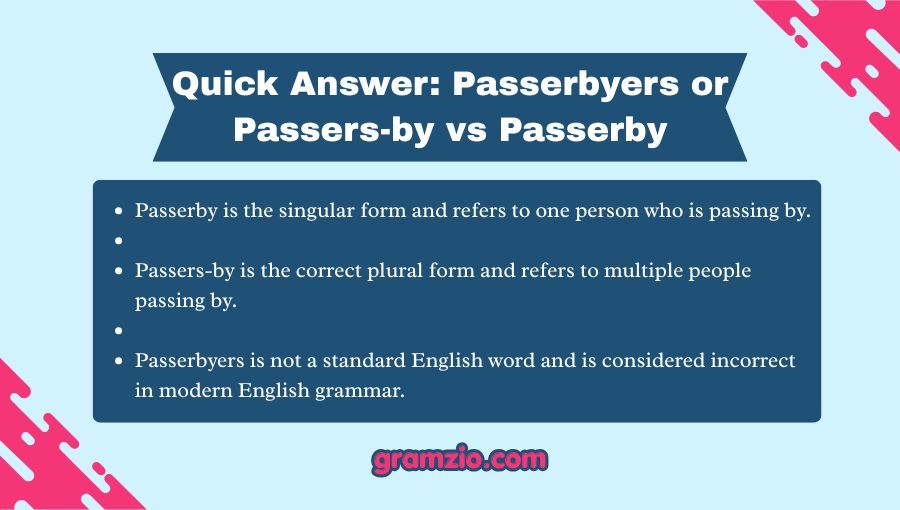
Passerby is the singular form and refers to one person who is passing by.
Passers-by is the correct plural form and refers to multiple people passing by.
Passerbyers is not a standard English word and is considered incorrect in modern English grammar.
Understanding the Basics: Passerbyers or Passers-by vs Passerby
The key difference is simple:
- Passerby = One person
- Passers-by = More than one person
- Passerbyers = Incorrect form
Comparison Table
| Form | Type | Meaning | Example | Correct/Incorrect |
|---|---|---|---|---|
| Passerby | Singular noun | One person passing by | A passerby witnessed the accident. | ✅ Correct |
| Passers-by | Plural noun | Multiple people passing by | Several passers-by stopped to help. | ✅ Correct |
| Passerbyers | Nonstandard form | Not recognized in standard English | The passerbyers watched the parade. | ❌ Incorrect |
Correct Meanings and Uses
What Does “Passerby” Mean?
A passerby is a person who happens to be passing a particular place.
Examples
- A passerby found the lost wallet.
- One passerby called emergency services.
- The passerby asked for directions.
Sentence Breakdown
A passerby found the wallet.
- A = article
- Passerby = singular noun
- Found = verb
- The wallet = object
The sentence refers to one individual.
Test Tip ✅
If you can replace the word with one person, use passerby.
What Does “Passers-by” Mean?
Passers-by is the accepted plural form.
Examples
- Several passers-by witnessed the event.
- Curious passers-by gathered around.
- Many passers-by stopped to take photos.
Sentence Breakdown
Several passers-by witnessed the event.
- Several = plural indicator
- Passers-by = plural noun
- Witnessed = verb
The sentence refers to multiple people.
Test Tip ✅
If you can replace the word with many people, use passers-by.
Why “Passerbyers” Is Incorrect
Some people assume the plural should be formed by adding -ers or -s to the end of the entire word.
This leads to forms like:
❌ Passerbyers
❌ Passerbys
Neither form is considered standard English.
The accepted plural remains:
✅ Passers-by
Test Tip ✅
When a compound noun contains a main noun and another modifying word, the plural is often added to the main noun, not the end of the expression.
Case Study Section
Workplace Incident Report
Imagine a security manager writing an incident report.
Incorrect Version
“Three passerbyers observed the accident and provided statements.”
Readers may immediately notice the grammar mistake, reducing the report’s professionalism.
Correct Version
“Three passers-by observed the accident and provided statements.”
This version follows standard English grammar and appears polished and credible.
Why It Matters
Professional documents rely on accurate grammar to maintain trust and clarity.
Grammar Rules Explanation
The reason for the confusion lies in the structure of the word.
Passerby is a compound noun:
- Passer = person who passes
- By = adverb/preposition
In English compound nouns, the plural often affects the primary noun.
Examples:
| Singular | Plural |
|---|---|
| Mother-in-law | Mothers-in-law |
| Attorney general | Attorneys general |
| Passerby | Passers-by |
The important word is passer, so the plural becomes passers.
The word by remains unchanged.
Major dictionaries, including the Merriam-Webster, list passers-by as the standard plural form.
Common Mistakes
People frequently make errors because they apply regular plural rules to an irregular noun.
Common Incorrect Forms
| Incorrect Form | Why It’s Wrong |
|---|---|
| Passerbyers | Not recognized by standard grammar |
| Passerbys | Ignores compound noun pluralization rules |
| Passer-bys | Nonstandard spelling |
| Passersby | Common but often considered less formal than passers-by |
Why These Mistakes Happen
Fast Typing ⌨️
Writers often type quickly and add an -s to the end without thinking.
Autocorrect 📱
Some devices may suggest incorrect alternatives.
Lack of Knowledge 📚
Many people have never learned how compound nouns form plurals.
Similar Grammar Confusions
| Confusing Pair | Correct Usage |
|---|---|
| It’s vs Its | Contraction vs Possessive |
| Your vs You’re | Possessive vs Contraction |
| Their vs There | Possessive vs Location |
| Affect vs Effect | Verb vs Noun |
| Passers-by vs Passerby | Plural vs Singular |
Usage in Different Contexts
Everyday Conversation
In casual speech:
- A passerby helped me carry my groceries.
- Several passers-by noticed the street performer.
These examples sound natural and correct.
Professional Writing
Business reports and news articles often use the term.
Examples:
- A passerby reported suspicious activity.
- Multiple passers-by provided eyewitness accounts.
Professional writing demands grammatical precision.
Creative Writing
Authors frequently use the term to create realistic scenes.
Example:
“The passerby paused beneath the streetlamp before disappearing into the fog.”
Plural version:
“Passers-by glanced at the mysterious figure but continued walking.”
Social Media and Texting
Even in informal settings, correct grammar improves credibility.
Example:
✅ Several passers-by stopped to watch.
❌ Several passerbyers stopped to watch.
Why It Matters
Correct grammar is more than a technical rule. It directly affects communication quality.
Clarity in Communication
Readers instantly understand whether you’re discussing one person or many people.
Example
- A passerby saw the accident.
- Passers-by saw the accident.
The meaning changes significantly.
Professionalism
Employers, clients, teachers, and readers notice grammatical accuracy.
Using standard English demonstrates attention to detail.
Better Digital Communication
Online communication moves quickly.
Accurate grammar helps messages remain clear and trustworthy.
Quote 💬
“Good grammar is the foundation of clear communication.”
While simple, this principle remains true in every type of writing.
Special Exception
Is “Passersby” Ever Acceptable?
You may occasionally see:
Passersby
without the hyphen.
Some modern publications and style guides accept this spelling, particularly in informal contexts.
However:
Most Traditional Preference
✅ Passers-by
Informal Alternative
✅ Passersby
Incorrect Form
❌ Passerbyers
For formal writing, academic papers, and professional documents, passers-by remains the safest choice.
Quick Recap Checklist
Which Form Should You Use?
| Question | If Yes → Use |
|---|---|
| Are you talking about one person? | Passerby |
| Are you talking about multiple people? | Passers-by |
| Are you thinking about using passerbyers? | Don’t use it |
| Are you writing formally? | Passers-by |
| Are you using standard grammar? | Passerby / Passers-by |
Practice Examples
Example 1
One witness stopped to help.
✅ A passerby stopped to help.
Example 2
Many witnesses stopped to help.
✅ Several passers-by stopped to help.
Example 3
People walking by noticed the fire.
✅ Passers-by noticed the fire.
Frequently Asked Questions (FAQs)
Is passerby a real word?
Yes. Passerby is a legitimate English noun referring to one person who happens to be passing a location.
What is the correct plural of passerby?
The correct plural is passers-by.
Example:
“Several passers-by watched the parade.”
Is passerbyers correct?
No. Passerbyers is not recognized as a standard English word and should be avoided.
Why isn’t the plural passerbys?
Because passerby is a compound noun. The plural is added to the main noun (passer), creating passers-by.
Can I write passersby without a hyphen?
Yes, some modern sources accept passersby, but passers-by remains the more traditional and widely accepted form.
Which form should I use in professional writing?
Use passerby for singular and passers-by for plural. These forms are safest and most widely accepted.
Final Comparison Table
| Singular | Plural | Status |
|---|---|---|
| Passerby | Passers-by | ✅ Standard English |
| Passerby | Passersby | ✅ Accepted in some contexts |
| Passerby | Passerbyers | ❌ Incorrect |
| Passerby | Passerbys | ❌ Incorrect |
Conclusion
Understanding passerbyers or passers-by vs passerby becomes easy once you know the grammar rule behind compound nouns. A passerby refers to one person who is passing by, while passers-by refers to multiple people. Although some modern writers occasionally use passersby, the traditional and most widely accepted plural remains passers-by.
The form passerbyers is not recognized in standard English and should be avoided in both formal and informal writing. By remembering that the plural applies to the noun passer, not the word by, you can confidently choose the correct form every time.
Clear grammar leads to clear communication. The next time you write about someone walking past, you’ll know exactly whether to use passerby or passers-by—and you’ll never be tempted by passerbyers again. 🎯
Also read: Stationary vs Stationery

Hi, I’m Axton Vane. I work at gramzio.com and bring over 11 years of experience in professional grammar. I specialize in refining complex syntax to help writers achieve perfect clarity in every sentence.