Concurrent vs Simultaneous: Meaning, Differences, and Proper Usage Explained
Quick Answer: Concurrent vs Simultaneous
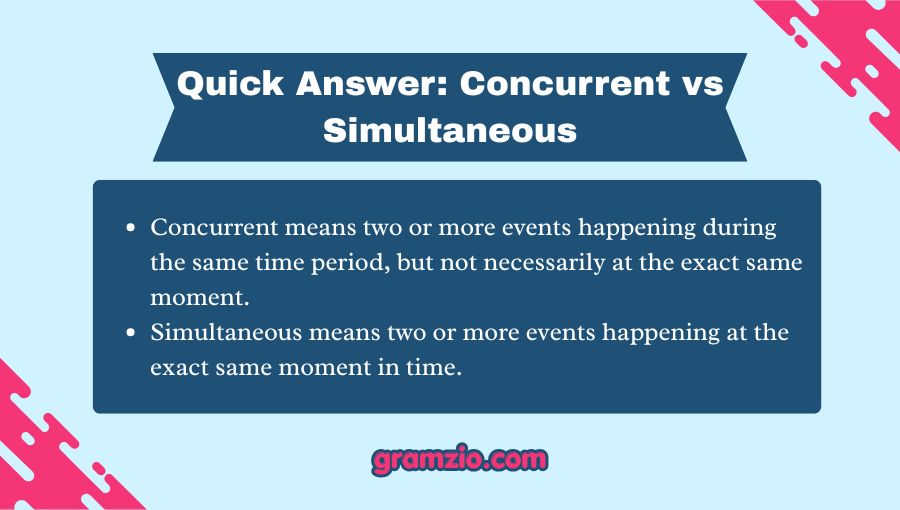
The difference between concurrent and simultaneous is based on precision of timing:
Concurrent means two or more events happening during the same time period, but not necessarily at the exact same moment.
Simultaneous means two or more events happening at the exact same moment in time.
In short:
- Concurrent = overlapping time period
- Simultaneous = exact same moment
Understanding the Basics of Concurrent vs Simultaneous
To truly understand concurrent vs simultaneous, we need to look at how each word functions in real language use.
What Does “Concurrent” Mean?
The word concurrent refers to events that overlap in time but may not start or end together.
📌 Example:
- Two online classes running from 9 AM to 11 AM are concurrent.
Even if students join at different times or activities vary slightly, the time period overlaps.
👉 Key idea: Time overlap, not exact alignment
What Does “Simultaneous” Mean?
The word simultaneous refers to actions happening at the exact same moment.
📌 Example:
- The two fireworks exploded simultaneously.
This means they happened at precisely the same second.
👉 Key idea: Exact same moment
Comparison Table: Concurrent vs Simultaneous
| Feature | Concurrent | Simultaneous |
|---|---|---|
| Form | Adjective | Adjective |
| Type | Time-based overlap | Exact timing alignment |
| Meaning | Happens during the same period | Happens at the exact same moment |
| Example | Two meetings overlap in time | Two phones ring at the same time |
| Correct Usage | Flexible timing | Strict timing |
| Incorrect Usage | Used when exact timing is needed | Used when only overlap exists |
Correct Meanings & Uses of Concurrent vs Simultaneous
1. Concurrent Usage in Detail
Concurrent events are common in systems, schedules, and workflows.
📌 Example:
- The university runs concurrent courses in different departments.
Sentence Breakdown:
- “University” = subject
- “runs” = action
- “concurrent courses” = overlapping programs
💡 Meaning: Courses happen within the same time period but are not identical in timing.
2. Simultaneous Usage in Detail
Simultaneous events are more precise and synchronized.
📌 Example:
- The dancers moved simultaneously on stage.
Sentence Breakdown:
- “Dancers” = subject
- “moved” = action
- “simultaneously” = exact coordination
💡 Meaning: All actions happen at the same instant.
Test Tip 🧠
Ask yourself:
- If timing can slightly vary → use concurrent
- If timing must be identical → use simultaneous
Case Study: Real-Life Usage Example
Workplace Scenario
Imagine a software company:
- Developers are working on different features from Monday to Friday → concurrent work
- A system update is deployed across all servers at the exact same second → simultaneous deployment
📧 Example Email:
“We are running concurrent development tasks across teams, but the final deployment will occur simultaneously across all production servers.”
This shows both words used correctly in a professional context.
Grammar Rules Explanation
According to standard English references like Merriam-Webster Dictionary, both words are grammatically correct adjectives, but their usage depends on context precision.
Why “Concurrent” is Correct in Some Cases
- English grammar allows overlap-based timing descriptions
- It does not require exact synchronization
Why “Simultaneous” is More Strict
- It implies exact time alignment
- It is used when precision is important
📌 Grammar Insight:
- Concurrent = flexible time frame
- Simultaneous = fixed moment
Common Mistakes in Concurrent vs Simultaneous
Many learners confuse these words due to similar meanings.
Why Mistakes Happen
- Fast typing ⌨️
- Autocorrect suggestions 📱
- Lack of understanding of timing difference
- Overuse of synonyms in casual speech
Common Confusion Table
| Incorrect Usage | Correct Form | Reason |
|---|---|---|
| The alarms rang concurrently at 8:00 AM | The alarms rang simultaneously at 8:00 AM | Exact same moment required |
| The meetings were simultaneous all week | The meetings were concurrent all week | Time period overlap |
| Two cars started concurrently at the exact second | Two cars started simultaneously at the exact second | Precision needed |
Usage in Different Contexts
1. Everyday Conversation 🗣️
- “We had two shows running concurrently this weekend.”
2. Professional Writing 💼
- “The team managed concurrent projects across three departments.”
3. Creative Writing ✍️
- “Their voices echoed simultaneously through the empty hall.”
4. Social Media/Texting 📱
- “We both posted stories simultaneously 😂”
Why It Matters (Important Section)
Understanding concurrent vs simultaneous improves communication clarity and professionalism.
✔ Helps avoid confusion
✔ Improves writing accuracy
✔ Essential for technical and legal writing
✔ Enhances professional credibility
📢 As linguists often say:
“Precision in language leads to precision in thought.”
Special Exception Section
In most English usage, there are no strict exceptions, but:
- In computing and IT, concurrent processes may still run “simultaneously” depending on system design.
- In physics, simultaneous events are often strictly defined by reference frames.
So context always matters.
Quick Recap Checklist
| Question | If Yes → Use |
|---|---|
| Do events overlap in time? | Concurrent |
| Do events happen at the exact same moment? | Simultaneous |
Practice Examples:
- Two trains arriving at the same second → Simultaneous
- Two projects running during the same month → Concurrent
- Two phones ringing exactly together → Simultaneous
FAQs: Concurrent vs Simultaneous
1. What is the main difference between concurrent and simultaneous?
Concurrent refers to overlapping time periods, while simultaneous refers to exact same moment events.
2. Can concurrent and simultaneous be used interchangeably?
No. They are not fully interchangeable because they differ in timing precision.
3. Is simultaneous more precise than concurrent?
Yes. Simultaneous requires exact alignment in time.
4. Which is used in technology and computing?
Concurrent is commonly used for processes running during overlapping time periods.
5. Can two events be both concurrent and simultaneous?
Yes, but only if they happen at the exact same time and within the same time frame.
6. What is an easy trick to remember the difference?
Think:
- Concurrent = “covering the same time period”
- Simultaneous = “same second, same moment”
Conclusion
The confusion between concurrent vs simultaneous is common, but the difference becomes clear once you understand timing precision. Concurrent refers to events that overlap in time, while simultaneous refers to events happening at the exact same moment.
Using these words correctly improves your writing clarity, professional communication, and grammar accuracy. Whether you are writing emails, reports, or casual messages, choosing the right word helps you sound more precise and confident.
So next time you describe events happening “at the same time,” pause for a second and ask yourself—are they overlapping or perfectly aligned? That simple question will guide you to the correct choice every time. ✅
Also read: Window Seal or Sill

Hi, I’m Dexter Rhodes. At gramzio.com, I apply my 10 years of experience in copy-editing to ensure every guide we publish is accurate, professional, and follows the highest editorial standards.