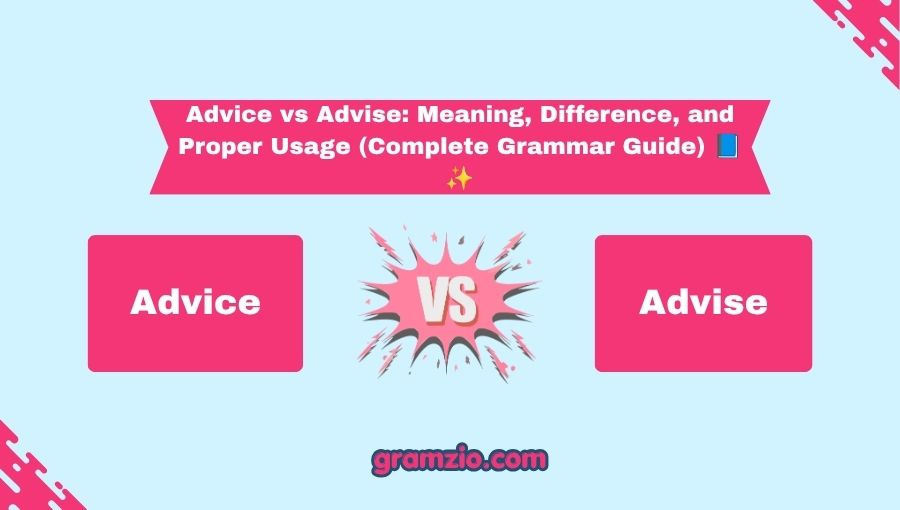
Advice vs Advise: Meaning, Difference, and Proper Usage (Complete Grammar Guide) 📘✨
The difference between Advice vs Advise is one of the most common grammar confusions in English writing. Many learners, students, and even professionals often mix these two words because they look and sound almost identical. However, their meanings and grammatical roles are completely different, and using them incorrectly can make your writing appear unprofessional or unclear.
The confusion around Advice vs Advise usually happens because both words are related to guidance or recommendations. But one is a noun and the other is a verb, which changes how they are used in sentences. This small distinction plays a very important role in English grammar and communication accuracy.
In this article, we will break down Advice vs Advise in the simplest way possible. You will learn their meanings, differences, correct usage, real-life examples, and common mistakes. By the end, you will be able to use both words confidently in writing and speaking without hesitation. 🚀
Quick Answer: Advice vs Advise
The difference between advice vs advise is simple:
“Advice” is a noun that means a suggestion or recommendation given to someone.
“Advise” is a verb that means the action of giving a suggestion or recommendation.
👉 Example:
- I need your advice. (noun)
- I advise you to study harder. (verb)
In short:
✔ Advice = thing (noun)
✔ Advise = action (verb)
Understanding the Basics: Advice vs Advise
To fully understand advice vs advise, you need to look at their grammatical roles.
1. Advice (Noun) 💡
“Advice” is something you receive or give as information or guidance. It is a noun, so it cannot act as an action word.
✔ Meaning: Suggestion, recommendation, guidance
✔ Type: Noun (uncountable)
Examples:
- She gave me excellent advice about my career.
- I need some financial advice.
- His advice helped me make the right decision.
👉 Important Note:
You NEVER say “advices” in standard English. It is uncountable.
2. Advise (Verb) 🗣️
“Advise” is the action of giving advice. It is a verb, meaning it describes what someone does.
✔ Meaning: To recommend, suggest, or guide
✔ Type: Verb
Examples:
- I advise you to save money.
- The doctor advises rest.
- They advised him not to travel.
Comparison Table: Advice vs Advise
| Form | Type | Meaning | Example Sentence | Correct/Incorrect |
|---|---|---|---|---|
| Advice | Noun | Suggestion or recommendation | I need your advice. | Correct |
| Advise | Verb | To give suggestion or guidance | I advise you to leave early. | Correct |
| Advise | Noun | (Incorrect use) | I need your advise. | Incorrect |
| Advice | Verb | (Incorrect use) | I advice you to study. | Incorrect |
Correct Meanings & Uses
Using “Advice” in Sentences
“Advice” is used when you are talking about the information itself, not the action.
✔ Example Breakdown:
- Sentence: She gave me advice about exams.
- “She” = subject
- “gave” = verb
- “advice” = object (thing received)
👉 Test Tip:
If you can replace the word with “suggestion,” use advice.
Using “Advise” in Sentences
“Advise” is used when someone is actively giving guidance.
✔ Example Breakdown:
- Sentence: I advise you to drink water.
- “I” = subject
- “advise” = verb (action)
- “you” = receiver
👉 Test Tip:
If you can replace it with “suggest,” use advise.
Case Study: Real-Life Usage Example 🧾
Workplace Email Scenario:
❌ Incorrect:
I advice you to submit the report today.
✔ Correct:
I advise you to submit the report today.
Explanation:
In a professional email, using the wrong form can make the message look uneducated or careless. “Advise” is correct because it shows an action.
Manager Feedback Example:
✔ “My manager gave me valuable advice on improving my performance.”
✔ “My manager advised me to improve my communication skills.”
👉 Notice:
- Advice = what was given
- Advise = action performed
Grammar Rules Explanation 📚
The confusion between advice vs advise exists because of their similar spelling and pronunciation. However, grammar authorities like Merriam-Webster and Oxford Dictionary clearly define them as separate forms.
Key Rule:
- Advice = noun (thing)
- Advise = verb (action)
Why they are different:
English often forms noun/verb pairs with similar spelling but different endings:
- Practice (noun) vs Practise (verb in British English)
- License (noun) vs License (verb in US English context)
- Advice vs Advise (classic noun-verb pair)
👉 The “-ice” ending usually signals a noun
👉 The “-ise/-ize” or “-ise” form often signals a verb
Common Mistakes ⚠️
Why People Confuse Advice vs Advise
Most mistakes happen because:
- ⚡ Fast typing leads to spelling errors
- 🤖 Autocorrect changes intended words
- 📉 Lack of grammar knowledge
- 🧠 Both words sound similar when spoken
Common Grammar Confusions Table
| Wrong Pair | Correct Form | Reason for Confusion |
|---|---|---|
| your/you’re | you’re | Apostrophe confusion |
| its/it’s | it’s | Possessive vs contraction |
| advice/advise | advice | noun vs verb similarity |
| affect/effect | effect | pronunciation similarity |
| then/than | than | comparison confusion |
Usage in Different Contexts 🌍
1. Everyday Conversation 🗣️
- Can you give me some advice?
- I advise you to rest.
2. Professional Writing 💼
- The consultant provided financial advice.
- We advise all employees to follow safety rules.
3. Creative Writing ✍️
- The old man’s advice changed her life forever.
- The mentor gently advised the young hero.
4. Social Media/Texting 📱
- Need some advice on this situation 😅
- I advise you to ignore negativity ✨
Why It Matters (Important) 🚨
Correct usage of advice vs advise is important because:
- It improves communication clarity
- It shows professionalism in writing
- It avoids misunderstandings
- It strengthens academic and workplace credibility
“Clear language builds clear understanding.”
Even a small grammar mistake can change how people perceive your writing skills.
Special Exception 🔍
There are no major exceptions for advice vs advise in modern English grammar. However:
- In British English, spelling conventions may vary slightly in other verb forms (like “organise/organize”), but advice/advise remains consistent globally.
- Both US and UK English follow the same rule here.
Quick Recap Checklist ✅
| Question | If Yes → Use |
|---|---|
| Is it a thing or suggestion? | Advice |
| Is it an action of giving suggestion? | Advise |
| Can it be replaced with “suggestion”? | Advice |
| Can it be replaced with “suggest”? | Advise |
Practice Examples 📝
- I need your ______ on this matter. → Advice
- The teacher ______ students to revise daily. → Advises
- She gave me great ______ before the exam. → Advice
FAQs: Advice vs Advise ❓
1. What is the main difference between advice and advise?
Advice is a noun meaning suggestion, while advise is a verb meaning to give a suggestion.
2. Can I say “an advice”?
No. “Advice” is uncountable, so you should say “some advice” or “a piece of advice.”
3. Is advise formal or informal?
“Advise” is formal and commonly used in professional and academic writing.
4. Why do people confuse advice and advise?
Because they look and sound similar, and fast typing or autocorrect often leads to mistakes.
5. Can advice be plural?
No. “Advice” does not have a plural form in standard English.
6. What is a simple trick to remember the difference?
If you are doing the action → advise
If you are talking about the thing → advice
Conclusion
Understanding the difference between advice vs advise is essential for clear and professional English communication. Although these words look similar, they serve completely different grammatical purposes. “Advice” is a noun that refers to a suggestion or recommendation, while “advise” is a verb that describes the action of giving that suggestion.
By remembering this simple rule—advice = thing, advise = action—you can avoid one of the most common English mistakes. This distinction is especially important in academic writing, workplace communication, and formal conversations where accuracy matters.
Mastering small grammar details like this improves your confidence and writing quality significantly. The next time you write, pause for a second and choose the correct form carefully. With practice, using advice vs advise correctly will become natural and effortless. ✨
Also read: That’s Mean vs That Means

Hi, I’m Elara Quinn. Working at gramzio.com, I use my 8 years of experience in linguistics to simplify difficult English rules, making them accessible and easy to learn for our global community.