Impatient vs Inpatient: Meaning, Difference, Usage, and Grammar Guide
The confusion between impatient vs inpatient is extremely common in English writing because both words look almost identical but have completely different meanings. Many learners, writers, and even professionals mistakenly swap these terms, which can completely change the meaning of a sentence. While “impatient” describes a personality trait related to not wanting to wait, “inpatient” is a medical term used for someone admitted to a hospital for treatment.
Have you ever paused while writing a sentence and wondered which one to use? You are not alone. These two words are often mixed up in texting, emails, and professional communication, especially because of autocorrect and fast typing. For example, saying “I am impatient in the hospital” means something very different from “I am an inpatient in the hospital.”
In this article, you will clearly understand the difference between impatient vs inpatient, learn their correct usage, explore grammar rules, see real-life examples, and discover common mistakes to avoid. By the end, you will never confuse these two words again and will use them confidently in any context.
Quick Answer Section: Impatient vs Inpatient
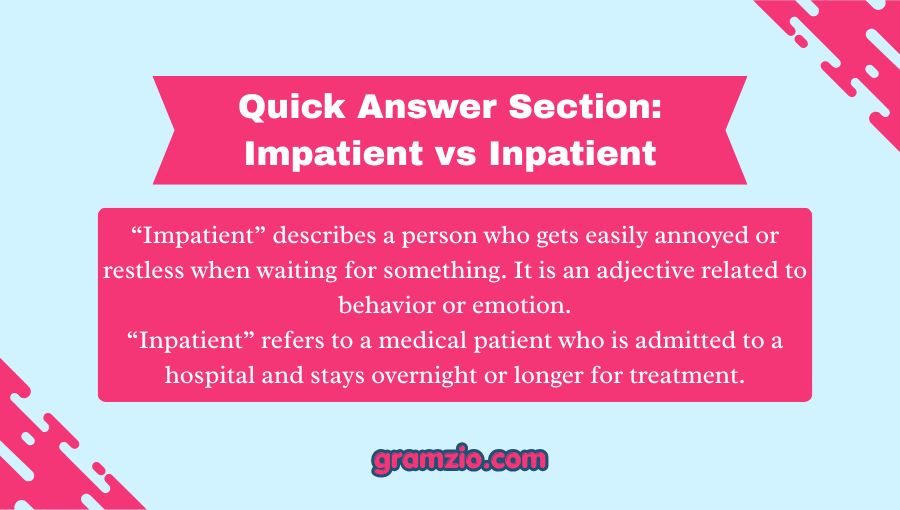
The difference between impatient vs inpatient is simple:
“Impatient” describes a person who gets easily annoyed or restless when waiting for something. It is an adjective related to behavior or emotion.
“Inpatient” refers to a medical patient who is admitted to a hospital and stays overnight or longer for treatment.
In short:
- Impatient = personality/behavior (eager, restless)
- Inpatient = medical status (hospital admission)
Understanding the Basics of Impatient vs Inpatient
The confusion between impatient vs inpatient happens mainly because of spelling similarity. However, they belong to completely different categories of English usage.
Key Differences Overview
| Form | Type | Meaning | Example Sentence | Correct/Incorrect |
|---|---|---|---|---|
| Impatient | Adjective | Unable to wait calmly; easily irritated | I am impatient while waiting in line. | Correct (emotion) |
| Inpatient | Noun/Adjective | A hospital patient admitted for treatment | She is an inpatient at the hospital. | Correct (medical) |
Simple Explanation
- Impatient = emotional state (personality trait)
- Inpatient = medical classification (hospital term)
Even though they look similar, they are not interchangeable in any context.
Correct Meaning and Usage of “Impatient”
What Does “Impatient” Mean?
The word impatient is an adjective used to describe someone who cannot wait calmly for something. It reflects frustration, eagerness, or restlessness.
Example Sentences
- I am impatient to see the results of my exam.
- She becomes impatient when the internet is slow.
- The child was impatient during the long trip.
Sentence Breakdown
In each sentence:
- Subject shows emotional state
- “Impatient” describes behavior
- It is NOT related to medical conditions
Test Tip
If the sentence expresses emotion, frustration, or eagerness → use impatient.
Ask yourself:
“Am I describing a feeling or personality?”
If yes → it is impatient.
Correct Meaning and Usage of “Inpatient”
What Does “Inpatient” Mean?
The word inpatient is used in medical contexts. It refers to a person who is admitted to a hospital for treatment and stays there for at least one night or longer.
Example Sentences
- He is an inpatient recovering after surgery.
- The hospital has 200 inpatient beds.
- She was treated as an inpatient for three days.
Sentence Breakdown
- Used in healthcare context
- Refers to hospital admission
- Often used as noun or adjective
Test Tip
If the sentence involves:
- hospital
- treatment
- medical admission
Then use inpatient.
Case Study: Real-Life Confusion Example
Imagine a hospital email:
❌ Incorrect:
The patient is very inpatient while waiting for discharge.
✔ Correct:
The patient is very impatient while waiting for discharge.
Now another example:
❌ Incorrect:
She is impatient in the hospital for surgery.
✔ Correct:
She is an inpatient in the hospital for surgery.
What Went Wrong?
- First sentence: emotional state → should be impatient
- Second sentence: medical status → should be inpatient
This shows how one small spelling change completely alters meaning.
Grammar Rules Behind Impatient vs Inpatient
Why “Impatient” is Correct in Emotional Contexts
“Impatient” comes from:
- prefix: im- (not)
- root: patient
So it literally means “not patient.”
Why “Inpatient” is Medical
“Inpatient” is formed from:
- “in” (inside hospital)
- “patient” (medical term)
It means someone who is “inside care as a patient.”
Grammar Authority Note
According to standard English dictionaries such as Merriam-Webster, both words are valid but belong to different lexical categories:
- Impatient → emotional adjective
- Inpatient → medical noun/adjective
Common Mistakes with Impatient vs Inpatient
Many people confuse these words due to:
- fast typing
- autocorrect errors
- lack of grammar awareness
- visual similarity
Common Confusion Table
| Confused Words | Mistake Example | Correct Usage Example |
|---|---|---|
| it’s / its | Its raining today ❌ | It’s raining today ✔ |
| your / you’re | Your going home ❌ | You’re going home ✔ |
| impatient/inpatient | She is inpatient to leave ❌ | She is impatient to leave ✔ |
Why These Mistakes Happen
- Typing quickly on mobile devices
- Autocorrect replacing words incorrectly
- Not knowing medical vs emotional usage
Usage in Different Contexts
1. Everyday Conversation
- I am impatient waiting for my food.
- He is an inpatient at the local hospital.
2. Professional Writing
- Patient reports show high impatience due to delays.
- The hospital expanded its inpatient facilities.
3. Creative Writing
- His impatient heart raced in silence.
- The inpatient ward was quiet at night.
4. Social Media/Texting
- So impatient for the weekend!
- My friend is an inpatient recovering well.
Why It Matters
Understanding impatient vs inpatient is important because it improves clarity and prevents misunderstanding.
Key Benefits:
- Better communication
- Professional writing accuracy
- Avoiding embarrassing mistakes
- Clear medical vs emotional distinction
Quote
“Precision in language leads to precision in understanding.”
Using the right word ensures your message is clear and professional.
Special Exception Section
There are no major exceptions in modern English usage for these two words. However:
- “Inpatient” is mostly used in healthcare systems.
- “Impatient” is widely used in both formal and informal contexts.
No interchangeable usage is acceptable.
Quick Recap Checklist
| Question | If Yes → Use |
|---|---|
| Are you talking about emotions or waiting? | Impatient |
| Are you talking about hospital admission? | Inpatient |
Practice Examples
- I am ___ for my exam results.
- The patient is an ___ at the hospital.
- She feels ___ during long meetings.
Answers:
- impatient
- inpatient
- impatient
FAQs: Impatient vs Inpatient
1. What is the main difference between impatient and inpatient?
“Impatient” describes an emotional state of not wanting to wait, while “inpatient” refers to a person admitted to a hospital for treatment.
2. Is inpatient a noun or adjective?
“Inpatient” can be both a noun (a hospital patient) and an adjective (inpatient care).
3. Can I use impatient in medical writing?
Yes, but only to describe emotions, not medical status. For example, a patient may feel impatient, but they are not “inpatient” emotionally.
4. Why do people confuse impatient and inpatient?
They are confused due to similar spelling, fast typing, and autocorrect errors.
5. What is inpatient care?
Inpatient care refers to medical treatment where a patient stays in a hospital overnight or longer.
6. Is impatient always negative?
Not always. It can also show eagerness, like being impatient for good news or exciting events.
Conclusion (150 words)
The confusion between impatient vs inpatient is a classic example of how similar-looking words in English can carry completely different meanings. While “impatient” reflects a human emotion of restlessness or eagerness, “inpatient” is strictly a medical term used in hospitals to describe admitted patients.
Understanding this difference is essential for clear communication, especially in professional, academic, and healthcare-related writing. A simple spelling mistake can completely change the meaning of a sentence, sometimes leading to confusion or misunderstanding.
By remembering one simple rule—impatient is emotional, inpatient is medical—you can avoid this common grammar mistake forever. Whether you are writing emails, essays, or social media posts, using the correct word ensures clarity and professionalism.
Language accuracy builds strong communication skills, and mastering small distinctions like this makes a big difference in how clearly your message is understood.
Also read: What Happen or What Happened

Hi, I’m Willa Sterling. I work at gramzio.com as a senior editor. With 15 years of experience in academic and formal grammar, I provide the expert insights you need to make your writing flawless.