Too Many vs To Many: What’s the Difference and Which One Is Correct? 🤔
Have you ever typed a sentence like, “There are to many people here,” and wondered if it looked right? You’re not alone. Many English learners and native speakers alike get confused by too many vs to many because the words too and to sound exactly the same when spoken.
This confusion is common in emails, social media posts, school assignments, and even professional documents. While the difference may seem small, using the wrong form can make your writing appear careless or less polished.
Understanding the distinction between too many vs to many is important because one phrase is grammatically correct in most situations, while the other is usually considered incorrect. Once you learn the simple rule behind these expressions, you’ll be able to spot mistakes instantly and write with greater confidence.
In this guide, you’ll learn the meaning, grammar rules, examples, common mistakes, exceptions, and practical tips to help you master this tricky grammar topic. 📚
Quick Answer: Too Many vs To Many
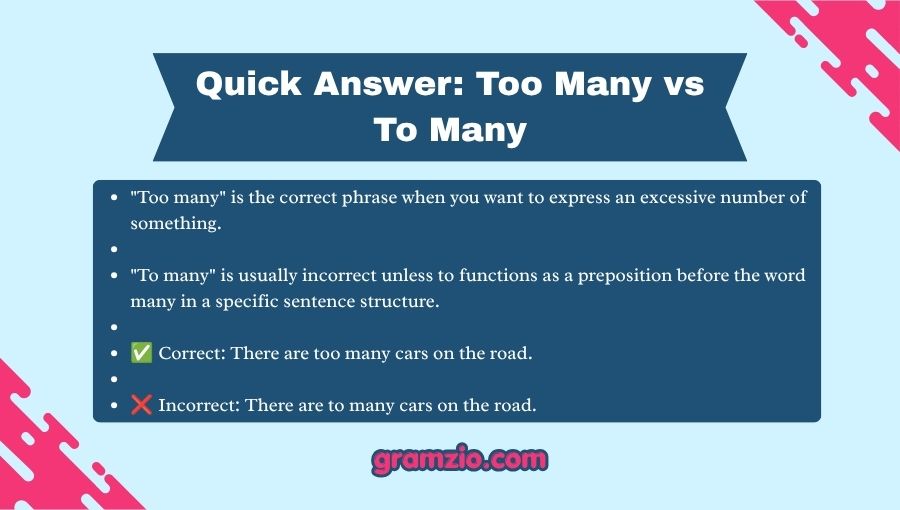
“Too many” is the correct phrase when you want to express an excessive number of something.
“To many” is usually incorrect unless to functions as a preposition before the word many in a specific sentence structure.
✅ Correct: There are too many cars on the road.
❌ Incorrect: There are to many cars on the road.
Understanding the Basics of Too Many vs To Many
The confusion comes from the fact that to and too are homophones. They sound alike but have different meanings and grammatical functions.
| Form | Type | Meaning | Example | Correct/Incorrect |
|---|---|---|---|---|
| Too Many | Adverb + Determiner | More than needed or desired | There are too many emails. | ✅ Correct |
| To Many | Preposition + Quantifier | Used only in special sentence structures | The award was given to many students. | ✅ Correct in specific contexts |
| To Many | Mistaken replacement for “too many” | Incorrect usage | There are to many emails. | ❌ Incorrect |
The Simple Rule
If you mean an excessive number, use too many.
If to indicates direction, relationship, or connection before many, then to many may be correct.
Correct Meanings and Uses
Using “Too Many”
The phrase too many means an excessive quantity of countable nouns.
Formula
Too + Many + Countable Noun
Examples
✅ There are too many books on my desk.
✅ We received too many applications.
✅ She has too many responsibilities.
Sentence Breakdown
There are too many books on my desk.
- Too = excessively
- Many = a large number
- Books = countable noun
Meaning: The number of books exceeds what is desired or manageable.
Test Tip 📝
Ask yourself:
“Do I mean more than necessary?”
If yes, use too many.
Using “To Many”
The phrase to many is not automatically wrong. It simply serves a different purpose.
Examples
✅ The scholarship was awarded to many students.
✅ The announcement was sent to many employees.
✅ The message appealed to many readers.
Sentence Breakdown
The scholarship was awarded to many students.
- To = indicates recipient
- Many = quantifier describing students
Meaning: Many students received the scholarship.
Here, to functions as a preposition, not an adverb.
Test Tip 📝
If you can replace to with phrases like:
- for
- toward
- into
- regarding
then to many may be correct.
Comparing the Two Side by Side
| Sentence | Meaning | Correct? |
|---|---|---|
| There are too many mistakes. | Excessive number of mistakes | ✅ |
| There are to many mistakes. | Incorrect spelling | ❌ |
| The email was sent to many clients. | Directed toward many clients | ✅ |
| We have too many clients. | Excessive number of clients | ✅ |
Case Study Section
Workplace Email Example 📧
Imagine a manager writing the following email:
❌ We received to many support requests this week.
Employees may notice the grammatical mistake immediately.
The corrected version:
✅ We received too many support requests this week.
Now consider another sentence:
✅ The report was distributed to many department heads.
This sentence is correct because to shows who received the report.
Lesson Learned
- Excessive quantity = too many
- Recipient or direction = to many
Understanding the distinction helps ensure professional communication.
Grammar Rules Explanation
According to standard English grammar and dictionaries such as Merriam-Webster, too functions as an adverb meaning:
- excessively
- more than enough
- additionally
When combined with many, it creates the phrase too many, meaning an excessive number.
Examples
✅ Too many visitors
✅ Too many assignments
✅ Too many interruptions
The word to, however, is a preposition or part of an infinitive verb.
Examples:
- Go to school
- Speak to someone
- Travel to Europe
Because their grammatical roles differ, replacing too with to changes the sentence and often creates an error.
Common Mistakes
People frequently confuse these expressions because they sound identical.
Why Mistakes Happen
1. Fast Typing ⌨️
Many writers accidentally type to instead of too because it is shorter and more commonly used.
2. Autocorrect
Some devices fail to catch contextual grammar mistakes.
3. Lack of Knowledge
Many people know the words sound alike but never learn the difference in meaning.
4. Informal Communication
Text messages and social media often encourage speed over accuracy.
Similar Grammar Confusions
| Confusing Words | Correct Difference |
|---|---|
| It’s vs Its | Contraction vs Possessive |
| Your vs You’re | Possessive vs You Are |
| Their vs There vs They’re | Possessive vs Location vs Contraction |
| Then vs Than | Time vs Comparison |
| Affect vs Effect | Verb vs Noun |
| Too vs To | Excess vs Direction |
Usage in Different Contexts
Everyday Conversation 🗣️
People often use too many when discussing quantities.
Examples:
- There are too many people in line.
- We bought too many groceries.
- She has too many shoes.
Professional Writing 💼
Accuracy matters in business communication.
Examples:
- The project encountered too many delays.
- We received too many customer complaints.
- The memo was sent to many managers.
Creative Writing ✍️
Writers use too many to emphasize overwhelm or abundance.
Example:
There were too many stars in the sky to count.
Social Media and Texting 📱
Grammar errors frequently appear online.
Incorrect:
❌ To many notifications today!
Correct:
✅ Too many notifications today!
Why It Matters
Using too many vs to many correctly improves communication in several ways.
1. Clarity
Readers instantly understand your meaning.
2. Professionalism
Correct grammar creates a positive impression.
3. Writing Accuracy
Small details contribute to stronger writing overall.
4. Digital Communication
Emails, social posts, and messages often shape first impressions.
Quote 💡
“Good grammar is the foundation of clear communication.”
A single misplaced letter can change how readers perceive your writing.
Special Exception
There are situations where to many is perfectly correct.
Examples:
✅ The proposal was presented to many stakeholders.
✅ The invitation was mailed to many households.
✅ The message resonated with and spoke to many people.
In these examples, to serves as a preposition introducing the recipient or target.
The key point is that to many is only correct when to naturally belongs in the sentence.
If you mean an excessive number, always choose too many.
Quick Recap Checklist
Which One Should You Use?
| Question | If Yes → Use |
|---|---|
| Do you mean more than necessary? | Too Many |
| Are you describing an excessive quantity? | Too Many |
| Is “to” showing direction or a recipient? | To Many |
| Can “to” be replaced by “toward” or “for”? | To Many |
Practice Examples
Example 1
There are ___ people in the room.
✅ Answer: too many
Example 2
The survey was sent ___ employees.
✅ Answer: to many
Example 3
We received ___ complaints this month.
✅ Answer: too many
FAQs About Too Many vs To Many
1. Is “to many” always wrong?
No. It is correct when to functions as a preposition before many, such as in The letter was sent to many customers.
2. What does “too many” mean?
It means an excessive number of countable items, people, or things.
3. How can I remember the difference?
Remember that too contains an extra “o,” which can remind you of extra or excessive.
4. Is “too many” formal English?
Yes. It is standard English and appropriate for academic, professional, and casual writing.
5. Why do people confuse “to” and “too”?
Because they are homophones. They sound the same but have different meanings and grammatical functions.
6. Can I use “too much” instead of “too many”?
Use too much with uncountable nouns and too many with countable nouns.
Examples:
✅ Too much water
✅ Too many bottles
Conclusion
Understanding too many vs to many is easier than it first appears. The phrase too many expresses an excessive number of countable items and is the correct choice in most situations where quantity is being discussed. Meanwhile, to many is only correct when the word to functions as a preposition showing direction, connection, or recipients.
A quick memory trick is to remember that too has an extra o, representing something extra or excessive. Whenever you mean “more than necessary,” choose too many. When to naturally belongs in the sentence because it points toward someone or something, to many may be appropriate.
Mastering this small grammar rule can significantly improve your writing, strengthen your credibility, and help you communicate with confidence. The next time you pause over too many vs to many, you’ll know exactly which one belongs on the page. 🎯
Also read: It Worth It or It Is Worth It

Hi, I’m Willa Sterling. I work at gramzio.com as a senior editor. With 15 years of experience in academic and formal grammar, I provide the expert insights you need to make your writing flawless.