Mei Fun vs Chow Fun: Understanding the Difference Between These Popular Chinese Noodle Dishes 🍜
When it comes to Mei Fun vs Chow Fun, many diners find themselves confused while scanning a Chinese restaurant menu. If you’ve ever wondered whether to order Mei Fun or Chow Fun, you’re certainly not alone. These popular noodle dishes appear on countless menus across the United States, and at first glance, they can seem very similar. Both are beloved staples of Chinese-American cuisine and are often served as flavorful stir-fried meals.
However, there are important differences between Mei Fun and Chow Fun. They use different types of noodles, have distinct textures, and are prepared in slightly different ways. Understanding these differences can help you choose the dish that best matches your taste preferences.
The confusion surrounding Mei Fun vs Chow Fun often comes from their similar names and their shared presence on Chinese restaurant menus. Yet once you understand the basics, telling them apart becomes quite simple.
In this guide, we’ll explore everything you need to know about Mei Fun and Chow Fun, including their ingredients, preparation methods, cultural origins, and the situations where each dish shines best.
Quick Answer: Mei Fun vs Chow Fun
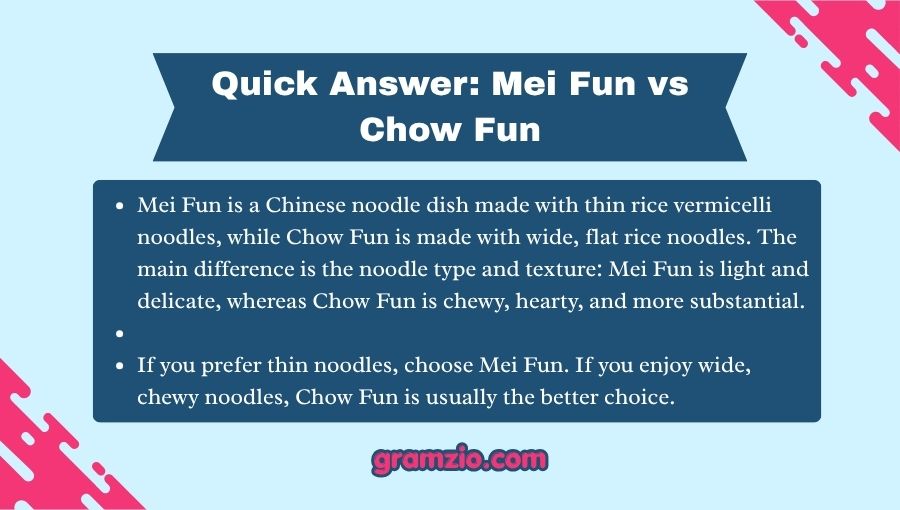
Mei Fun is a Chinese noodle dish made with thin rice vermicelli noodles, while Chow Fun is made with wide, flat rice noodles. The main difference is the noodle type and texture: Mei Fun is light and delicate, whereas Chow Fun is chewy, hearty, and more substantial.
If you prefer thin noodles, choose Mei Fun. If you enjoy wide, chewy noodles, Chow Fun is usually the better choice.
Understanding the Basics of Mei Fun vs Chow Fun
The easiest way to understand the difference is to focus on the noodles themselves.
| Feature | Mei Fun | Chow Fun |
|---|---|---|
| Form | Thin noodles | Wide flat noodles |
| Type | Rice vermicelli | Flat rice noodles |
| Meaning | “Rice noodles” | “Stir-fried noodles” |
| Example | Singapore Mei Fun | Beef Chow Fun |
| Correct Description | Thin rice noodle dish | Wide rice noodle dish |
| Incorrect Description | Flat noodle dish | Vermicelli noodle dish |
Core Difference
The primary distinction is the noodle shape and texture.
- Mei Fun uses extremely thin rice noodles.
- Chow Fun uses broad, flat rice noodles.
- Both are commonly stir-fried.
- Both can include vegetables, meat, seafood, or tofu.
The noodle itself dramatically changes the eating experience.
Correct Meanings and Uses
What Is Mei Fun? 🍜
Mei Fun refers to thin rice vermicelli noodles commonly used in Chinese cuisine.
These noodles are:
- Thin and delicate
- Made from rice flour
- Light in texture
- Often stir-fried with vegetables and protein
Example
Sentence: I ordered Singapore Mei Fun for lunch.
Breakdown:
- Singapore Mei Fun is a spicy stir-fried noodle dish.
- The noodles are thin rice vermicelli.
- The dish often contains shrimp, pork, eggs, and curry powder.
Test Tip ✅
If the noodles resemble thin strands similar to angel hair pasta, you’re probably looking at Mei Fun.
What Is Chow Fun? 🍽️
Chow Fun refers to stir-fried dishes made with wide, flat rice noodles.
These noodles are:
- Broad and flat
- Soft yet chewy
- Excellent for absorbing sauces
- Popular in Cantonese cuisine
Example
Sentence: Beef Chow Fun is one of the restaurant’s most popular dishes.
Breakdown:
- Wide rice noodles are stir-fried.
- Beef and bean sprouts are commonly included.
- A savory soy-based sauce is often used.
Test Tip ✅
If the noodles are wide enough to pick up individually with chopsticks, they are most likely Chow Fun noodles.
Noodle Characteristics Compared
Mei Fun Noodles
Characteristics include:
- Thin strands
- Delicate texture
- Quick cooking time
- Light flavor absorption
- Lower visual bulk
These noodles create a lighter meal experience.
Chow Fun Noodles
Characteristics include:
- Broad ribbon-like shape
- Chewy bite
- Strong sauce absorption
- Rich texture
- Heavier mouthfeel
These noodles create a more filling meal.
Case Study: Ordering at a Chinese Restaurant
Imagine two coworkers going out for lunch.
Conversation
Sarah: I want something light but flavorful.
David: I want something hearty and filling.
The server recommends:
- Singapore Mei Fun for Sarah
- Beef Chow Fun for David
Why?
Sarah prefers:
- Thin noodles
- Lighter texture
- More spice
David prefers:
- Chewy noodles
- Rich texture
- Heavier meal
This real-world example demonstrates how understanding the difference between Mei Fun and Chow Fun can improve your dining experience.
Grammar Rules Explanation
Unlike grammar topics such as “your vs you’re,” Mei Fun vs Chow Fun is not a grammatical distinction. Instead, it is a vocabulary and culinary distinction.
According to standard dictionary references and restaurant usage, these terms identify specific types of noodle dishes rather than interchangeable words.
Why Accuracy Matters
Using the correct term helps:
- Avoid menu confusion
- Communicate clearly
- Order the dish you actually want
- Improve food-related writing accuracy
When discussing Chinese cuisine, precision matters just as it does in grammar and professional writing.
Historical Origins of Mei Fun and Chow Fun
Understanding the history behind these dishes provides useful context.
Origin of Mei Fun
Mei Fun originates from southern Chinese culinary traditions.
The noodles are:
- Rice-based
- Lightweight
- Common in stir-fries
- Popular throughout Asia
The term generally refers to rice vermicelli noodles.
Origin of Chow Fun
Chow Fun comes largely from Cantonese cooking traditions.
The term combines:
- “Chow” meaning stir-fried
- “Fun” meaning rice noodle
One of the most famous examples is Beef Chow Fun, a classic Cantonese dish enjoyed worldwide.
Common Mistakes People Make
Many people incorrectly assume that Mei Fun and Chow Fun are simply different names for the same dish.
Why the Mistake Happens
Common reasons include:
- Fast menu reading
- Similar naming structure
- Limited familiarity with Chinese cuisine
- Restaurant menu variations
Similar Confusions Table
| Confusion | Correct Difference |
|---|---|
| Mei Fun vs Chow Fun | Different noodle types |
| Lo Mein vs Chow Mein | Different preparation styles |
| It’s vs Its | Contraction vs possession |
| Your vs You’re | Possessive vs contraction |
| Then vs Than | Time vs comparison |
| Affect vs Effect | Verb vs noun |
Causes of Mistakes
| Reason | Explanation |
|---|---|
| Fast Typing | People overlook details |
| Autocorrect | Words may be altered incorrectly |
| Lack of Knowledge | Limited exposure creates confusion |
| Similar Names | Both dishes contain the word “Fun” |
Popular Variations
Singapore Mei Fun 🌶️
One of the most famous Mei Fun dishes.
Features:
- Curry powder
- Shrimp
- Pork
- Egg
- Vegetables
Often mildly spicy.
Vegetable Mei Fun 🥕
A lighter vegetarian option.
Contains:
- Carrots
- Cabbage
- Onions
- Bean sprouts
Beef Chow Fun 🥩
A Cantonese classic.
Features:
- Sliced beef
- Bean sprouts
- Scallions
- Soy sauce
Known for its smoky flavor.
Seafood Chow Fun 🦐
Includes:
- Shrimp
- Squid
- Fish
- Mixed seafood
A favorite among seafood lovers.
Usage in Different Contexts
Everyday Conversation
Example:
“I usually order Mei Fun because I like thin noodles.”
Natural and straightforward.
Professional Writing
Example:
“The restaurant’s menu features both Mei Fun and Chow Fun selections.”
Appropriate for food reviews and hospitality writing.
Creative Writing
Example:
“The aroma of sizzling Chow Fun drifted through the crowded night market.”
Creates vivid imagery.
Social Media and Texting
Example:
“Craving Beef Chow Fun tonight 😋”
Short and engaging.
Nutritional Differences
Although recipes vary, there are some general differences.
| Category | Mei Fun | Chow Fun |
|---|---|---|
| Texture | Light | Chewy |
| Noodle Thickness | Thin | Wide |
| Sauce Absorption | Moderate | High |
| Feeling After Meal | Lighter | Fuller |
| Common Flavor Profile | Delicate | Rich |
Remember that calories depend largely on ingredients and preparation methods.
Why It Matters ⭐
Understanding Mei Fun vs Chow Fun matters more than many people realize.
Clarity in Communication
Accurate terminology prevents confusion when ordering food.
Professionalism
Food writers, bloggers, and restaurant reviewers should use correct dish names.
Better Dining Experiences
Knowing the difference helps diners choose meals that match their preferences.
Writing Accuracy
Food-related content becomes more informative and trustworthy.
“Clear communication begins with using the right words.”
Whether discussing grammar, cuisine, or culture, precision always improves understanding.
Special Exceptions
There are a few situations where distinctions become less clear.
Restaurant Variations
Some restaurants:
- Modify traditional recipes
- Use regional terminology
- Create fusion dishes
As a result, menu descriptions may differ slightly.
Regional Differences
Chinese-American restaurants sometimes adapt dishes to local tastes.
Therefore, checking the menu description is always a good idea.
Quick Recap Checklist
Which One Should You Use?
| Question | If Yes → Use |
|---|---|
| Do you want thin noodles? | Mei Fun |
| Do you want wide noodles? | Chow Fun |
| Do you prefer a lighter texture? | Mei Fun |
| Do you prefer a chewy texture? | Chow Fun |
| Do you like curry-flavored noodles? | Singapore Mei Fun |
| Do you enjoy classic Cantonese dishes? | Beef Chow Fun |
Practice Examples
Example 1
Question: Which dish uses rice vermicelli?
✅ Answer: Mei Fun
Example 2
Question: Which dish uses wide flat noodles?
✅ Answer: Chow Fun
Example 3
Question: Which is typically chewier?
✅ Answer: Chow Fun
FAQs About Mei Fun vs Chow Fun
Is Mei Fun healthier than Chow Fun?
Not necessarily. Healthiness depends more on ingredients, sauces, and portion size than on noodle type.
What noodles are used in Mei Fun?
Mei Fun uses thin rice vermicelli noodles made primarily from rice flour and water.
What noodles are used in Chow Fun?
Chow Fun uses wide, flat rice noodles that are soft, chewy, and ideal for stir-frying.
Is Singapore Mei Fun actually from Singapore?
Surprisingly, Singapore Mei Fun is largely a Chinese-American and Hong Kong-style creation rather than a traditional Singaporean dish.
Which dish is more filling?
Most people find Chow Fun more filling because the wide noodles provide a heavier texture and heartier eating experience.
Can both dishes be vegetarian?
Yes. Both Mei Fun and Chow Fun can be prepared with vegetables and tofu instead of meat or seafood.
Final Comparison Table
| Feature | Mei Fun | Chow Fun |
|---|---|---|
| Noodle Shape | Thin | Wide |
| Texture | Light | Chewy |
| Common Dish | Singapore Mei Fun | Beef Chow Fun |
| Cuisine Style | Southern Chinese | Cantonese |
| Sauce Holding Ability | Moderate | High |
| Best For | Lighter meals | Hearty meals |
Conclusion
Understanding Mei Fun vs Chow Fun is actually quite simple once you focus on the noodles. Mei Fun uses thin rice vermicelli noodles that create a light and delicate eating experience, while Chow Fun uses wide, flat rice noodles that provide a chewy and satisfying texture.
Although both dishes are staples of Chinese and Chinese-American cuisine, they deliver very different flavors, textures, and dining experiences. Choosing between them comes down to personal preference. If you enjoy thin noodles and lighter dishes, Mei Fun is likely the better option. If you prefer broad noodles with a hearty bite and rich sauce absorption, Chow Fun is usually the winner.
The next time you open a restaurant menu, you won’t have to guess. You’ll know exactly what separates Mei Fun from Chow Fun—and you’ll be able to order with confidence. 🍜
Also read: To Fast Or Too Fast

Hi, I’m Dexter Rhodes. At gramzio.com, I apply my 10 years of experience in copy-editing to ensure every guide we publish is accurate, professional, and follows the highest editorial standards.