Maximal vs Maximum: What’s the Difference and Which One Should You Use? 🤔
When comparing maximal vs maximum, many people wonder whether these two words mean exactly the same thing. If you’ve ever paused while writing or speaking and questioned which term is correct, you’re not alone. English learners, students, writers, and even native speakers often find this pair confusing because both words relate to the idea of the highest possible level.
At first glance, maximal vs maximum seems like a simple comparison because both words relate to something being as large, great, or extensive as possible. However, their meanings, grammatical functions, and usage contexts are not always identical.
Using the wrong word may not always create a major misunderstanding, but it can make your writing sound less precise. In academic writing, professional communication, and technical fields, choosing the correct term is important for clarity and accuracy.
This guide will explain the difference between maximal vs maximum in simple English. You’ll learn their meanings, grammar rules, practical examples, common mistakes, and when each word should be used. By the end, you’ll never be confused about these two terms again. 🚀
Quick Answer: Maximal vs Maximum
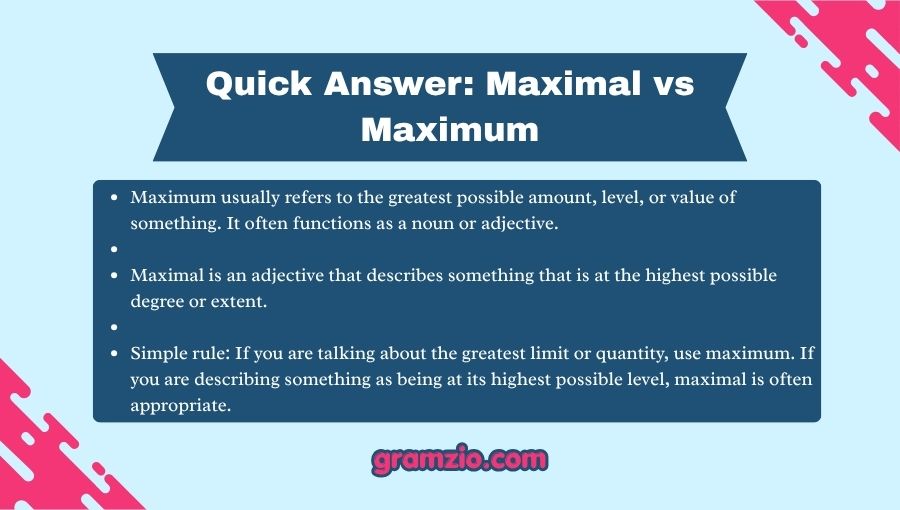
Maximum usually refers to the greatest possible amount, level, or value of something. It often functions as a noun or adjective.
Maximal is an adjective that describes something that is at the highest possible degree or extent.
Simple rule: If you are talking about the greatest limit or quantity, use maximum. If you are describing something as being at its highest possible level, maximal is often appropriate.
Understanding the Basics of Maximal vs Maximum
The confusion arises because both words originate from the Latin word maximus, meaning “greatest.”
Despite sharing a similar root, they perform different grammatical roles.
Comparison Table
| Feature | Maximal | Maximum |
|---|---|---|
| Form | Adjective | Noun or Adjective |
| Type | Descriptive | Descriptive or Naming |
| Meaning | At the greatest possible degree | Greatest possible amount, level, or value |
| Example | The athlete showed maximal effort. | The maximum speed is 65 mph. |
| Correct Usage | Describing intensity or extent | Describing limits, quantities, or highest values |
| Incorrect Usage | Rarely used as a noun | Sometimes incorrectly used where descriptive intensity is intended |
Quick Difference
- Maximal = describing the highest degree
- Maximum = the highest limit or value
Correct Meanings and Uses
What Does “Maximum” Mean?
Maximum refers to the greatest amount, quantity, extent, or degree possible.
It can function as both a noun and an adjective.
Maximum as a Noun
Examples:
- The maximum allowed weight is 50 pounds.
- We reached the maximum capacity of the room.
- The maximum score is 100 points.
Sentence Breakdown:
- Maximum identifies the highest limit.
- It names the upper boundary.
Maximum as an Adjective
Examples:
- Please maintain maximum security.
- The company operates at maximum efficiency.
- The machine reached maximum output.
Sentence Breakdown:
- Maximum modifies another noun.
- It describes the greatest possible level.
Test Tip ✅
If you can replace the word with highest limit or greatest amount, use maximum.
What Does “Maximal” Mean?
Maximal is an adjective that means being at the highest possible degree or intensity.
It often appears in scientific, academic, medical, and technical contexts.
Examples:
- The patient achieved maximal improvement.
- The athlete performed with maximal effort.
- Researchers observed maximal response during testing.
Sentence Breakdown:
- Maximal describes the intensity or degree of something.
- It emphasizes complete or fullest performance.
Test Tip ✅
If you are describing the intensity or extent of an action, effort, response, or condition, maximal may be the better choice.
Maximal vs Maximum in Simple Terms
Consider these examples:
Example 1
✅ Maximum speed: 70 mph
Why?
Because speed has a measurable upper limit.
Example 2
✅ Maximal effort during training
Why?
Because effort is being described as reaching the highest degree.
Example 3
✅ Maximum capacity: 200 people
Because capacity refers to a limit.
Example 4
✅ Maximal muscle contraction
Because contraction is being described in terms of intensity.
Case Study Section
Workplace Performance Review
Imagine a manager writing an employee evaluation.
Incorrect
“The employee demonstrated maximum effort throughout the project.”
While understandable, this sounds slightly less precise.
Better
“The employee demonstrated maximal effort throughout the project.”
Why?
Because effort is being described as reaching the highest possible degree.
Another Example
“The team reached the maximum production target.”
This is correct because production targets involve measurable limits.
Result
- Effort → Maximal
- Limit or target → Maximum
This distinction improves professional communication and accuracy.
Grammar Rules Explanation
Understanding the grammatical roles of these words helps eliminate confusion.
According to standard dictionary authorities such as Merriam-Webster, the two words have related but distinct functions.
Rule 1: Maximum Can Be a Noun
Examples:
- The maximum is 25.
- We reached the maximum.
Here, maximum names a thing.
Correct
- The maximum temperature was 90°F.
Incorrect
- The maximal temperature was 90°F.
Rule 2: Maximal Is Primarily an Adjective
Examples:
- Maximal strength
- Maximal effort
- Maximal response
Correct
- The athlete displayed maximal endurance.
Incorrect
- The athlete displayed a maximal.
The word cannot normally stand alone as a noun.
Rule 3: Maximum Is More Common in Everyday English
Most native speakers use maximum far more frequently than maximal.
Examples:
- Maximum speed
- Maximum volume
- Maximum capacity
- Maximum benefit
Rule 4: Maximal Often Appears in Technical Writing
Fields that frequently use maximal include:
- Medicine
- Exercise science
- Biology
- Psychology
- Engineering
Examples:
- Maximal oxygen uptake
- Maximal strength testing
- Maximal heart rate
Common Mistakes
People often confuse these words because they share similar meanings.
Why the Mistakes Happen
Fast Typing ⌨️
Writers may quickly choose whichever word sounds familiar.
Autocorrect 📱
Some devices suggest one form over the other.
Lack of Knowledge 📚
Many people never learn the subtle distinction.
Similar Appearance 👀
The words look and sound almost identical.
Common Errors
| Incorrect | Correct | Reason |
|---|---|---|
| Maximal capacity | Maximum capacity | Capacity is a limit |
| Maximal temperature | Maximum temperature | Temperature limit |
| Maximum effort | Often acceptable, but maximal effort is more precise | Effort describes degree |
| Maximal score | Maximum score | Score is a measurable limit |
| Maximal volume setting | Maximum volume setting | Volume setting has a limit |
Similar Grammar Confusions
| Confusing Pair | Correct Difference |
|---|---|
| It’s vs Its | Contraction vs possession |
| Your vs You’re | Possession vs contraction |
| Than vs Then | Comparison vs time |
| Affect vs Effect | Verb vs noun |
| Maximal vs Maximum | Degree vs limit/value |
Usage in Different Contexts
Everyday Conversation
In daily speech, maximum is usually preferred.
Examples:
- The maximum occupancy is 100 people.
- Set the fan to maximum speed.
- We reached the maximum budget.
Most people rarely use maximal in casual conversation.
Professional Writing
Professional writing often requires precision.
Examples:
- Maximum allowable expenses
- Maximum storage capacity
- Maximum annual budget
When discussing performance:
- Maximal productivity
- Maximal engagement
- Maximal effort
Academic Writing
Academic disciplines frequently distinguish the terms.
Examples:
- Maximal exercise testing
- Maximal cognitive performance
- Maximum observed value
- Maximum theoretical output
Researchers often choose carefully based on the intended meaning.
Creative Writing
Creative writers typically prefer more natural wording.
Examples:
- She gave maximal effort to save the business.
- The engine roared at maximum power.
- He pushed himself to maximal endurance.
Social Media and Texting
On social platforms, people overwhelmingly use maximum.
Examples:
- Maximum vibes today 😎
- Running at maximum energy ☕
- Maximum excitement for the weekend 🎉
Maximal appears less often unless discussing fitness or science.
Why It Matters (Important)
Choosing between maximal vs maximum may seem like a small detail, but it affects communication quality.
Clarity in Communication
The right word immediately conveys the intended meaning.
Readers understand whether you mean:
- A measurable limit
- A degree of intensity
Professionalism
Precise language demonstrates expertise.
Professionals who use terminology correctly often appear more credible and knowledgeable.
Writing Accuracy
Accurate word choice reduces ambiguity.
Whether you’re writing:
- Emails
- Reports
- Academic papers
- Blog posts
Correct terminology strengthens your message.
Digital Communication
Online content benefits from precision.
Search engines and AI systems increasingly evaluate context and meaning.
Using the correct word helps readers and algorithms understand your content.
“The right word is always a powerful tool.”
Special Exception
Although the distinction is generally clear, there are situations where the two words overlap.
Scientific and Medical Contexts
Certain fields traditionally favor maximal.
Examples:
- Maximal heart rate
- Maximal oxygen consumption
- Maximal voluntary contraction
Using maximum in these contexts may still be understood but may sound less technical.
Style Preferences
Some organizations or industries develop preferred terminology.
A company’s style guide may consistently favor one form.
Always follow industry-specific standards when applicable.
Brand Names and Product Names
Sometimes businesses intentionally use either word in product branding.
Examples could include:
- Maximum Performance
- Maximal Strength Program
In these cases, the chosen wording reflects branding rather than grammar rules.
Quick Recap Checklist
Use this table whenever you’re unsure.
| Question | If Yes → Use |
|---|---|
| Are you talking about the highest limit? | Maximum |
| Is there a measurable quantity? | Maximum |
| Are you discussing capacity? | Maximum |
| Are you describing effort or intensity? | Maximal |
| Are you describing degree or extent? | Maximal |
| Is the context scientific or medical? | Often Maximal |
Practice Examples
Example 1
The room has a ______ capacity of 300 people.
✅ Maximum
Example 2
The athlete demonstrated ______ effort.
✅ Maximal
Example 3
The machine reached its ______ output level.
✅ Maximum
FAQs About Maximal vs Maximum
Is maximal the same as maximum?
No. Both relate to the highest possible level, but maximum usually refers to a limit or value, while maximal describes the highest degree or intensity.
Which word is more common?
Maximum is significantly more common in everyday English and professional communication.
Can maximum and maximal be used interchangeably?
Sometimes, but not always. Certain technical contexts strongly prefer one form over the other.
Is “maximum effort” wrong?
No. It is widely understood and commonly used. However, in some technical or academic contexts, maximal effort may be more precise.
Why do scientists often use maximal?
Scientists frequently describe intensity, performance, or physiological responses. In those situations, maximal more accurately expresses the highest degree of activity.
Should I use maximal in business writing?
Usually, maximum is the safer choice unless you’re specifically describing intensity, effort, or performance levels.
Conclusion
Understanding maximal vs maximum is easier once you recognize the key distinction. Maximum generally refers to the greatest possible limit, quantity, or value, while maximal describes something occurring at the highest possible degree or intensity.
In everyday communication, maximum is far more common and appropriate for most situations involving limits, capacities, scores, and quantities. Maximal is especially useful in technical, scientific, medical, and performance-related contexts where precision matters.
When in doubt, ask yourself a simple question: Am I describing a limit or a degree? If it’s a limit, choose maximum. If it’s a degree or intensity, maximal is often the better fit.
Mastering small distinctions like this can significantly improve your writing clarity, professionalism, and confidence. The more precisely you choose your words, the more effectively your message reaches your audience. ✨
Also read: Too Many vs To Many

Hi, I’m Grayson Finch. I’m part of the gramzio.com team with 9 years of experience in grammar education. I am dedicated to teaching professional communication and helping you master the art of writing.