Fewer vs Less: The Complete Guide to Mastering This Common Grammar Confusion
Have you ever paused while writing a sentence and wondered about Fewer vs Less? You’re not alone. This is one of the most common grammar confusions in English, and even native speakers often mix up these two words in everyday speech and writing. The confusion happens because both fewer and less refer to quantity, but they are used in completely different grammatical situations.
For example, should you say “less water” or “fewer water”? What about “less problems” or “fewer problems”? The difference may seem small, but using the wrong word can make your writing sound less professional and less accurate.
In this complete guide, we will break down Fewer vs Less in the simplest way possible. You will learn the exact rules, see real-life examples, explore common mistakes, and discover practical tips to never confuse them again. By the end, you will confidently choose the correct word every time you write or speak. ✍️
Quick Answer: Fewer vs Less
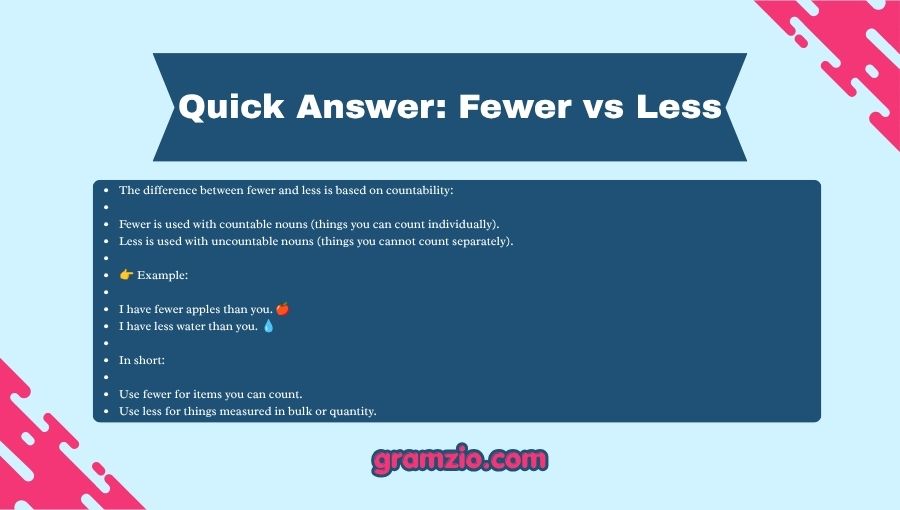
The difference between fewer and less is based on countability:
- Fewer is used with countable nouns (things you can count individually).
- Less is used with uncountable nouns (things you cannot count separately).
👉 Example:
- I have fewer apples than you. 🍎
- I have less water than you. 💧
In short:
- Use fewer for items you can count.
- Use less for things measured in bulk or quantity.
Understanding the Basics of Fewer vs Less
To fully understand Fewer vs Less, you first need to understand two types of nouns in English grammar:
1. Countable Nouns (Use “Fewer”)
These are things you can count individually:
- Books 📚
- Cars 🚗
- Students 🎓
- Apples 🍎
👉 Example:
- There are fewer students in the class today.
2. Uncountable Nouns (Use “Less”)
These are things you cannot count one by one:
- Water 💧
- Sugar 🍬
- Money 💰
- Time ⏰
👉 Example:
- I have less money this month.
Comparison Table: Fewer vs Less
| Form | Type | Meaning | Example Sentence | Correct/Incorrect |
|---|---|---|---|---|
| Fewer | Countable noun | Smaller number of items | Fewer chairs in the room | Correct |
| Less | Uncountable noun | Smaller amount or quantity | Less milk in the glass | Correct |
| Fewer | Uncountable noun | Incorrect usage | Fewer water | Incorrect ❌ |
| Less | Countable noun | Incorrect usage (formal rule) | Less books | Incorrect ❌ |
Correct Meanings & Uses
1. When to Use “Fewer”
Use fewer when talking about items you can count individually.
Examples:
- There are fewer cars on the road today.
- She has fewer assignments this semester.
- We need fewer chairs for the meeting.
👉 Sentence breakdown:
- “Fewer cars” = cars are individual items → countable → correct usage
🧠 Test Tip:
Ask yourself: Can I count it one by one?
- If YES → Use fewer
2. When to Use “Less”
Use less when referring to things measured in quantity, not individual units.
Examples:
- I drink less coffee now.
- There is less traffic today.
- He has less patience than before.
👉 Sentence breakdown:
- “Less coffee” = coffee is measured as a quantity, not individual units → correct usage
🧠 Test Tip:
Ask yourself: Can I count it individually?
- If NO → Use less
⚠️ Important Modern Note:
In informal English, especially in spoken language, people sometimes say “less people” instead of “fewer people.” However, in formal writing, exams, and professional communication, this is still considered incorrect.
Case Study: Real-Life Usage Example
Scenario: Office Email
❌ Incorrect:
We have less employees available for the project this week.
✔ Correct:
We have fewer employees available for the project this week.
Now compare:
✔ Correct:
We have less workload this week.
Explanation:
- “Employees” are countable → fewer employees
- “Workload” is uncountable → less workload
👉 This shows how both words can appear in the same context but must be used correctly based on noun type.
Grammar Rules Explanation
The Fewer vs Less rule is supported by standard grammar authorities such as Merriam-Webster and traditional English grammar guides.
Core Rule:
- Fewer = countable nouns
- Less = uncountable nouns
Why this rule exists:
English separates nouns into:
- Discrete units (countable)
- Continuous quantities (uncountable)
This helps maintain clarity in communication.
Example:
- Fewer apples (you can count apples)
- Less water (you measure water, not count it individually)
Common Mistakes in Fewer vs Less
People often confuse fewer vs less due to everyday speech habits and modern usage trends.
Why mistakes happen:
- Fast typing ⌨️
- Autocorrect errors
- Lack of grammar knowledge
- Influence of spoken English
Common Confusion Table
| Incorrect Usage | Correct Usage | Reason |
|---|---|---|
| Less people | Fewer people | People are countable |
| Less books | Fewer books | Books are countable |
| Fewer money | Less money | Money is uncountable |
| Less chairs | Fewer chairs | Chairs are countable |
Additional Confusing Word Pairs:
- It’s vs Its
- Your vs You’re
- Much vs Many
- Affect vs Effect
Usage in Different Contexts
1. Everyday Conversation 🗣️
- I eat less sugar now.
- There are fewer buses today.
2. Professional Writing 💼
- The company reported fewer errors in production.
- We need less downtime for better performance.
3. Creative Writing ✍️
- She felt less fear as she walked through the forest.
- There were fewer stars in the cloudy sky.
4. Social Media/Texting 📱
- Less drama, more peace ✌️
- Fewer worries, better life 🌿
Why It Matters (Important)
Using fewer vs less correctly is important because it:
- Improves clarity in communication
- Enhances professional credibility
- Shows strong grammar skills
- Reduces misunderstandings
📌 As writer William Zinsser said:
“Clarity is the most important element of writing.”
Correct grammar ensures your message is clear and professional, especially in emails, exams, and business communication.
Special Exception
There is one notable exception in modern English usage:
👉 With time, money, distance, and weight, “less” is commonly used, even though technically these can sometimes be counted.
Examples:
- Less than 10 miles
- Less than 5 hours
- Less than $50
Even though “dollars” and “hours” are countable units, English treats them as measurements in this context.
Quick Recap Checklist
| Question | If Yes → Use |
|---|---|
| Can I count it individually? | Fewer |
| Is it a measurement or quantity? | Less |
Practice Examples:
- There are ___ students in the class. → Fewer
- I have ___ time today. → Less
- She bought ___ oranges. → Fewer
FAQs: Fewer vs Less
1. What is the main difference between fewer and less?
Fewer is used for countable nouns, while less is used for uncountable nouns.
2. Is “less people” correct?
In formal English, no. The correct phrase is “fewer people” because people can be counted.
3. Can “less” ever be used with countable nouns?
In informal spoken English, yes. However, in formal writing, it is incorrect.
4. Why do people confuse fewer and less?
Because spoken English often ignores strict grammar rules, and people generalize “less” for simplicity.
5. Is “less money” or “fewer money” correct?
“Less money” is correct because money is treated as an uncountable quantity.
6. What is the easiest way to remember the rule?
If you can count it → fewer
If you cannot count it → less
Conclusion
Understanding the difference between Fewer vs Less is essential for clear and correct English communication. The rule is simple but powerful: use fewer for countable nouns and less for uncountable nouns.
Although modern speech sometimes blurs the rule, formal writing still strictly follows it. Whether you’re writing emails, preparing for exams, or improving your grammar skills, mastering this difference will make your English sound more polished and professional.
So next time you hesitate, just remember:
👉 Count it? Use fewer.
👉 Measure it? Use less.
Small grammar choices make a big difference in communication—and now you’ve mastered one of the most important ones. ✨
Also read: Discreet vs Discrete

Hi, I’m Willa Sterling. I work at gramzio.com as a senior editor. With 15 years of experience in academic and formal grammar, I provide the expert insights you need to make your writing flawless.