Discreet vs Discrete: Meaning, Difference, Usage & Examples (Complete Guide)
The confusion between discreet vs discrete is one of the most common English grammar mistakes that even advanced writers make. 🤔 These two words look almost identical, sound the same, but their meanings are completely different. Because of this similarity, many people accidentally use the wrong word in writing, which can completely change the meaning of a sentence.
For example, “discreet behavior” refers to someone being careful and private, while “discrete units” refers to separate and individual parts. Mixing them up can lead to misunderstanding, especially in professional or academic writing.
In this article, we will clearly break down discreet vs discrete, explain their meanings, differences, usage rules, examples, and common mistakes. By the end, you will confidently know exactly which word to use in any situation. ✨
Quick Answer: Discreet vs Discrete
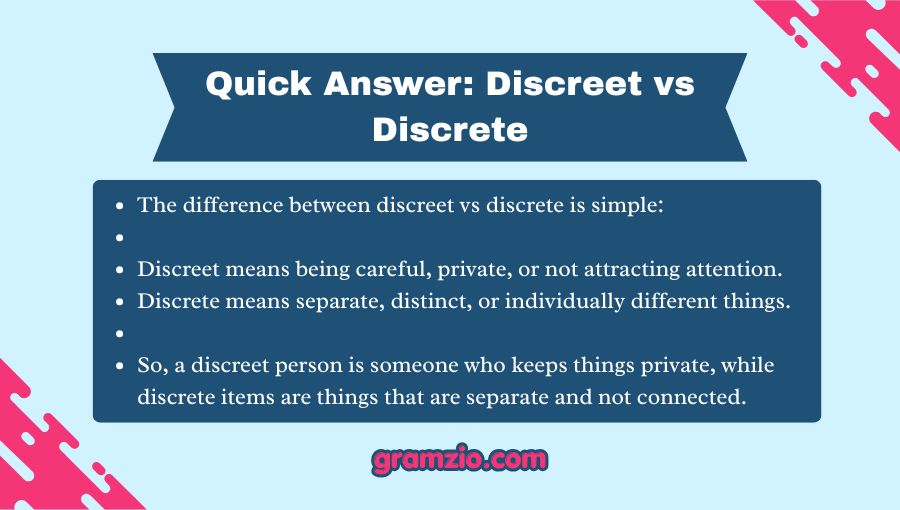
The difference between discreet vs discrete is simple:
- Discreet means being careful, private, or not attracting attention.
- Discrete means separate, distinct, or individually different things.
So, a discreet person is someone who keeps things private, while discrete items are things that are separate and not connected.
Understanding the Basics: Discreet vs Discrete
To fully understand discreet vs discrete, we need to break down each word individually.
1. Discreet (Meaning & Usage)
Discreet refers to behavior that is:
- Careful
- Private
- Not attracting attention
- Respectful of confidentiality
👉 It is often used in social, emotional, or professional contexts.
Example:
- She was very discreet about her personal life.
- The manager gave a discreet signal to stop the conversation.
2. Discrete (Meaning & Usage)
Discrete refers to things that are:
- Separate
- Distinct
- Individually different
- Not connected as a whole
👉 It is commonly used in mathematics, science, and technical writing.
Example:
- The system is divided into discrete units.
- Data is stored in discrete categories.
Comparison Table: Discreet vs Discrete
| Feature | Discreet 🕵️ | Discrete 🔢 |
|---|---|---|
| Form | Adjective | Adjective |
| Type | Behavioral / Social | Structural / Technical |
| Meaning | Careful, private, subtle | Separate, distinct, individual |
| Example | He was discreet about the surprise party | The app has discrete modules |
| Correct Usage | Talking about privacy | Talking about separation |
| Incorrect Usage | “Discrete behavior” ❌ | “Discreet units” ❌ |
Correct Meanings & Uses Explained
A. When to Use “Discreet”
Use discreet when talking about:
- Privacy 🔒
- Sensitive information
- Careful communication
- Polite or subtle behavior
Example Breakdown:
- She made a discreet phone call during the meeting.
👉 Meaning:
- She made a call quietly
- She did not want attention
- She acted carefully
Test Tip 🧠
If you can replace the word with “careful” or “private”, then discreet is correct.
B. When to Use “Discrete”
Use discrete when talking about:
- Separate units
- Independent parts
- Distinct categories
- Technical systems
Example Breakdown:
- The camera system has discrete sensors.
👉 Meaning:
- Sensors are separate
- Each part works independently
- They are not combined
Test Tip 🧠
If you can replace the word with “separate” or “distinct”, then discrete is correct.
Case Study: Real-Life Usage
Workplace Email Example 📧
Incorrect:
- “We need to handle this in a discrete manner.” ❌
Correct:
- “We need to handle this in a discreet manner.” ✅
👉 Explanation:
The sentence is about privacy and sensitivity, so “discreet” is correct.
Technical Report Example 🧾
Incorrect:
- “The software is divided into discreet modules.” ❌
Correct:
- “The software is divided into discrete modules.” ✅
👉 Explanation:
The sentence is about separate system parts, so “discrete” is correct.
Grammar Rules Explanation
According to major dictionaries like Merriam-Webster, both words are correct but have entirely different origins and meanings:
- Discreet comes from Latin discretus, meaning “careful or separated in judgment.”
- Discrete also comes from Latin discretus, but evolved to mean “separate or distinct.”
Even though they share historical roots, modern English usage has completely separated their meanings.
Why Confusion Happens
- They sound identical when spoken
- Only one letter difference in spelling
- Auto-correct mistakes
- Lack of awareness of meaning difference
Common Mistakes
Why People Confuse Discreet vs Discrete
- Fast typing ⌨️
- Autocorrect errors 📱
- Lack of grammar knowledge 📚
- Similar pronunciation 🔊
Similar Grammar Confusions Table
| Confusion Pair | Correct Meaning |
|---|---|
| Its vs It’s | Possession vs contraction |
| Your vs You’re | Ownership vs “you are” |
| Affect vs Effect | Action vs result |
| Discreet vs Discrete | Private vs separate |
| Then vs Than | Time vs comparison |
Usage in Different Contexts
1. Everyday Conversation 🗣️
- She is very discreet about her personal life.
- Each task is handled as a discrete step.
2. Professional Writing 💼
- Managers must be discreet when handling HR issues.
- The project is divided into discrete phases.
3. Creative Writing ✍️
- He gave her a discreet smile in the crowd.
- The story unfolds in discrete chapters.
4. Social Media/Texting 📱
- Keep it discreet 🤫
- Each update is a discrete post
Why It Matters
Using discreet vs discrete correctly is important because:
- It improves clarity in communication
- It shows professionalism
- It prevents misunderstanding
- It enhances writing quality
📌 As writer William Zinsser said:
“Clarity is the most important virtue in writing.”
A small spelling mistake can completely change meaning—especially in professional writing.
Special Exception
There are no major exceptions where these words can be interchangeable. Even in informal writing, the distinction remains strict.
However:
- “Discreet” is more common in daily speech.
- “Discrete” is more common in technical/scientific writing.
Quick Recap Checklist
| Question | If YES → Use |
|---|---|
| Is it about privacy or secrecy? | Discreet |
| Is it about separation or individuality? | Discrete |
Practice Examples
- She gave a ______ signal during the meeting.
- The system contains ______ components.
- He remained ______ about the surprise plan.
FAQs: Discreet vs Discrete
1. What is the main difference between discreet and discrete?
Discreet means careful or private, while discrete means separate or distinct.
2. Is discreet used for people or things?
It is mainly used for people and behavior involving privacy or sensitivity.
3. Is discrete a scientific term?
Yes, it is commonly used in mathematics, physics, and computing.
4. Why do people confuse these words?
Because they sound identical and differ only by one letter.
5. Can I use them interchangeably?
No, they have completely different meanings and are not interchangeable.
6. Which word is more common?
“Discreet” is more common in everyday language, while “discrete” is used in technical contexts.
Conclusion
Understanding discreet vs discrete is essential for clear and accurate communication. Although these words look and sound almost the same, their meanings are completely different. Discreet refers to being careful, private, and subtle, while discrete refers to things that are separate, distinct, and individual.
Using the correct word not only improves your grammar but also enhances your professionalism and clarity in writing. Whether you are writing emails, academic papers, or social media posts, this small distinction makes a big difference.
So next time you hesitate between the two, just remember:
👉 Privacy = Discreet
👉 Separation = Discrete
Master this difference, and your English writing will instantly become sharper and more accurate. ✨
Also read: Elicit vs Illicit

Hi, I’m Axton Vane. I work at gramzio.com and bring over 11 years of experience in professional grammar. I specialize in refining complex syntax to help writers achieve perfect clarity in every sentence.