Bring vs Take: The Complete Guide to Understanding the Difference (With Easy Examples 😊)
Have you ever said, “I will bring you to the airport” and later wondered if it sounded wrong? Or maybe you asked someone, “Can you take this gift to my friend?” and felt unsure if “bring” would have been better. If yes, you are not alone. The confusion between bring vs take is one of the most common English grammar challenges for learners and even native speakers.
Both words involve moving something or someone from one place to another, but the difference depends on direction and perspective. This small detail changes the meaning completely. That is why people often mix them up in conversations, emails, and even professional writing.
In this article, you will learn the clear difference between bring and take, when to use each one, common mistakes, real-life examples, and simple memory tricks to never get confused again. By the end, you will feel confident using both words correctly in everyday English. Let’s make this simple once and for all 😊
Quick Answer: Bring vs Take
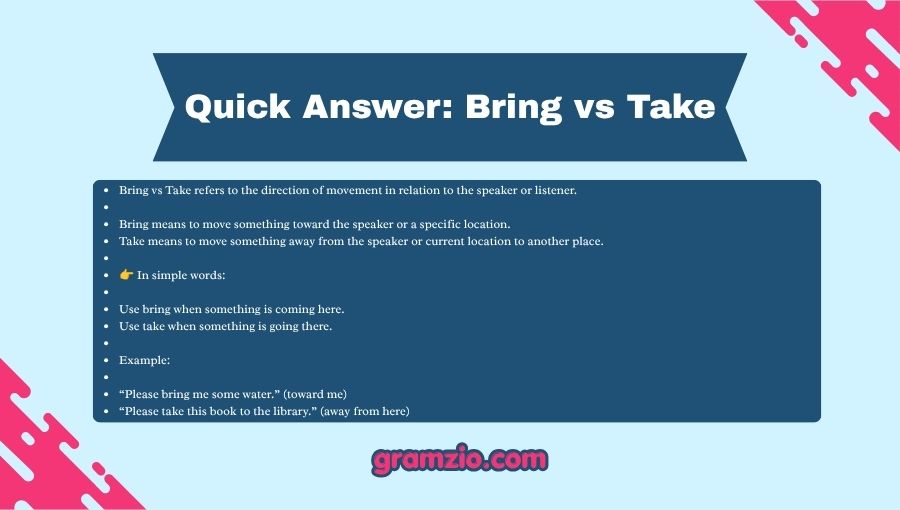
Bring vs Take refers to the direction of movement in relation to the speaker or listener.
- Bring means to move something toward the speaker or a specific location.
- Take means to move something away from the speaker or current location to another place.
👉 In simple words:
- Use bring when something is coming here.
- Use take when something is going there.
Example:
- “Please bring me some water.” (toward me)
- “Please take this book to the library.” (away from here)
Understanding the Basics of Bring vs Take
The main difference between bring vs take depends on direction and perspective. This is a core concept in English grammar that confuses many learners because it is not just about movement—it is about where the speaker is located.
Simple Rule:
- Bring = toward the speaker
- Take = away from the speaker
Comparison Table
| Form | Type | Meaning | Example | Correct/Incorrect |
|---|---|---|---|---|
| Bring | Verb | To carry something toward a place or person | “Bring your laptop to my office.” | Correct |
| Take | Verb | To carry something away from a place or person | “Take this file to the manager.” | Correct |
| Bring | Verb | Moving away from speaker | “Bring this document to the school (when going away)” | Incorrect |
| Take | Verb | Moving toward speaker | “Take this glass to me” | Incorrect |
Correct Meanings & Uses of Bring vs Take
Let’s break this down into simple sections so you can fully understand how to use each word correctly.
1. Using “Bring” (Toward the Speaker)
We use bring when something or someone is coming closer to the speaker or listener.
Examples:
- “Please bring your friend to the party.” 🎉
- “Can you bring me a pen?”
- “She will bring dinner to our house tonight.”
Sentence Breakdown:
- Action: bring
- Direction: toward speaker
- Object: pen, friend, dinner
Test Tip 🧠:
Ask yourself: Is it coming to me or my location?
If yes → use bring
2. Using “Take” (Away from the Speaker)
We use take when something is moving away from the speaker or current location.
Examples:
- “Take this package to the post office.” 📦
- “He took his sister to school.”
- “Please take the trash outside.”
Sentence Breakdown:
- Action: take
- Direction: away from speaker
- Object: package, sister, trash
Test Tip 🧠:
Ask yourself: Is it going away from me?
If yes → use take
3. The Role of Perspective in Bring vs Take
The biggest confusion comes from perspective.
For example:
- If I am at home and say: “Bring me water” → water comes to me.
- If I am at home and say: “Take water to the kitchen” → water leaves me and goes elsewhere.
👉 The same object can use either word depending on direction.
Case Study: Real-Life Conversation Example
Let’s see how bring vs take works in real life.
Scenario: Office Email
Incorrect Email:
“Please bring this report to the head office tomorrow.”
This is only correct if the speaker is at the head office.
Correct Email:
“Please take this report to the head office tomorrow.”
Scenario: Friend Conversation
- A: “I’m going to the park. Do you want me to bring your headphones?”
- B: “Yes, bring them to me later.”
Here:
- Park = destination
- “Bring” is used because headphones come back toward the listener later.
Grammar Rules Explanation (Authority-Based Insight)
According to standard English grammar rules (as described in references like Merriam-Webster usage guidance), bring and take are directional verbs based on viewpoint.
Key Rule:
- “Bring” is used for movement toward the speaker or a specific destination associated with the speaker.
- “Take” is used for movement away from the speaker or origin point.
Why People Get Confused:
English does not always follow strict physical logic. Instead, it follows speaker-centered logic. That is why direction depends on where the speaker is located in the conversation.
Common Mistakes in Bring vs Take
People often confuse these words due to fast speech, texting habits, and autocorrect errors.
Common Errors Table
| Confusion | Correct Form | Reason for Mistake |
|---|---|---|
| Bring vs Take | Bring = toward, Take = away | Misunderstanding direction |
| Its vs It’s | It’s = it is | Fast typing |
| Your vs You’re | You’re = you are | Autocorrect + speed |
| There vs Their | Their = possession | Lack of grammar clarity |
Why These Mistakes Happen:
- Fast typing on mobile phones 📱
- Autocorrect suggestions
- Lack of grammar practice
- Speaking influence from native language
Usage in Different Contexts
1. Everyday Conversation 🗣️
- “Bring your phone here.”
- “Take this food home.”
2. Professional Writing 💼
- “Please take the documents to HR.”
- “Kindly bring your ID to the meeting.”
3. Creative Writing ✍️
- “The wind brought memories back.”
- “He took her heart away.”
4. Social Media/Texting 📲
- “Bring snacks!! 😋”
- “I’ll take this pic to Instagram.”
Why It Matters (Important)
Using bring vs take correctly improves:
- Clarity in communication
- Professional tone in writing
- Avoiding misunderstandings
- Better English fluency
“Small grammar details create big differences in understanding.”
Even a simple mistake can change meaning in emails, workplace communication, or instructions.
Special Exception
There are no strict exceptions to bring vs take rules, but idiomatic expressions may behave differently.
Example:
- “Take care” (does not involve physical movement)
- “Bring it on” (means challenge accepted)
These are fixed phrases and should be memorized.
Quick Recap Checklist
| Question | If Yes → Use |
|---|---|
| Is something coming toward the speaker? | Bring |
| Is something going away from the speaker? | Take |
| Is direction unclear? | Check speaker location |
Practice Examples:
- “___ this gift to your mom.” → Take
- “Please ___ me some water.” → Bring
- “She will ___ her laptop to school.” → Take
FAQs: Bring vs Take
1. What is the main difference between bring and take?
Bring means moving something toward the speaker, while take means moving it away.
2. Can bring and take be used interchangeably?
No, they cannot. Their meaning depends on direction and perspective.
3. Is it correct to say “bring to school”?
Yes, if the speaker is at the school or the destination is school from the speaker’s perspective.
4. What is an easy trick to remember bring vs take?
Use this rule: Bring = come here, Take = go there.
5. Why do native speakers still confuse bring and take?
Because usage depends on context and perspective, which can change in conversation.
6. Are bring and take used in idioms?
Yes, for example:
- “Bring it on”
- “Take care”
Conclusion
Understanding the difference between bring vs take is essential for clear and correct English communication. While both words involve movement, the key factor is direction relative to the speaker. If something is moving toward you or your location, use bring. If it is moving away from you, use take.
This simple rule will help you avoid confusion in everyday conversations, academic writing, and professional communication. With practice, choosing between bring and take will become automatic and natural.
Mastering small grammar differences like this makes your English more accurate, confident, and professional. So next time you speak or write, just remember: bring comes here, take goes there 😊.
Also read: Among vs Between

Hi, I’m Grayson Finch. I’m part of the gramzio.com team with 9 years of experience in grammar education. I am dedicated to teaching professional communication and helping you master the art of writing.