Elicit vs Illicit: Meaning, Differences, Usage, and Common Grammar Confusion Explained 📚✨
Have you ever read a sentence and paused because two words looked almost identical but meant completely different things? 🤔 One of the most common English grammar confusions is “Elicit vs Illicit.” These two words sound similar, look almost alike, and are often mixed up in writing—especially in fast typing, texting, or casual communication.
However, their meanings are completely unrelated. One is about drawing out information or response, while the other is about something illegal or forbidden. This small spelling difference can completely change the meaning of a sentence, which makes it extremely important to understand them correctly.
Many students, writers, and even professionals confuse these terms, leading to grammar mistakes in emails, essays, and social media posts. In this detailed guide, we will break down everything you need to know about elicit vs illicit, including meanings, usage rules, examples, common mistakes, and expert grammar tips. By the end, you’ll never confuse them again. ✅
Quick Answer: Elicit vs Illicit
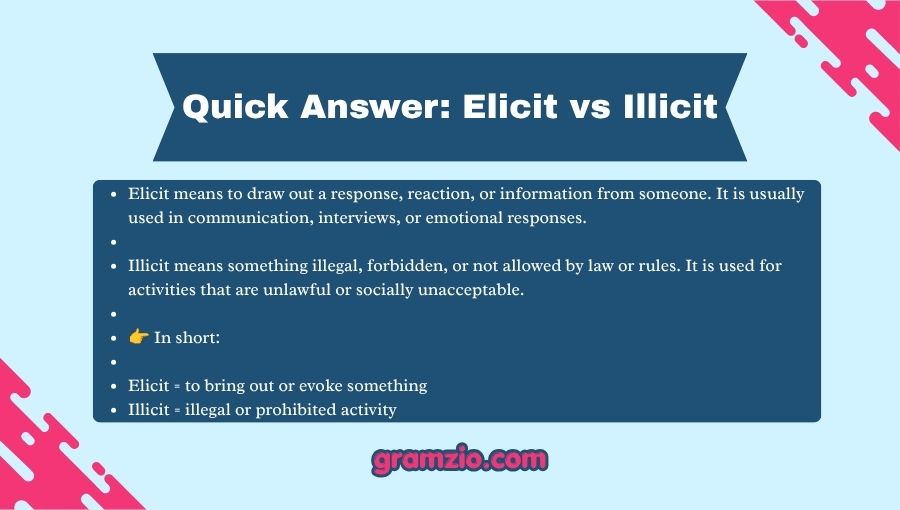
Elicit means to draw out a response, reaction, or information from someone. It is usually used in communication, interviews, or emotional responses.
Illicit means something illegal, forbidden, or not allowed by law or rules. It is used for activities that are unlawful or socially unacceptable.
👉 In short:
- Elicit = to bring out or evoke something
- Illicit = illegal or prohibited activity
Understanding the Basics: Elicit vs Illicit
The confusion between these two words comes from their similar pronunciation, but their meanings and usage are very different.
🔹 Elicit (Verb)
- Type: Verb
- Meaning: To draw out, bring forth, or evoke a response, answer, or reaction
- Usage Context: Communication, psychology, interviews, discussions
Example:
- The teacher tried to elicit answers from the students.
- Her speech elicited a strong emotional response.
👉 Here, “elicit” means to bring out something from someone.
🔹 Illicit (Adjective)
- Type: Adjective
- Meaning: Illegal, forbidden, or not allowed by law or rules
- Usage Context: Law, crime, ethics, rules
Example:
- The police discovered illicit drugs in the warehouse.
- They were involved in illicit activities.
👉 Here, “illicit” means something illegal or not permitted.
📊 Comparison Table: Elicit vs Illicit
| Feature | Elicit | Illicit |
|---|---|---|
| Form | Verb | Adjective |
| Type | Action word | Descriptive word |
| Meaning | To draw out response/information | Illegal or forbidden |
| Example | The question elicited answers | Illicit trade was reported |
| Correct Usage | Communication & reaction | Law & wrongdoing |
Correct Meanings & Uses Explained
🧠 1. Elicit – To Draw Out Information or Reaction
The word elicit is used when someone causes a response, feeling, or information to come out.
Example 1:
- The detective tried to elicit the truth from the suspect.
👉 Breakdown:
- “Detective” = subject
- “tried to elicit” = action
- “truth” = object being drawn out
Example 2:
- The comedian’s joke elicited laughter from the audience.
👉 Here, laughter is the response being “brought out.”
💡 Test Tip:
If you can replace the word with “bring out” or “evoke,” then “elicit” is correct.
🚫 2. Illicit – Something Illegal or Not Allowed
The word illicit refers to anything that breaks laws, rules, or moral standards.
Example 1:
- Illicit gambling is strictly prohibited in this area.
Example 2:
- He was arrested for illicit trafficking.
👉 In both cases, the activities are illegal.
💡 Test Tip:
If the sentence involves crime, law, or forbidden actions, use “illicit.”
📌 Case Study Section: Real-Life Example
Workplace Email Scenario
❌ Incorrect usage:
The manager tried to illicit feedback from employees.
✔ Correct usage:
The manager tried to elicit feedback from employees.
Explanation:
- The manager is trying to get feedback → so “elicit” is correct
- “Illicit” would incorrectly suggest illegal feedback 😄
📚 Grammar Rules Explanation
According to standard English dictionaries like Merriam-Webster, the distinction is clear:
- Elicit comes from Latin elicere, meaning “to draw out.”
- Illicit comes from Latin illicitus, meaning “not allowed.”
Why confusion happens:
- Both words sound similar (/ɪˈlɪsɪt/)
- Only one letter difference
- Fast typing leads to mistakes
- Autocorrect often fails to correct context
👉 Grammar Rule Summary:
- Use elicit when dealing with responses or reactions.
- Use illicit when dealing with legality or prohibition.
⚠️ Common Mistakes
Why People Confuse Elicit vs Illicit
- Fast typing ⌨️
- Auto-correct errors 📱
- Lack of grammar awareness 📚
- Similar pronunciation 🔊
📊 Table of Similar Grammar Confusions
| Word Pair | Common Mistake |
|---|---|
| Elicit / Illicit | Meaning confusion |
| Its / It’s | Possession vs contraction |
| Your / You’re | Ownership vs “you are” |
| Affect / Effect | Verb vs noun confusion |
| Accept / Except | Inclusion vs exclusion |
🧾 Usage in Different Contexts
🗣️ Everyday Conversation
- The teacher tried to elicit answers from students.
- Avoid illicit behavior in public places.
💼 Professional Writing
- Reports should elicit clear responses from readers.
- Companies must avoid illicit financial practices.
🎨 Creative Writing
- The story elicited deep emotions from readers.
- The novel explored illicit love affairs.
📱 Social Media/Texting
- That meme elicited so much laughter 😂
- He was caught doing something illicit 😬
🌟 Why It Matters
Understanding elicit vs illicit is important because:
- It improves communication clarity
- It prevents misunderstandings
- It enhances professional writing quality
- It builds strong grammar confidence
📢 As linguists often say:
“Precision in language creates clarity in thought.”
Even a small spelling difference can completely change meaning, especially in formal writing.
🔍 Special Exception
There are no major exceptions for elicit vs illicit in modern English usage. However:
- “Illicit” is sometimes used in creative writing for dramatic effect.
- “Elicit” is widely used in academic, psychological, and journalistic writing.
🧠 Quick Recap Checklist
| Question | If Yes → Use |
|---|---|
| Is it about getting a response? | Elicit |
| Is it about illegal activity? | Illicit |
| Is it related to emotions or answers? | Elicit |
| Is it related to crime or law violation? | Illicit |
Practice Examples
- The survey aims to ______ honest feedback.
👉 Answer: elicit - He was involved in ______ trade.
👉 Answer: illicit - The speech ______ applause from the audience.
👉 Answer: elicited
❓ FAQs: Elicit vs Illicit
1. What is the main difference between elicit and illicit?
Elicit means to draw out a response, while illicit means illegal or forbidden.
2. Is elicit a verb or adjective?
Elicit is a verb used to describe the action of bringing out responses or reactions.
3. Can illicit be used in formal writing?
Yes, illicit is commonly used in legal, academic, and formal writing to describe illegal activities.
4. Why do people confuse elicit and illicit?
Because they sound similar and differ by only one letter, leading to typing and spelling errors.5. What is a simple trick to remember elicit vs illicit?
- Elicit = E for Emotion/Extract
- Illicit = I for Illegal
6. Are elicit and illicit interchangeable?
No, they are completely different words with unrelated meanings.
🏁 Conclusion
The confusion between elicit vs illicit is very common, but once you understand their meanings, it becomes easy to use them correctly. Elicit is all about drawing out responses, reactions, or information, while illicit refers to something illegal or not permitted.
Remember this simple rule:
👉 If it’s about communication, use elicit.
👉 If it’s about law or crime, use illicit.
Mastering such grammar differences improves not only your writing skills but also your clarity and professionalism. Keep practicing with real examples, and soon you’ll never mix them up again. 🚀
Also read: Complement vs Compliment

Hi, I’m Dexter Rhodes. At gramzio.com, I apply my 10 years of experience in copy-editing to ensure every guide we publish is accurate, professional, and follows the highest editorial standards.