Year Old vs Years Old: Which One Is Correct? 👶✍️ Complete Grammar Guide
Have you ever paused while writing a sentence like, “My daughter is five year old” and wondered whether it should be year old or years old? 🤔 The confusion between Year Old vs Years Old is one of the most common grammar mistakes in English writing because both forms look almost correct at first glance.
The confusion around Year Old vs Years Old usually happens because English changes words depending on how they function in a sentence. Sometimes year stays singular, while other times years becomes plural. Add hyphens into the mix, and many writers become unsure.
This small grammar rule matters more than people think. Using the wrong form can make writing sound awkward or unprofessional. Whether you are writing emails, school assignments, resumes, social media captions, or stories, understanding the difference improves clarity and confidence.
In this guide, you will learn exactly when to use year old and years old, see practical examples, discover common mistakes, and learn easy tricks to remember the rule forever. 📘
Quick Answer: Year Old vs Years Old
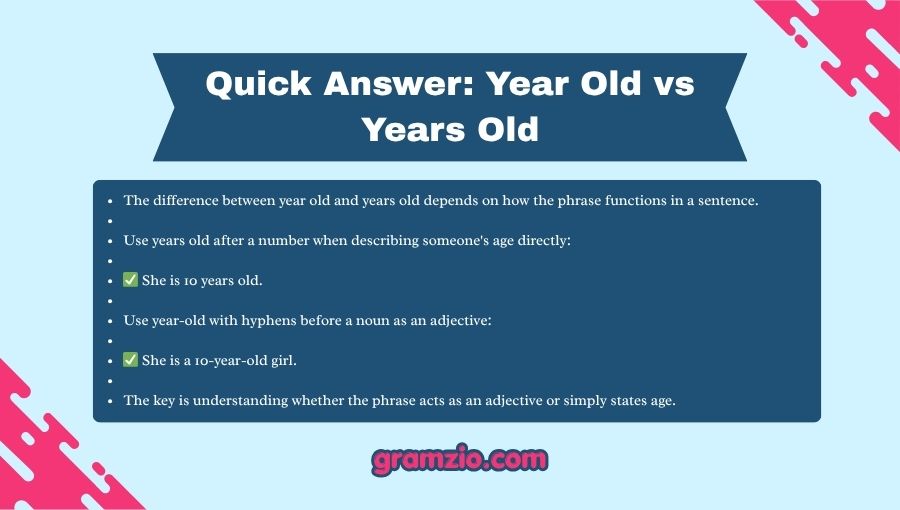
The difference between year old and years old depends on how the phrase functions in a sentence.
Use years old after a number when describing someone’s age directly:
✅ She is 10 years old.
Use year-old with hyphens before a noun as an adjective:
✅ She is a 10-year-old girl.
The key is understanding whether the phrase acts as an adjective or simply states age.
Understanding the Basics: Year Old vs Years Old
The biggest difference is grammatical function.
- Years old = age expression after a verb
- Year-old = compound adjective before a noun
Here is a simple comparison table:
| Form | Type | Meaning | Example | Correct/Incorrect |
|---|---|---|---|---|
| years old | Age phrase | States age | He is 8 years old. | ✅ Correct |
| year-old | Compound adjective | Describes noun | An 8-year-old boy | ✅ Correct |
| year old | Missing hyphen adjective | Incorrect before noun | An 8 year old boy | ❌ Incorrect |
| years-old | Wrong plural adjective | Incorrect | An 8-years-old child | ❌ Incorrect |
Notice something important: when year-old becomes an adjective, year stays singular.
Correct Meanings & Uses
Using “Years Old” to State Age 🎂
Use years old when directly telling someone’s age.
Structure:
Number + years old
Examples:
✅ My sister is 12 years old.
Sentence breakdown:
- 12 = number
- years = plural noun
- old = descriptive word
Another example:
✅ The building is 100 years old.
The phrase simply tells age.
Test Tip 📝
Remove old from the sentence.
Example:
My sister is 12 years old.
Becomes:
My sister is 12 years.
That sounds logical structurally, so years old works.
Using “Year-Old” as an Adjective 👦
Use year-old before a noun.
Structure:
Number + year-old + noun
Examples:
✅ We adopted a two-year-old cat.
Sentence breakdown:
- two-year-old modifies cat
- It acts as one adjective unit
More examples:
✅ A five-year-old child entered the room.
✅ The company hired a 22-year-old engineer.
Test Tip 📝
Ask:
“Is it directly describing a noun?”
If yes, use year-old.
Case Study Section
Imagine an email written by a manager:
❌ We hired a 25 years old designer.
Something feels wrong.
Correct version:
✅ We hired a 25-year-old designer.
Now imagine a conversation:
Person A: How old is Sarah?
Person B: Sarah is 25 years old.
Different sentence structures require different forms.
This real-world example shows why context matters.
Grammar Rules Explanation
English uses compound adjectives before nouns. According to standard grammar guidance and dictionary conventions such as those followed by dictionaries like Merriam-Webster, compound modifiers placed before nouns are commonly hyphenated.
Examples:
- full-time employee
- well-known actor
- five-year-old student
When a number and noun combine into one adjective, the noun usually becomes singular.
Compare:
✅ A ten-mile walk
Not:
❌ A ten-miles walk
Likewise:
✅ A ten-year-old boy
Not:
❌ A ten-years-old boy
The noun inside a compound adjective remains singular.
Why Does “Year” Become Singular? 🤔
Many learners ask:
“If the person is five years old, why isn’t it five-years-old child?”
Because compound adjectives follow a special grammar rule.
Examples:
| Correct | Incorrect |
|---|---|
| a five-year-old child | a five-years-old child |
| a two-hour trip | a two-hours trip |
| a three-mile run | a three-miles run |
The noun becomes singular when it joins the adjective phrase.
Common Mistakes
People make errors with Year Old vs Years Old for several reasons:
Fast Typing ⌨️
People write quickly and forget hyphens.
Example:
❌ A 7 year old dog
Correct:
✅ A 7-year-old dog
Autocorrect Problems 📱
Phones sometimes remove punctuation.
Lack of Grammar Knowledge 📚
Many people learn English through conversation rather than grammar rules.
Similar Grammar Confusions Table
| Confusing Pair | Correct Example |
|---|---|
| it’s / its | It’s raining outside. |
| your / you’re | You’re very kind. |
| affect / effect | The weather affected traffic. |
| who / whom | Whom did you call? |
| then / than | She is taller than me. |
| year old / years old | He is 7 years old. |
Examples of Correct and Incorrect Usage
Correct Examples ✅
She is six years old.
I have a three-year-old daughter.
The restaurant hired a twenty-year-old chef.
My car is ten years old.
Incorrect Examples ❌
She is six year old.
I have a three years old daughter.
The restaurant hired a twenty-years-old chef.
My car is ten year old.
Usage in Different Contexts
Everyday Conversation 🗣️
People often say:
✅ My son is four years old.
Natural and common.
Professional Writing 💼
Professional documents need correct grammar.
Example:
✅ The company employed a 30-year-old analyst.
Incorrect grammar can hurt credibility.
Creative Writing ✍️
Novelists often use compound adjectives.
Example:
The curious eight-year-old boy looked toward the sky.
The hyphen improves readability.
Social Media and Texting 📱
People often skip punctuation online:
❌ my 5 year old brother
Better:
✅ my 5-year-old brother
Even casual writing benefits from correct formatting.
Why It Matters (Important)
Small grammar details create big impressions.
Correct use of Year Old vs Years Old improves:
Clarity
Readers instantly understand your meaning.
Professionalism
Correct grammar builds trust.
Writing Accuracy
Good grammar prevents confusion in digital communication.
Consider this quote:
“Good grammar is the foundation of clear communication.”
A tiny hyphen can completely change how polished your writing appears.
Special Exception
There are few exceptions, but style guides occasionally vary with age descriptions after nouns.
Example:
The child, five years old, entered quietly.
No hyphens are needed because the phrase follows the noun rather than preceding it.
Compare:
✅ The five-year-old child entered quietly.
✅ The child is five years old.
Both are correct.
Quick Recap Checklist ✔️
| Question | If Yes → Use |
|---|---|
| Are you directly stating age? | years old |
| Is the phrase before a noun? | year-old |
| Is it acting as one adjective? | year-old |
| Are you describing someone after a verb? | years old |
Practice Examples
- Emma is eight ____ old.
Answer:
✅ years
- We adopted a two-____-old puppy.
Answer:
✅ year
- The car is fifteen ____ old.
Answer:
✅ years
Frequently Asked Questions (FAQs)
Is it 10 years old or 10 year old?
Both can be correct depending on structure.
✅ He is 10 years old.
✅ He is a 10-year-old boy.
Why is “year” singular in year-old?
Because compound adjectives usually keep the noun singular.
Example:
A three-year-old cat
Not:
A three-years-old cat
Should year-old always have hyphens?
Yes, when it comes before a noun.
✅ A six-year-old student
Can I write “5 year old” without hyphens?
Formal grammar says no.
Correct:
✅ 5-year-old
Is “years old” always plural?
Usually yes for numbers greater than one.
Examples:
1 year old
2 years old
10 years old
Which form is more common in professional writing?
Professional writing generally follows standard grammar rules:
✅ five-year-old employee
✅ employee is five years old
Advanced Tip for Remembering the Rule 🧠
Use this memory trick:
Before a noun = singular with hyphens
After a verb = plural without hyphen changes
Examples:
Before noun:
A seven-year-old child
After verb:
The child is seven years old.
Simple and easy.
Final Comparison Table
| Sentence | Correct Form |
|---|---|
| She is 8 ____ old | years |
| An 8-____-old student | year |
| My dog is 2 ____ old | years |
| A two-____-old puppy | year |
Conclusion
The confusion between Year Old vs Years Old becomes much easier once you understand the grammar pattern behind it. Use years old when directly stating age after a verb, and use year-old with hyphens before a noun as a compound adjective.
Remember the simple rule:
✅ She is ten years old.
✅ She is a ten-year-old student.
The difference may seem small, but tiny grammar choices can significantly improve clarity, professionalism, and writing quality. Mastering this rule helps your writing sound natural and polished in every situation—from emails and essays to texts and social media posts.
The next time you pause before typing year old or years old, remember: context decides everything. ✨
Also read: Gases or Gasses

Hi, I’m Willa Sterling. I work at gramzio.com as a senior editor. With 15 years of experience in academic and formal grammar, I provide the expert insights you need to make your writing flawless.