On the Plane or n the Plane? ✈️ Complete Grammar Guide
Have you ever been confused about whether to say “On the Plane or n the Plane” when writing a quick message or travel update? ✈️ This small grammar question often causes hesitation, especially when people are typing fast or using mobile autocorrect. Many users accidentally drop letters or mix up prepositions, leading to unclear or incorrect writing.
The confusion around “On the Plane or n the Plane” is more common than you might think. While “on the plane” is the correct and standard English expression, “n the plane” is usually just a typing mistake or missing letter error. Even a single missing character can change how professional or clear your message looks.
Understanding this difference is important for clear communication in emails, social media posts, and everyday conversation. In this article, we will break down the correct usage, explain grammar rules, and help you avoid this common mistake once and for all. ✨
Quick Answer: On the Plane or n the Plane
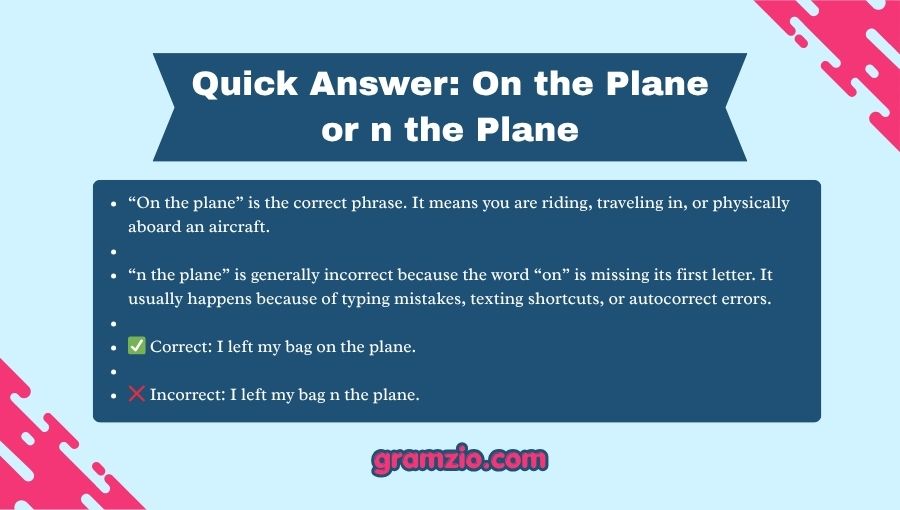
“On the plane” is the correct phrase. It means you are riding, traveling in, or physically aboard an aircraft.
“n the plane” is generally incorrect because the word “on” is missing its first letter. It usually happens because of typing mistakes, texting shortcuts, or autocorrect errors.
✅ Correct: I left my bag on the plane.
❌ Incorrect: I left my bag n the plane.
Understanding the Basics: On the Plane or n the Plane
The main difference is simple:
- On the plane → Correct phrase
- n the plane → Incomplete phrase or typo
English prepositions are essential. Words like on, in, at, by, under, and over connect ideas and indicate relationships.
Here is a clear comparison:
| Form | Type | Meaning | Example | Correct/Incorrect |
|---|---|---|---|---|
| On the plane | Prepositional phrase | Located aboard an aircraft | I met her on the plane. | ✅ Correct |
| n the plane | Typing error | Missing first letter of “on” | I met her n the plane. | ❌ Incorrect |
The phrase on the plane functions naturally because English treats public transportation differently from many other enclosed spaces.
Correct Meanings & Uses
Using “On the Plane” Correctly ✈️
When talking about traveling aboard an aircraft, English speakers generally say on the plane.
Examples:
- I slept on the plane during the flight.
- We watched movies on the plane.
- She met a famous actor on the plane.
Sentence Breakdown
Sentence:
I slept on the plane.
Subject: I
Verb: slept
Prepositional phrase: on the plane
The phrase tells us where the action happened.
Test Tip 💡
Ask yourself:
“Am I talking about being aboard an aircraft?”
If yes, use on the plane.
Why English Uses “On” for Transportation
This sometimes confuses learners because people are physically inside airplanes.
Yet English commonly says:
- on the bus
- on the train
- on the plane
- on the ship
This is an established language pattern.
Examples:
✅ on the train
✅ on the airplane
✅ on the subway
English views larger forms of transportation as platforms or systems people board.
When “In the Plane” Appears
Sometimes people ask:
“Why not say in the plane?”
Actually, in the plane can occasionally be correct.
Examples:
- There were ten passengers in the plane.
- Smoke filled the cabin in the plane.
However, for ordinary travel situations, native speakers strongly prefer on the plane.
Case Study Section 📧
Imagine this workplace email:
Subject: Delayed Arrival
“Hello Team,
I am currently on the plane and may not respond immediately.
I will reply after landing.”
This sounds natural and professional.
Now compare:
“Hello Team,
I am currently n the plane…”
Readers may think:
- Typing error
- Missing word
- Careless writing
Even one missing letter can reduce credibility.
Real-life communication depends on precision.
Grammar Rules Explanation
Grammar authorities such as dictionaries and style guides recognize on as the standard preposition used with transportation systems people board.
The rule generally works like this:
Use on with:
- planes
- trains
- buses
- ships
- public transportation
Examples:
- on a bus
- on a train
- on an airplane
- on a ferry
Use in more often with:
- cars
- taxis
- small vehicles
Examples:
- in a car
- in a taxi
Why?
Historically, people boarded larger transportation platforms, creating the tradition of using on.
Therefore:
✅ I am on the plane.
❌ I am n the plane.
Common Mistakes 🚫
Why do these errors happen?
Several reasons contribute.
Fast typing
People type quickly and accidentally skip letters.
Example:
Typing:
n the plane
instead of:
on the plane
Autocorrect issues
Phones occasionally fail to catch missing letters.
Lack of grammar knowledge
Many learners assume physical location determines preposition choice.
Since passengers sit inside aircraft, they incorrectly think in must always be used.
Similar Grammar Confusions
| Confusing Pair | Correct Meaning |
|---|---|
| it’s / its | contraction vs possession |
| your / you’re | possession vs you are |
| than / then | comparison vs time |
| affect / effect | verb vs noun |
| on the plane / n the plane | complete phrase vs typo |
Usage in Different Contexts
Everyday Conversation 🗣️
People commonly say:
- I forgot my charger on the plane.
- We ate snacks on the plane.
- I met new friends on the plane.
Natural and easy.
Professional Writing 💼
Business communication values accuracy.
Example:
“I will answer emails once I am off the plane.”
Professional writing should avoid incomplete phrases.
Creative Writing 📖
Authors often use travel settings.
Example:
“She stared out the window on the plane and wondered what awaited her.”
The phrase flows naturally.
Social Media and Texting 📱
Fast typing creates errors.
Common:
“im n the plane rn”
Meaning:
“I’m on the plane right now.”
Texting shortcuts happen, but standard writing should remain correct.
Why It Matters ⭐
Small grammar choices create big communication differences.
Using on the plane correctly improves:
Clarity
Readers immediately understand your meaning.
Professionalism
Correct grammar reflects attention to detail.
Writing accuracy
Digital communication moves quickly. Clear writing prevents misunderstandings.
Credibility
People trust polished communication more.
A useful reminder:
“Clear writing creates clear thinking.”
Tiny corrections often create stronger communication.
Special Exception
There are rare situations where n appears intentionally.
Examples:
Text abbreviations
Some people intentionally shorten words:
“im n class”
“im n traffic”
“im n the plane”
These are casual shortcuts, not standard grammar.
Character limitations
Older texting systems occasionally encouraged shortened spelling.
However, modern writing standards still favor complete words.
So outside informal texting:
✅ on the plane
❌ n the plane
Quick Recap Checklist ✔️
| Question | If Yes → Use |
|---|---|
| Are you aboard an aircraft? | On the plane |
| Are you writing formally? | On the plane |
| Is “n” replacing “on”? | Correct it |
| Is it a typo? | Add the missing “o” |
Practice examples:
- I watched a movie ___ the plane.
Answer: on
- We met during our trip ___ the plane.
Answer: on
- I accidentally left my headphones ___ the plane.
Answer: on
FAQs: On the Plane or n the Plane
Is “on the plane” grammatically correct?
Yes. It is the standard English expression for being aboard an aircraft.
Is “n the plane” ever correct?
Generally no. It is usually a typing mistake or texting abbreviation.
Why do people say “on” instead of “in” the plane?
English traditionally uses on for larger transportation systems people board, such as buses, trains, and planes.
Can I say “in the plane”?
Yes, but only in certain contexts. Native speakers usually prefer on the plane when discussing travel.
Is “n” acceptable in texting?
Informally, some people use it as shorthand. Formal writing should avoid it.
Do grammar mistakes affect professionalism?
Yes. Small mistakes can influence how readers perceive attention to detail and credibility.
Conclusion
The confusion between “On the Plane or n the Plane” comes down to one simple truth: “on the plane” is correct, while “n the plane” is usually a typo or shortcut. ✈️
English uses on with forms of transportation people board, including buses, trains, ships, and airplanes. Although missing one small letter may seem unimportant, even tiny mistakes can affect clarity and professionalism.
The next time you write a message before takeoff, remember the rule:
✅ I’m on the plane.
❌ I’m n the plane.
Good grammar is not about perfection—it is about helping people understand you clearly. One letter can make all the difference.
Also read: Quieter vs More Quiet

Hi, I’m Willa Sterling. I work at gramzio.com as a senior editor. With 15 years of experience in academic and formal grammar, I provide the expert insights you need to make your writing flawless.