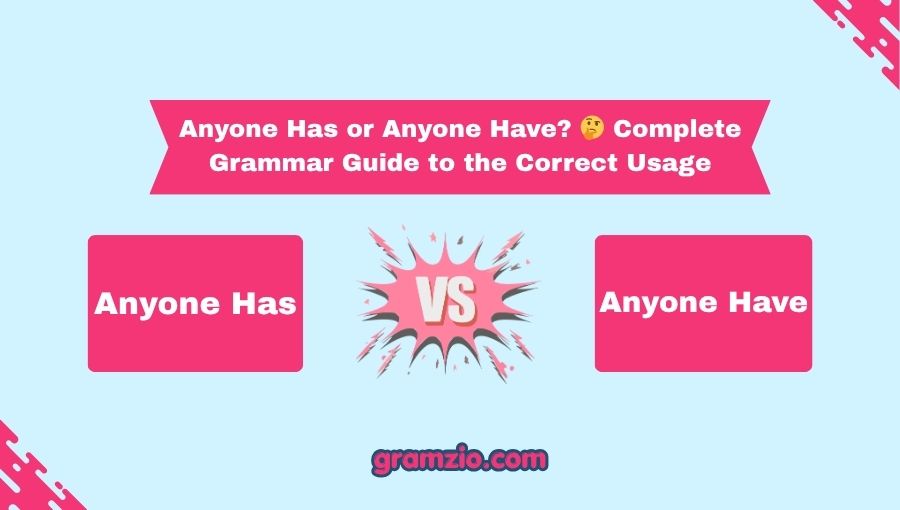
Anyone Has or Anyone Have? 🤔 Complete Grammar Guide to the Correct Usage
Have you ever paused while typing a message and wondered whether to use Anyone Has or Anyone Have? You are not alone. This is one of the most common grammar confusions in English because words like anyone, has, and have often create uncertainty when used together.
The confusion becomes stronger because anyone sounds like it refers to many people, yet grammatically it behaves in a different way. Many English learners—and even native speakers—pause before deciding between “anyone has” and “anyone have.”
Understanding the difference is important because this small grammar choice can change how natural, correct, and professional your writing sounds. Whether you’re writing emails, social media posts, school assignments, or workplace messages, using the correct form improves clarity and credibility.
In this complete guide, you will learn exactly when to use Anyone Has or Anyone Have, why one form is correct in certain situations, the grammar rules behind it, real-life examples, common mistakes, and simple memory tricks to help you never get confused again.
Quick Answer: Anyone Has or Anyone Have? ⚡
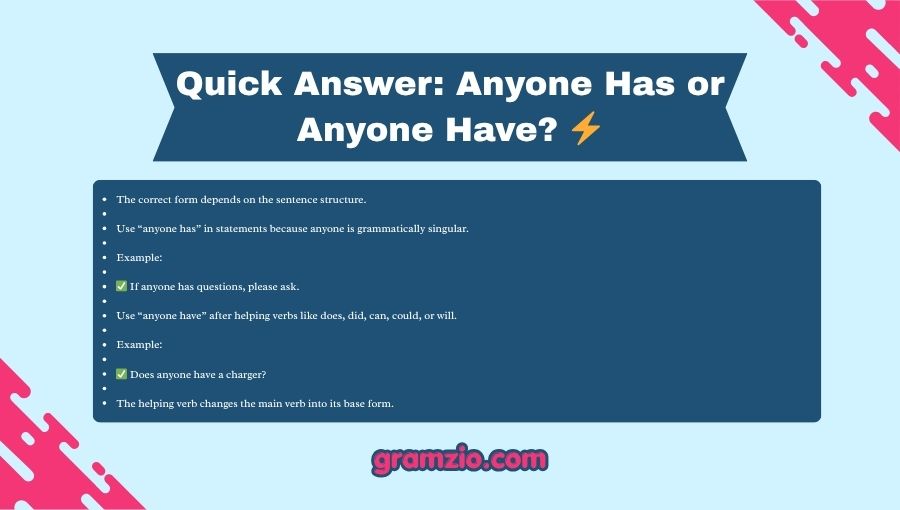
The correct form depends on the sentence structure.
- Use “anyone has” in statements because anyone is grammatically singular.
Example:
✅ If anyone has questions, please ask.
- Use “anyone have” after helping verbs like does, did, can, could, or will.
Example:
✅ Does anyone have a charger?
The helping verb changes the main verb into its base form.
Understanding the Basics: Anyone Has or Anyone Have
The confusion exists because anyone refers to an unspecified person, but English grammar treats it as a singular indefinite pronoun.
Look at this comparison:
| Form | Type | Meaning | Example | Correct/Incorrect |
|---|---|---|---|---|
| Anyone has | Statement structure | A person possesses something | Anyone has access to the file | ❌ Usually incorrect wording |
| If anyone has | Conditional statement | If any person possesses something | If anyone has questions, ask now | ✅ Correct |
| Does anyone have | Question structure | Asking whether any person possesses something | Does anyone have a pen? | ✅ Correct |
| Anyone have | Without helper verb | Missing agreement | Anyone have a phone? | ❌ Usually incorrect in standard grammar |
Notice something important: sentence structure changes the answer.
Correct Meanings and Uses
Using “Anyone Has” in Statements
Because anyone is singular, singular verbs often follow it.
Examples:
✅ Anyone has the right to apply.
However, this sounds awkward in natural American English. Native speakers usually say:
✅ Anyone can apply.
or
✅ If anyone has concerns, let me know.
Sentence breakdown:
- Subject: Anyone
- Verb: has
- Object: concerns
Because anyone is singular, has agrees with it.
Test Tip 📝
Replace anyone with one person.
If one person has sounds right, then has is likely correct.
Example:
If one person has questions…
Correct.
Using “Anyone Have” After Helping Verbs
This is where learners often make mistakes.
Examples:
✅ Does anyone have a calculator?
❌ Does anyone has a calculator?
Why?
The helping verb does already carries the tense and agreement.
Therefore, the main verb returns to its base form:
- do → have
- does → have
- did → have
Examples:
✅ Did anyone have trouble accessing the website?
✅ Will anyone have time tomorrow?
Test Tip 📝
Ask:
“Is there already a helper verb?”
Examples:
- Does
- Did
- Can
- Could
- Will
- Would
If yes, use have, not has.
Case Study: Workplace Email Example 📧
Imagine a manager sends this message:
❌ Does anyone has the updated sales report?
Employees immediately notice something sounds strange.
Correct version:
✅ Does anyone have the updated sales report?
Why it works:
- Helping verb = does
- Main verb returns to base form = have
Professional communication becomes smoother and more polished.
Now consider another workplace example:
✅ If anyone has concerns about the meeting schedule, please contact HR.
This sentence works because no helping verb appears.
Grammar Rules Explanation
English grammar follows a standard rule for subject-verb agreement.
Anyone belongs to a group called indefinite pronouns.
Examples include:
- anybody
- everyone
- somebody
- nobody
- anyone
These pronouns are treated as singular.
According to traditional grammar references such as Merriam-Webster, indefinite pronouns like anyone generally take singular verbs.
Examples:
✅ Everyone has arrived.
✅ Somebody has my keys.
✅ Anyone has permission.
However, helper verbs create a different pattern:
Helping verb + base verb
Example:
Does + have
not:
Does + has
This rule applies throughout English.
Examples:
❌ Does she walks?
✅ Does she walk?
❌ Does anyone has?
✅ Does anyone have?
Common Mistakes 🚫
People make errors for several reasons:
- Fast typing
- Autocorrect changes
- Grammar uncertainty
- Speaking habits
- Lack of knowledge
Common mistake:
❌ Does anyone has a phone charger?
Correct:
✅ Does anyone have a phone charger?
Similar Grammar Confusions Table
| Confusing Pair | Incorrect | Correct |
|---|---|---|
| It’s / Its | The dog wagged it’s tail | The dog wagged its tail |
| Your / You’re | Your funny | You’re funny |
| Their / There | Put it in their | Put it there |
| Anyone has / anyone have | Does anyone has keys? | Does anyone have keys? |
| Then / Than | Bigger then me | Bigger than me |
Why these mistakes happen:
- Fast texting habits 📱
- Autocorrect suggestions
- Weak grammar foundation
- Informal speech patterns
Usage in Different Contexts
Everyday Conversation
People frequently ask:
✅ Does anyone have water?
✅ Does anyone have a charger?
Daily speech heavily uses this structure.
Professional Writing
Business communication values grammar accuracy.
Example:
✅ If anyone has questions regarding the proposal, please contact the office.
Professional writing requires precision.
Creative Writing
Authors may intentionally break rules in dialogue.
Example:
“Anyone have a flashlight?” shouted Jake.
This may appear in fiction because writers imitate natural speech.
Social Media and Texting 📱
Online messages often shorten grammar.
Examples:
Anyone have movie suggestions?
Technically informal but commonly used.
Formal grammar still prefers:
Does anyone have movie suggestions?
Why It Matters ⭐
Some people think this difference is tiny.
It is not.
Small grammar choices shape communication quality.
Benefits include:
Clarity
Correct grammar prevents misunderstanding.
Professionalism
People often judge writing quality quickly.
Writing Accuracy
Good grammar improves digital communication.
Confidence
You write and speak more naturally.
A helpful quote says:
“Clear writing creates clear thinking.”
Simple grammar choices create stronger communication.
Special Exception
English sometimes bends rules in casual conversation.
You may hear:
“Anyone have a pen?”
This appears frequently in speech.
Why?
Informal spoken English often drops helping verbs.
The complete version:
“Does anyone have a pen?”
Both may appear in real life, but formal writing prefers the complete structure.
This is not truly a grammar exception; it is more of a conversational shortcut.
Quick Recap Checklist ✅
| Question | If Yes → Use |
|---|---|
| Is there a helping verb like does? | Have |
| Is anyone acting as singular subject? | Has |
| Is it a statement without helper verbs? | Has |
| Is it a formal question? | Have |
Practice examples:
- Does anyone ___ a notebook?
Answer:
✅ have
- If anyone ___ concerns, contact us.
Answer:
✅ has
- Did anyone ___ trouble logging in?
Answer:
✅ have
Extra Examples for Better Understanding 📚
Correct:
✅ If anyone has ideas, tell me.
✅ Does anyone have scissors?
✅ Has anyone seen my wallet?
Incorrect:
❌ Does anyone has scissors?
❌ If anyone have questions…
❌ Did anyone has lunch?
Notice the pattern: helping verbs remove has.
Memory Trick 🧠
Remember this sentence:
Helper present? Use HAVE.
No helper?
Match the subject.
Examples:
Does → have
Can → have
Will → have
No helper:
Anyone has
This shortcut works surprisingly well.
FAQs: Anyone Has or Anyone Have
1. Is “Does anyone has” correct?
No. The correct phrase is:
✅ Does anyone have
The helping verb does requires the base verb have.
2. Why is anyone singular?
Anyone is an indefinite pronoun referring to one unspecified person at a time.
Therefore it takes singular agreement.
3. Can I say “Anyone have a pen?”
Yes, in casual speech.
However, standard grammar prefers:
Does anyone have a pen?
4. Why does “has” change to “have”?
Helping verbs remove extra verb agreement.
The main verb returns to its base form.
5. Is “If anyone has questions” correct?
Yes.
This is completely correct because no helping verb changes the structure.
6. Which form should I use in business writing?
Use formal grammar:
✅ Does anyone have…
and
✅ If anyone has…
Avoid shortened informal structures.
Conclusion
The debate over Anyone Has or Anyone Have becomes much easier once you understand the grammar pattern behind it. Although anyone represents an unspecified person, it acts as a singular pronoun. That means has often matches it in statements such as “If anyone has questions.” However, when helper verbs like does, did, or can enter the sentence, the main verb changes to its base form, making have the correct choice.
The simplest rule to remember is this: helper verb present = use have. No helper verb = match the singular subject.
Small grammar details create a big difference in communication. ✨ Mastering tiny rules like this helps your writing sound more polished, natural, and professional. One correct word choice today can improve every sentence you write tomorrow.
Also read: Timeslot vs Time Slot

Hi, I’m Dexter Rhodes. At gramzio.com, I apply my 10 years of experience in copy-editing to ensure every guide we publish is accurate, professional, and follows the highest editorial standards.