Strongly Recommend vs Highly Recommend: Which Phrase Should You Use? 🤔
The confusion around Strongly Recommend vs Highly Recommend is very common in English writing and speaking. Have you ever wondered whether it is better to say “I strongly recommend this movie” or “I highly recommend this movie”? 🍿 Both phrases sound correct, but many learners are unsure if they mean the same thing or if one is more professional than the other.
Both expressions are widely used in emails, reviews, workplace communication, social media posts, and everyday conversations. At first glance, they seem almost identical because both show positive opinion and support. However, their tone, intensity, and natural usage can be slightly different depending on context.
Many English learners and even native speakers struggle with these phrases because small word choices can change how a message feels. Using the right one can make your communication clearer, more natural, and more professional.
In this guide, you’ll learn everything about Strongly Recommend vs Highly Recommend, including meanings, grammar rules, real-life examples, common mistakes, and practical usage tips so you can confidently choose the correct phrase every time.
Quick Answer: Strongly Recommend vs Highly Recommend ⚡
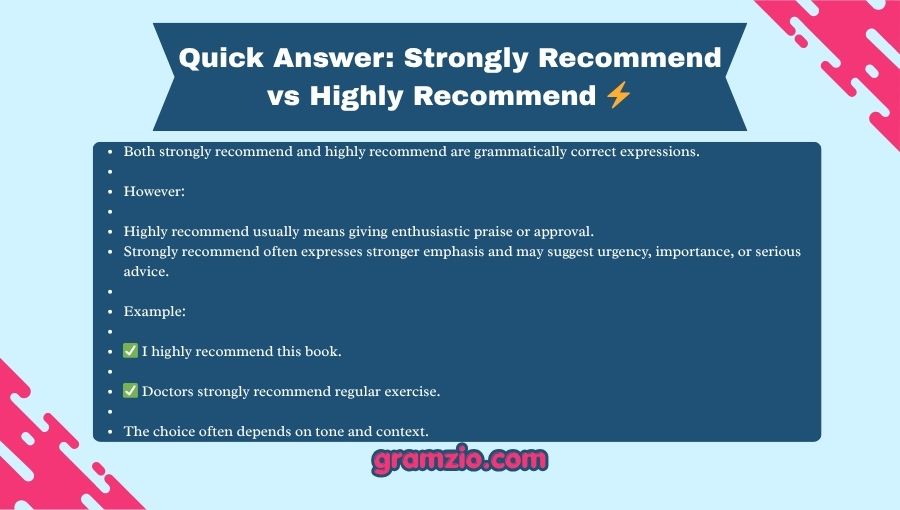
Both strongly recommend and highly recommend are grammatically correct expressions.
However:
- Highly recommend usually means giving enthusiastic praise or approval.
- Strongly recommend often expresses stronger emphasis and may suggest urgency, importance, or serious advice.
Example:
✅ I highly recommend this book.
✅ Doctors strongly recommend regular exercise.
The choice often depends on tone and context.
Understanding the Basics: Strongly Recommend vs Highly Recommend
The core difference lies in emphasis and natural usage patterns.
“Recommend” means suggesting something because you believe it is good or beneficial.
Words like highly and strongly modify the verb and change the intensity.
| Form | Type | Meaning | Example | Correct/Incorrect |
|---|---|---|---|---|
| Highly recommend | Adverb + Verb | Enthusiastically praise or endorse | I highly recommend this movie. | ✅ Correct |
| Strongly recommend | Adverb + Verb | Firmly advise or emphasize importance | Experts strongly recommend vaccinations. | ✅ Correct |
| Very recommend | Adverb + Verb | Incorrect structure | I very recommend it. | ❌ Incorrect |
Key Difference
Highly recommend = enthusiastic endorsement 👍
Strongly recommend = firm or serious advice 📌
Correct Meanings and Uses
Highly Recommend: Enthusiastic Praise 🌟
People often use highly recommend when sharing positive opinions and encouraging others to try something.
Examples:
✅ I highly recommend this Italian restaurant.
Sentence breakdown:
- Subject: I
- Adverb: highly
- Verb: recommend
- Object: this Italian restaurant
Meaning:
The speaker had a very positive experience and wants others to try it.
More examples:
✅ We highly recommend this laptop.
✅ Travel bloggers highly recommend visiting local markets.
✅ Teachers highly recommend this educational app.
Test Tip 💡
If the sentence feels like praise, endorsement, or positive feedback, highly recommend is usually the best choice.
Strongly Recommend: Firm Advice 📢
Strongly recommend often appears when people are giving serious guidance.
Examples:
✅ Doctors strongly recommend getting enough sleep.
Breakdown:
- Subject: Doctors
- Adverb: strongly
- Verb: recommend
- Object: getting enough sleep
Meaning:
This sounds more serious and important than casual praise.
Additional examples:
✅ Experts strongly recommend wearing seat belts.
✅ Financial advisors strongly recommend saving early.
✅ The company strongly recommends updating passwords regularly.
Test Tip 💡
If the statement sounds urgent, official, or authoritative, strongly recommend usually fits better.
Case Study Section: Workplace Email Example 💼
Imagine a manager sending a message:
Version A:
“I highly recommend attending this seminar.”
Meaning:
The manager thinks the seminar is excellent.
Version B:
“I strongly recommend attending this seminar.”
Meaning:
The manager believes attendance is important and should be taken seriously.
Notice the subtle difference:
- Highly = positive enthusiasm
- Strongly = stronger pressure or emphasis
This small wording change affects how readers interpret the message.
Grammar Rules Explanation 📚
Adverbs modify verbs. In both expressions:
- Highly = adverb
- Strongly = adverb
- Recommend = verb
The sentence pattern becomes:
Adverb + Recommend
Examples:
✅ highly recommend
✅ strongly recommend
According to standard dictionary guidance and grammar references, adverbs like highly and strongly intensify actions and opinions.
The phrase highly recommend has become especially common because English speakers naturally use “highly” with positive evaluations.
Examples:
- highly respected
- highly successful
- highly effective
- highly recommend
Meanwhile, strongly often collocates with advice and opinions:
- strongly advise
- strongly oppose
- strongly encourage
- strongly recommend
That explains why both sound natural but create different effects.
Why “Very Recommend” Is Incorrect ❌
Many learners accidentally write:
❌ I very recommend this.
This is incorrect because “very” does not naturally modify “recommend.”
Use:
✅ I highly recommend this.
✅ I strongly recommend this.
English relies heavily on natural word pairings called collocations.
Common Mistakes 🚫
People confuse these phrases for several reasons:
Fast Typing ⌨️
People quickly choose whichever phrase first comes to mind.
Autocorrect 📱
Phone suggestions can influence wording.
Lack of Knowledge 📖
Many learners assume all intensifiers work equally.
Similar Grammar Confusions
| Confusion | Correct Usage |
|---|---|
| Its / It’s | It’s = it is |
| Your / You’re | You’re = you are |
| Affect / Effect | Affect is usually a verb |
| Then / Than | Than compares |
| Highly recommend / Strongly recommend | Depends on tone |
Common Errors
❌ I very recommend this.
✅ I highly recommend this.
❌ We powerful recommend this policy.
✅ We strongly recommend this policy.
❌ I much recommend it.
✅ I highly recommend it.
Usage in Different Contexts 🌍
Different situations influence phrase choice.
Everyday Conversation
People often prefer highly recommend.
Example:
“I highly recommend that café.”
Reason:
Friendly and conversational.
Professional Writing
Formal settings may use either phrase.
Examples:
“Experts strongly recommend cybersecurity updates.”
“I highly recommend this training program.”
Creative Writing
Authors select wording based on emotional tone.
Example:
“The old traveler highly recommended the village bakery.”
or
“The captain strongly recommended avoiding the storm.”
Social Media and Texting 📲
People often use:
“Highly recommend!! 🔥”
This sounds natural and enthusiastic.
“Strongly recommend” can feel more formal online.
Why It Matters ⭐
Word choice influences communication more than many people realize.
Using the right phrase improves:
Clarity
Readers understand your meaning faster.
Professionalism
Correct language creates a stronger impression.
Digital Writing Accuracy
Emails, reviews, blogs, and social posts rely on precision.
Consider this quote:
“Words are small tools that create big impressions.”
Using highly recommend versus strongly recommend changes the emotional tone of your message.
Small details matter.
Special Exception 🔍
There is no major grammatical exception here.
However, certain industries develop preferences.
Medical organizations frequently use:
“Doctors strongly recommend…”
Review sites and influencers often prefer:
“I highly recommend…”
This pattern comes from audience expectations rather than strict grammar rules.
Quick Recap Checklist ✅
| Question | If Yes → Use |
|---|---|
| Are you enthusiastically praising something? | Highly recommend |
| Are you giving serious advice? | Strongly recommend |
| Is urgency involved? | Strongly recommend |
| Is it a review or opinion? | Highly recommend |
Practice Examples
Choose the correct phrase:
- Doctors _____ annual checkups.
Answer:
✅ strongly recommend
- I _____ this new TV series.
Answer:
✅ highly recommend
- Safety experts _____ wearing helmets.
Answer:
✅ strongly recommend
FAQs: Strongly Recommend vs Highly Recommend
Is “strongly recommend” grammatically correct?
Yes. It is completely correct and often expresses firm advice or serious emphasis.
Is “highly recommend” more common?
Yes. In everyday reviews and recommendations, “highly recommend” appears more frequently.
Can I use both interchangeably?
Sometimes yes, but subtle differences in tone exist.
Highly = enthusiastic praise
Strongly = stronger emphasis
Why do doctors often say “strongly recommend”?
Medical professionals usually communicate importance and urgency, making “strongly” more suitable.
Does “highly recommend” sound more friendly?
Usually yes. It feels warmer and more conversational.
Which sounds more professional?
Both can sound professional. The best choice depends on context.
Conclusion
Understanding Strongly Recommend vs Highly Recommend is easier once you focus on tone rather than strict grammar rules. Both phrases are correct, and both use proper English structure. The difference comes from the feeling they create.
Use highly recommend when expressing enthusiastic praise or positive feedback. Use strongly recommend when giving serious advice or emphasizing importance.
Think of it this way:
⭐ Highly recommend = strong approval
📌 Strongly recommend = firm guidance
The next time you write a review, send an email, or offer advice, choose your wording carefully. One small word can completely shape how your message is received.
Also read: Anyone Has or Anyone Have

Hi, I’m Axton Vane. I work at gramzio.com and bring over 11 years of experience in professional grammar. I specialize in refining complex syntax to help writers achieve perfect clarity in every sentence.