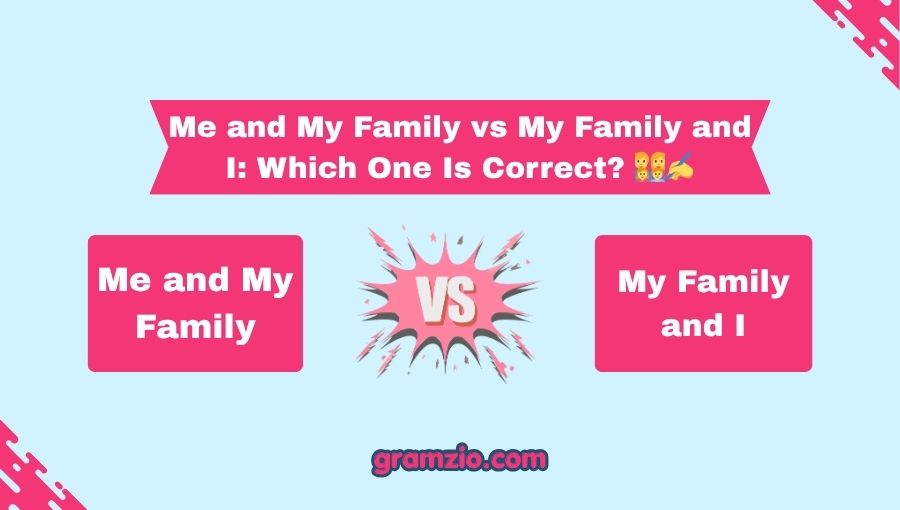
Me and My Family vs My Family and I: Which One Is Correct? 👨👩👧👦✍️
Have you ever paused while writing a sentence like “Me and my family went to the beach” and wondered if it sounds right? You’re not alone. Many English learners and even native speakers get confused about Me and My Family vs My Family and I because both phrases are common in everyday speech.
The confusion happens because informal conversation often bends grammar rules. You hear phrases like “Me and John went shopping” or “Me and my family love traveling” all the time. Since people say these expressions regularly, they start to feel correct. However, spoken habits and proper grammar are not always the same thing.
Understanding Me and My Family vs My Family and I matters because the correct choice affects clarity, professionalism, and writing accuracy. Whether you are writing emails, school assignments, captions, or professional documents, using the right phrase makes your English stronger and more polished. 😊
Let’s clear up the confusion once and for all.
Quick Answer: Me and My Family vs My Family and I
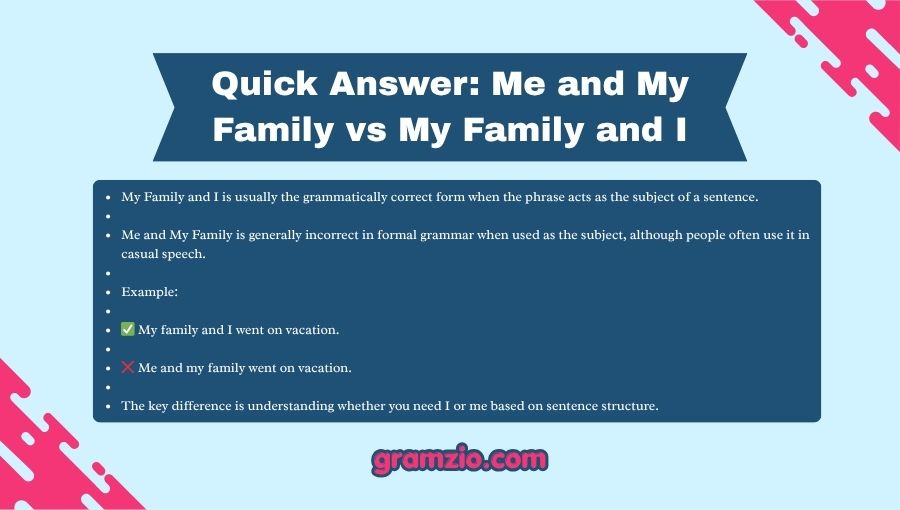
My Family and I is usually the grammatically correct form when the phrase acts as the subject of a sentence.
Me and My Family is generally incorrect in formal grammar when used as the subject, although people often use it in casual speech.
Example:
✅ My family and I went on vacation.
❌ Me and my family went on vacation.
The key difference is understanding whether you need I or me based on sentence structure.
Understanding the Basics: Me and My Family vs My Family and I
The confusion comes from pronoun case. English uses different pronouns depending on whether the pronoun functions as a subject or object.
- I = subject pronoun
- Me = object pronoun
Comparison Table
| Form | Type | Meaning | Example | Correct/Incorrect |
|---|---|---|---|---|
| My Family and I | Subject phrase | Performs action | My family and I visited Texas. | ✅ Correct |
| Me and My Family | Informal/object phrase | Receives action or casual speech | The teacher invited me and my family. | ✅ Correct as object |
| Me and My Family | Subject phrase | Performs action | Me and my family visited Texas. | ❌ Incorrect |
Notice something important: Me and my family is not always wrong. It depends on where it appears in a sentence.
Correct Meanings & Uses
Using “My Family and I” as the Subject
Use My Family and I when the phrase performs the action.
Examples:
✅ My family and I enjoy watching movies.
Sentence breakdown:
- Subject: My family and I
- Verb: enjoy
- Object: watching movies
The subject performs the action.
Another example:
✅ My family and I are planning a road trip.
The people doing the planning are my family and I.
Test Tip 🎯
Remove my family from the sentence.
Example:
My family and I went to the mall.
Remove my family:
I went to the mall.
This sounds correct.
Now test:
Me and my family went to the mall.
Remove my family:
Me went to the mall.
That sounds wrong.
Easy test. Instant answer.
Using “Me and My Family” as an Object
You can use me and my family when receiving an action.
Examples:
✅ The neighbors invited me and my family to dinner.
Sentence breakdown:
Subject: The neighbors
Verb: invited
Object: me and my family
The action happened to them.
More examples:
✅ The photographer took pictures of me and my family.
✅ The company sent gifts to me and my family.
Test Tip 🎯
Remove my family:
The neighbors invited me.
Correct.
Never say:
The neighbors invited I.
Case Study Section 📧
Imagine an employee writing an email:
Incorrect:
“Me and my family would like to thank you for your support.”
The sentence may sound natural in conversation, but in professional writing it creates a grammatical issue.
Correct:
“My family and I would like to thank you for your support.”
Why?
Because my family and I are performing the action of thanking.
In a workplace setting, small grammar mistakes can affect first impressions. Proper wording creates credibility and professionalism.
Grammar Rules Explanation
English grammar follows a distinction between subject pronouns and object pronouns.
Subject pronouns:
- I
- He
- She
- We
- They
Object pronouns:
- Me
- Him
- Her
- Us
- Them
According to standard grammar references such as Merriam-Webster, pronouns change based on grammatical role.
Subject example:
✅ I attended the meeting.
Object example:
✅ The manager invited me.
Now apply the same principle:
Subject:
✅ My family and I attended the meeting.
Object:
✅ The manager invited me and my family.
Grammar becomes easier once you identify who performs the action.
Why Word Order Also Matters
People often say:
“Me and my family…”
Even when me is grammatically acceptable, style guides usually place the other people first.
Instead of:
Me and my family attended.
Better:
My family and I attended.
English etiquette traditionally places yourself last.
This creates a more polite tone. 😊
Examples:
Less preferred:
Me and Sarah worked together.
Preferred:
Sarah and I worked together.
Common Mistakes 🚫
People make this error for several reasons.
Fast typing
People write exactly how they speak.
Autocorrect habits
Phones rarely fix pronoun structure mistakes.
Lack of grammar knowledge
Many people never learn pronoun case rules.
Influence from conversation
Informal speech often ignores grammar standards.
Similar Grammar Confusions
| Confusion | Correct Usage |
|---|---|
| Its vs It’s | Possession vs contraction |
| Your vs You’re | Ownership vs “you are” |
| Their vs They’re | Possession vs “they are” |
| Who vs Whom | Subject vs object |
| I vs Me | Subject vs object |
| Lay vs Lie | Put something vs recline |
These mistakes happen because spoken English often sounds different from written English.
Examples of Common Errors
Incorrect:
❌ Me and my family are excited.
Correct:
✅ My family and I are excited.
Incorrect:
❌ Me and my family went shopping.
Correct:
✅ My family and I went shopping.
Incorrect:
❌ Please give tickets to I and my family.
Correct:
✅ Please give tickets to me and my family.
Usage in Different Contexts
Everyday Conversation 🏠
Casual speech is relaxed.
People commonly say:
“Me and my family are going out tonight.”
You will hear this frequently.
However, grammar teachers still prefer:
“My family and I are going out tonight.”
Professional Writing 💼
Formal situations require correctness.
Examples:
✅ My family and I appreciate your assistance.
Professional writing includes:
- emails
- applications
- business communication
- academic papers
Creative Writing 📚
Creative writers sometimes intentionally use informal speech.
Example dialogue:
“Me and my family don’t trust him,” Jake said.
Writers may break grammar rules to sound realistic.
Social Media and Texting 📱
Online writing is often casual.
Examples:
“Me and my family at the beach 😎”
Social media users prioritize speed over grammar.
Still, polished captions look stronger:
“My family and I had an amazing beach day!”
Why It Matters ⭐
Many people think grammar choices are small details.
They are not.
Using My Family and I correctly improves:
Clarity
Readers instantly understand your sentence.
Professionalism
Correct grammar creates trust.
Writing accuracy
Better grammar prevents misunderstandings.
Digital communication quality
Strong writing stands out online.
Consider this quote:
“Good grammar is credibility translated into words.”
Your grammar influences how people see your writing.
Special Exception
There are moments where grammar rules bend slightly.
Casual speech exception
In everyday conversation:
“Me and my family are leaving now.”
This is common and understood.
Linguists recognize that spoken language often differs from formal grammar.
However, formal writing standards still recommend:
“My family and I are leaving now.”
Speech and writing sometimes follow different expectations.
Quick Recap Checklist ✅
| Question | If Yes → Use |
|---|---|
| Are you performing the action? | My Family and I |
| Are you receiving the action? | Me and My Family |
| Are you writing formally? | My Family and I |
| Are you speaking casually? | Depends on context |
| Does “I” sound correct after removing others? | My Family and I |
Practice Examples
Choose the correct answer:
- ___ visited the museum yesterday.
Answer:
✅ My family and I
- The coach spoke with ___ after the game.
Answer:
✅ me and my family
- ___ enjoy hiking every summer.
Answer:
✅ My family and I
Frequently Asked Questions (FAQs)
Is “Me and My Family” always wrong?
No. It can be correct when used as an object.
Example:
“The host welcomed me and my family.”
Why do so many people say “Me and My Family”?
Because people often speak informally and repeat phrases they hear from others.
Can I use “Me and My Family” in school writing?
No. Formal writing should usually use My Family and I when acting as the subject.
Is “My Family and Me” correct?
Yes, when functioning as an object.
Example:
“The teacher congratulated my family and me.”
How can I quickly test which form to use?
Remove the other people.
Example:
“My family and I traveled.”
Becomes:
“I traveled.”
If it works, use I.
Is word order important?
Yes. English etiquette places yourself after others.
Preferred:
“My family and I”
Less preferred:
“I and my family”
Conclusion
Understanding Me and My Family vs My Family and I becomes simple once you learn one core rule: use I for subjects and me for objects. While casual conversation often includes Me and my family, formal grammar follows a different standard.
A quick trick can save you every time: remove the other people from the sentence and see whether I or me sounds correct. This small test works surprisingly well and helps avoid common mistakes.
Grammar is not about sounding complicated. It is about making communication clear, polished, and effective. ✨
Remember this line:
When you perform the action, choose “My Family and I.” When receiving the action, choose “me and my family.”
Also read: Year Old vs Years Old

Hi, I’m Grayson Finch. I’m part of the gramzio.com team with 9 years of experience in grammar education. I am dedicated to teaching professional communication and helping you master the art of writing.