Afterward vs Afterwards: What’s the Difference and How to Use Them Correctly
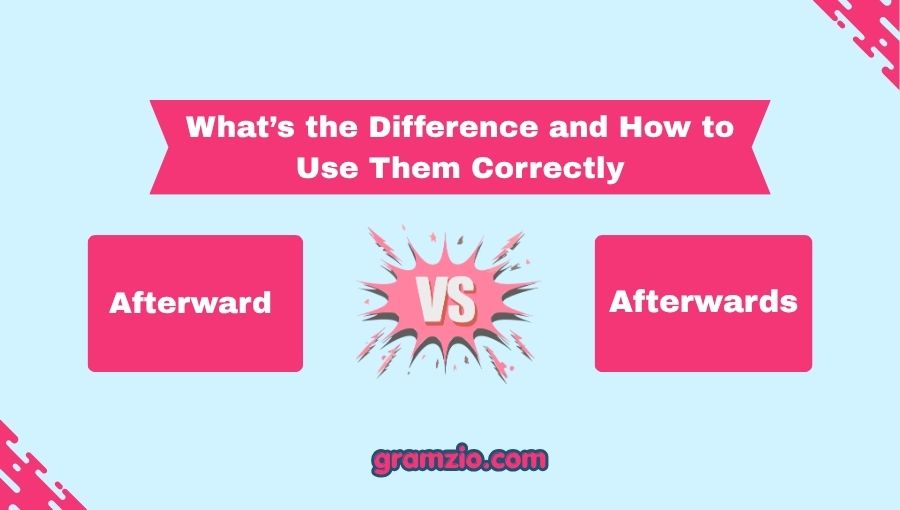
The confusion between afterward vs afterwards is something almost every English learner and even native writer experiences at some point. 🤔 These two words look nearly identical, sound the same, and both refer to something happening later in time. Because of this similarity, people often wonder which one is correct or more professional to use in writing.
The truth is that the difference between afterward vs afterwards is not about meaning, but about regional preference. American English typically uses “afterward,” while British English prefers “afterwards.” This small variation can create uncertainty when you are writing emails, essays, blogs, or professional documents where accuracy matters.
In this guide, we will clearly break down everything about afterward vs afterwards, including their meanings, grammar rules, real-life usage, common mistakes, and expert tips. By the end, you will confidently know when and how to use each form without hesitation. Let’s simplify it step by step and remove all confusion once and for all. ✍️
Quick Answer: Afterward vs Afterwards
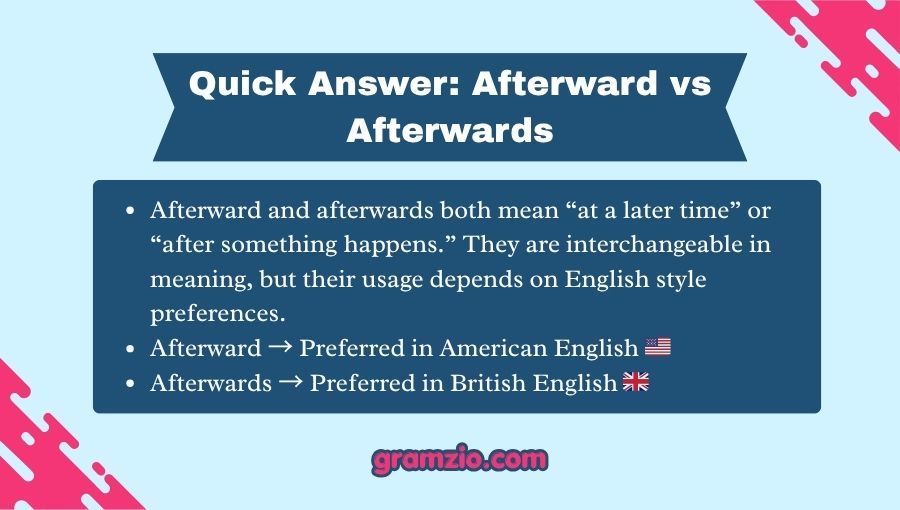
Afterward and afterwards both mean “at a later time” or “after something happens.” They are interchangeable in meaning, but their usage depends on English style preferences.
- Afterward → Preferred in American English 🇺🇸
- Afterwards → Preferred in British English 🇬🇧
Both are grammatically correct, and neither is wrong. The choice depends on your audience and writing style.
Understanding the Basics of Afterward vs Afterwards
To truly understand the difference between afterward vs afterwards, you need to know that both words function as adverbs of time. They describe something that happens later in time.
Key Idea: Same Meaning, Different Style
- Both words indicate a sequence in time.
- They can be used at the beginning or end of a sentence.
- The only difference is regional preference.
Comparison Table: Afterward vs Afterwards
| Feature | Afterward | Afterwards |
|---|---|---|
| Form | Adverb | Adverb |
| Type | Time adverb | Time adverb |
| Meaning | At a later time | At a later time |
| Usage Region | American English 🇺🇸 | British English 🇬🇧 |
| Example | We went home afterward. | We went home afterwards. |
| Correct? | ✅ Correct | ✅ Correct |
Correct Meanings & Uses
1. Using “Afterward” (American English Style 🇺🇸)
“Afterward” is commonly used in American English writing and speech. It is slightly more concise and preferred in professional American communication.
Example Sentences:
- We had dinner and went for a walk afterward.
- She finished her presentation and left afterward.
Sentence Breakdown:
- Event 1: Dinner / Presentation
- Event 2: Walk / Leaving
- “Afterward” connects them in time order.
💡 Test Tip:
If your audience is American, “afterward” is usually the safest choice.
2. Using “Afterwards” (British English Style 🇬🇧)
“Afterwards” is widely used in British English and other Commonwealth countries like the UK, Australia, and parts of Asia.
Example Sentences:
- We went shopping and had coffee afterwards.
- He apologized and left the room afterwards.
Sentence Breakdown:
- First action: Shopping / Apology
- Second action: Coffee / Leaving
- “Afterwards” shows what happened later.
💡 Test Tip:
If your writing follows British English, use “afterwards” for a natural tone.
Case Study: Real-Life Usage Example
Imagine you are writing an email at work:
📧 Email Example (American Company):
“Please review the document. We will discuss it afterward in the meeting.”
📧 Email Example (British Company):
“Please review the document. We will discuss it afterwards in the meeting.”
👉 Both are correct. The only difference is the audience style preference.
Grammar Rules Explanation
According to standard English grammar references like Merriam-Webster Dictionary, both afterward and afterwards are classified as adverbs meaning “later” or “at a subsequent time.”
Why Both Are Correct:
- English allows variation in adverb endings.
- The “-s” in “afterwards” is a historical linguistic variation.
- Modern grammar does not consider either form incorrect.
Key Grammar Insight:
There is no difference in meaning, only in regional usage preference.
Common Mistakes with Afterward vs Afterwards
Many learners confuse these words due to fast typing, autocorrect, or lack of awareness.
Why Mistakes Happen:
- ⚡ Fast typing leads to spelling confusion
- 📱 Autocorrect may change the word automatically
- 📚 Lack of understanding of US vs UK English differences
Similar Grammar Confusions Table
| Incorrect Pair | Correct Usage |
|---|---|
| its / it’s | It’s = it is, Its = possession |
| your / you’re | You’re = you are |
| affect / effect | Affect = verb, Effect = noun |
| afterward / afterwards | Both correct depending on region |
Usage in Different Contexts
1. Everyday Conversation 🗣️
- I will call you afterward.
- Let’s meet afterwards.
2. Professional Writing 💼
- The report will be reviewed afterward.
- The meeting will be summarized afterwards.
3. Creative Writing ✍️
- She smiled and walked away afterward.
- The hero returned afterwards, changed forever.
4. Social Media/Texting 📱
- Let’s hang out afterward 👍
- Going gym afterwards 💪
Why It Matters (Important Section)
Using the correct form of afterward vs afterwards improves clarity and professionalism in writing. Even small language details can impact how your message is perceived.
Benefits of Correct Usage:
- Improves communication clarity
- Enhances professional writing quality
- Builds trust in academic and business contexts
- Helps avoid confusion in global communication
📌 Quote:
“Good writing is clear thinking made visible.”
Special Exception Section
There are no strict exceptions to afterward vs afterwards, but style guides may vary depending on:
- Publishing house requirements
- Academic institution guidelines
- Brand writing tone (US vs UK audience targeting)
Always check your style guide if you are writing for official publication.
Quick Recap Checklist
| Question | If Yes → Use |
|---|---|
| Are you writing for US audience? | Afterward |
| Are you writing for UK audience? | Afterwards |
| Is it formal writing? | Match style guide |
| Is meaning “later”? | Both are correct |
Practice Examples:
- We left the party ______.
- She called me ______.
- They will discuss it ______.
✔ Answers: afterward / afterwards (depends on region)
FAQs: Afterward vs Afterwards
1. What is the difference between afterward and afterwards?
There is no meaning difference. “Afterward” is American English, while “afterwards” is British English.
2. Is afterward correct grammar?
Yes, “afterward” is completely correct and widely used in American English.
3. Is afterwards British or American?
“Afterwards” is mainly British English and common in UK writing.
4. Can I use both interchangeably?
Yes, both are interchangeable in meaning, but not always in style depending on audience.
5. Which is more formal, afterward or afterwards?
Neither is more formal. The choice depends on regional writing style.
6. Should I use afterward or afterwards in IELTS writing?
Use “afterwards” if you follow British English, which is standard for IELTS.
Conclusion
The confusion between afterward vs afterwards is one of the simplest yet most common grammar doubts in English writing. The good news is that both words are correct and share the same meaning—“at a later time.” The only real difference is regional preference: American English prefers afterward, while British English prefers afterwards.
Understanding this small difference helps you write more naturally and confidently, whether you are preparing emails, essays, blogs, or social media content. Choosing the right form also improves readability and ensures your writing matches your audience’s expectations.
At the end of the day, grammar is not just about rules—it’s about clarity and communication. So the next time you pause between these two words, just remember your audience. That simple decision will make your English sound more polished and professional. ✨
Also read: Linchpin vs Lynchpin

Hi, I’m Dexter Rhodes. At gramzio.com, I apply my 10 years of experience in copy-editing to ensure every guide we publish is accurate, professional, and follows the highest editorial standards.