Respond vs Response: What’s the Difference? 🤔
Respond vs response is one of the most commonly confused grammar pairs in English, especially in emails, conversations, and professional writing. Many people accidentally use “respond” when they should use “response,” or vice versa, because the words look and sound very similar. 🤔
If you have ever written a sentence like “Thank you for your quick respond” or “I will response tomorrow,” you are not alone. These mistakes happen often due to fast typing, autocorrect, or confusion about grammar rules. However, learning the difference between respond vs response is actually very simple once you understand how each word works in a sentence.
In short, one word describes an action, while the other refers to the reply itself. Using the correct form can instantly improve your grammar, writing clarity, and professionalism. ✨
In this complete guide, you’ll learn the exact difference between respond vs response, see real-life examples, avoid common mistakes, and master their correct usage with confidence. 🚀
Quick Answer: Respond vs Response
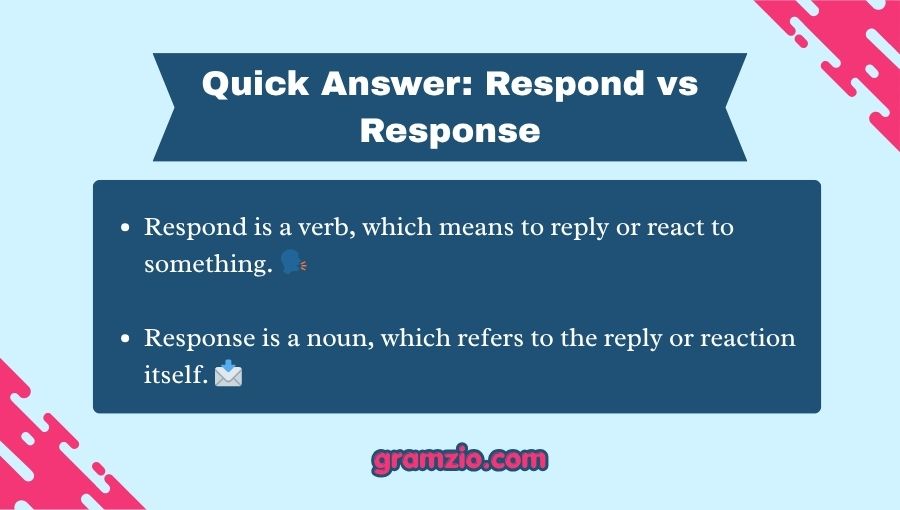
Respond is a verb, which means to reply or react to something. 🗣️
Response is a noun, which refers to the reply or reaction itself. 📩
👉 Example:
- I will respond to your message.
- I received your response.
Understanding the Basics of Respond vs Response
The key difference between respond vs response lies in their grammatical roles.
| Form | Type | Meaning | Example | Correct/Incorrect |
|---|---|---|---|---|
| Respond | Verb | To reply or react | She will respond quickly. | ✅ Correct |
| Response | Noun | A reply or reaction | Her response was helpful. | ✅ Correct |
| Respond | Noun | Incorrect usage | I got your respond. | ❌ Incorrect |
| Response | Verb | Incorrect usage | I will response soon. | ❌ Incorrect |
💡 Simple Rule:
- If you need an action, use respond.
- If you need a thing (the reply itself), use response.
Correct Meanings & Uses
1. What Does “Respond” Mean? 🗣️
“Respond” is a verb, meaning to say or do something as a reaction.
Examples:
- She didn’t respond to my question.
- Please respond as soon as possible.
- He responded with a smile.
Sentence Breakdown:
- Subject: She
- Verb: Respond
- Object: to my question
👉 Here, respond shows the action being performed.
🔎 Test Tip:
If you can replace the word with “reply” or “react,” then “respond” is correct.
2. What Does “Response” Mean? 📩
“Response” is a noun, meaning the reply or reaction itself.
Examples:
- Her response was very clear.
- I’m waiting for your response.
- His response surprised everyone.
Sentence Breakdown:
- Subject: Her response
- Verb: was
- Complement: very clear
👉 Here, response represents the result, not the action.
🔎 Test Tip:
If the word can be replaced with “answer” or “reaction,” use response.
Case Study: Real-Life Usage 📊
Workplace Email Example
❌ Incorrect:
I will response to your email tomorrow.
✅ Correct:
I will respond to your email tomorrow.
❌ Incorrect:
Thank you for your quick respond.
✅ Correct:
Thank you for your quick response.
Real-Life Scenario
Imagine you’re emailing your manager:
- “I will respond shortly” → You are promising an action
- “Thank you for your response” → You are referring to the reply received
This distinction ensures professionalism and clarity in communication. 💼
Grammar Rules Explanation 📘
According to standard English grammar authorities like Merriam-Webster:
- Respond comes from the Latin respondere, meaning “to answer.”
- It functions strictly as a verb.
- Response is the noun form derived from the same root.
- It refers to the result of responding.
Key Grammar Rule:
👉 Verbs describe actions.
👉 Nouns name things, ideas, or results.
So:
- “Respond” = action
- “Response” = result
Common Mistakes ❌
Why Do People Confuse Respond vs Response?
- Fast typing ⌨️
- Autocorrect errors 🤖
- Lack of grammar knowledge 📚
- Similar spelling and pronunciation
Common Grammar Confusions Table
| Confusion | Correct Usage Example |
|---|---|
| It’s vs Its | It’s raining / Its color is red |
| Your vs You’re | Your book / You’re welcome |
| Affect vs Effect | Affect = verb / Effect = noun |
| Then vs Than | Then we left / Better than before |
| Respond vs Response | Respond = verb / Response = noun |
Usage in Different Contexts 🌍
1. Everyday Conversation
- “Did you respond to her?”
- “I liked his response.”
2. Professional Writing 💼
- “Please respond by Friday.”
- “We appreciate your response.”
3. Creative Writing ✍️
- “He didn’t respond, but his silence was a response.”
4. Social Media/Texting 📱
- “Why didn’t you respond? 😅”
- “Thanks for the quick response 🙌”
Why It Matters ✨
Using respond vs response correctly improves:
- ✅ Clarity in communication
- ✅ Professional image
- ✅ Writing accuracy
- ✅ Confidence in English
📌 Quote:
“Clear language leads to clear thinking—and clear thinking leads to better results.”
Even small grammar mistakes can change how people perceive your message.
Special Exception ⚠️
There are no major exceptions to this rule.
However, you may see:
- “Responsive” (adjective) → describing something quick to respond
- “Responded” (past tense verb)
These are related forms but follow standard grammar rules.
Quick Recap Checklist ✅
| Question | If Yes → Use |
|---|---|
| Is it an action? | Respond |
| Is it a thing (reply or reaction)? | Response |
| Can you replace it with “reply”? | Respond |
| Can you replace it with “answer”? | Response |
Practice Examples
- I will ______ to your message. → Respond
- Thank you for your quick ______. → Response
- She didn’t ______ to the invitation. → Respond
FAQs: Respond vs Response❓
1. What is the main difference between respond vs response?
Respond is a verb (action), while response is a noun (the result of that action).
2. Can “response” ever be used as a verb?
No. “Response” is always a noun and cannot function as a verb.
3. Is “respond back” correct?
It is commonly used but slightly redundant. “Respond” alone is usually enough.
4. Which is correct: “quick respond” or “quick response”?
“Quick response” is correct because “response” is a noun.
5. How can I easily remember the difference?
Think:
- Respond = Do something
- Response = The result
6. Is this mistake common in professional writing?
Yes, especially in emails. Using the correct form improves professionalism.
Conclusion
Understanding respond vs response is simple once you know the core rule: one is an action, and the other is the result of that action.
Use respond when you are describing what someone does. Use response when referring to what someone gives as a reply. This small distinction makes a big difference in clarity, professionalism, and correctness.
Mastering this pair will instantly improve your writing—whether you’re sending emails, posting online, or working on formal documents. ✨
👉 Remember this:
You respond to a message, and you receive a response.
Keep practicing, and soon, you’ll never confuse them again! 🚀
Also read: Envolved or Involved

Hi, I’m Willa Sterling. I work at gramzio.com as a senior editor. With 15 years of experience in academic and formal grammar, I provide the expert insights you need to make your writing flawless.