Analysis vs Analyses

Analysis vs Analyses

Analysis vs Analyses: Meaning, Differences, Usage & Examples (Complete Guide)

The confusion between analysis vs analyses is one of the most common grammar mistakes in English, especially for students, writers, and professionals. 🤔 These two words look almost identical, but they have very different meanings depending on whether you are talking about one study or multiple studies. Because of this similarity, many people often use them incorrectly in writing and speech.

The terms analysis vs analyses are widely used in academics, business reports, scientific writing, and everyday communication. However, using them incorrectly can make your writing seem less professional or even confusing. That’s why understanding the difference is important not just for exams, but for real-world communication.

In this complete guide, you will learn everything about analysis vs analyses, including meanings, rules, examples, comparison tables, common mistakes, and real-life usage. By the end, you’ll never mix them up again. Let’s make this simple once and for all.


Quick Answer: Analysis vs Analyses
Analysis vs Analyses

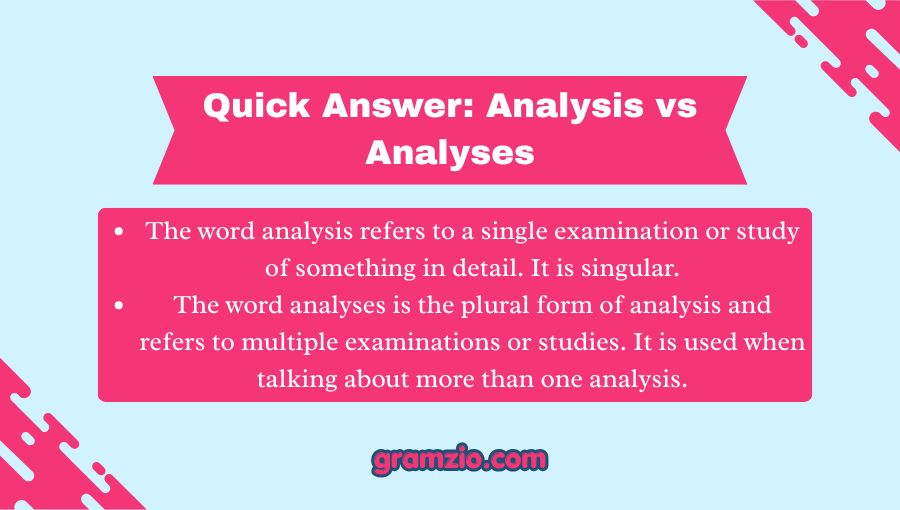
  • The word analysis refers to a single examination or study of something in detail. It is singular.
  • The word analyses is the plural form of analysis and refers to multiple examinations or studies. It is used when talking about more than one analysis.

👉 In simple terms:

  • Analysis = one study/examination
  • Analyses = more than one study/examination

Understanding the Basics of Analysis vs Analyses

The word analysis comes from Greek origin and refers to the process of examining something in detail. It is widely used in science, business, education, and data interpretation.

When we change it into plural form, it becomes analyses. This follows a special English rule where words ending in -is change to -es in plural form.

🔍 Key Difference Explained

Form Type Meaning Example Sentence Correct/Incorrect
Analysis Singular One detailed examination or study The analysis of data is complete. Correct
Analyses Plural More than one examination or study The analyses of data are complete. Correct
Analysises Incorrect Not a valid word ❌ Invalid usage Incorrect

Correct Meaning and Uses of “Analysis”

📌 1. Singular Form: Analysis

Analysis refers to a detailed examination of something to understand it better.

✔ Example:

  • The analysis of the report shows positive results.

✍ Sentence Breakdown:

  • “The analysis” → subject (singular)
  • “shows” → verb agreement
  • “positive results” → object

💡 Test Tip:

If you can replace the word with “one study” or “one review,” use analysis.


Correct Meaning and Uses of “Analyses”

📌 2. Plural Form: Analyses

Analyses refers to multiple examinations or studies.

✔ Example:

  • The scientist conducted several analyses of the samples.

✍ Sentence Breakdown:

  • “several analyses” → plural subject
  • “conducted” → action verb
  • “samples” → object

💡 Test Tip:

If the sentence involves “many studies” or “multiple reviews,” use analyses.


Case Study: Real-Life Usage Example

🏢 Workplace Scenario:

Imagine you are working in a data analytics company.

📧 Email Example:

“Dear Team,
The analysis of last month’s sales data is complete. However, we still need further analyses of customer behavior patterns from different regions.”

✔ Explanation:

  • “analysis” → one main report
  • “analyses” → multiple studies on different data sets

This shows how both forms can appear in the same professional context.


Grammar Rules Behind Analysis vs Analyses

The difference between these two words follows a Latin/Greek pluralization rule in English.

  • Words ending in -is often change to -es in plural form.

📘 Examples:

  • analysis → analyses
  • crisis → crises
  • thesis → theses
  • diagnosis → diagnoses

📚 Authority Reference:

According to Merriam-Webster Dictionary, “analysis” is singular, while “analyses” is its correct plural form used in formal writing and academic contexts.


Common Mistakes with Analysis vs Analyses

Many learners make errors due to spelling confusion or misunderstanding plural rules.

❌ Common Reasons for Mistakes:

  • Fast typing ⌨️
  • Autocorrect errors 📱
  • Lack of grammar knowledge 📖

⚠️ Common Confusions Table:

Incorrect Form Correct Form Example Error Correct Usage
analysises analyses ❌ Wrong plural The analyses are ready
analisis analysis ❌ Misspelling The analysis is complete
analyzises analyses ❌ Non-existent form The analyses are correct

Usage in Different Contexts

🗣️ 1. Everyday Conversation

  • I read an analysis of the movie.

💼 2. Professional Writing

  • The financial analysis shows profit growth.

🎨 3. Creative Writing

  • Her emotional analysis of the poem was deep.

📱 4. Social Media/Texting

  • This meme needs no analysis 😂

Why It Matters in Writing

Using analysis vs analyses correctly is not just about grammar—it impacts how people perceive your communication skills.

✔ Importance:

  • Improves clarity in communication
  • Enhances professional credibility
  • Avoids misunderstandings in reports and emails
  • Strengthens academic writing quality

“Good grammar is the foundation of clear communication.”

Even a small mistake can change the tone of your message, especially in academic or business environments.


Special Exception Section

There are no major exceptions to the rule for “analysis vs analyses.” However, in informal speech or texting, people sometimes ignore plural accuracy—but this is not recommended in formal writing.


Quick Recap Checklist

Question If Yes → Use
Are you talking about one study? analysis
Are you talking about more than one study? analyses

📝 Practice Examples:

  1. The ___ of the experiment was successful. → analysis
  2. Multiple ___ were conducted in the lab. → analyses
  3. Her ___ of the poem was impressive. → analysis

FAQs: Analysis vs Analyses

❓ What is the main difference between analysis and analyses?

Analysis is singular, while analyses is the plural form.

❓ Is “analyses” used in academic writing?

Yes, “analyses” is commonly used in research papers when referring to multiple studies.

❓ Can I use “analysis” for multiple things?

No, “analysis” is only used for one study or examination.

❓ Why do people confuse analysis and analyses?

Because both words look similar, and the plural form follows an unusual grammar rule.

❓ Is “analysises” correct?

No, “analysises” is incorrect and not recognized in English grammar.

❓What are similar words like analysis vs analyses?

Examples include:

  • crisis → crises
  • thesis → theses
  • diagnosis → diagnoses

Conclusion

Understanding the difference between analysis vs analyses is essential for clear and professional communication. While “analysis” refers to a single study or examination, “analyses” refers to multiple studies. The distinction is simple once you remember the rule: -is becomes -es in plural form.

Using these words correctly improves your writing quality, especially in academic, scientific, and business contexts. It also shows attention to detail and strong language skills.

Next time you write, just pause for a moment and ask yourself—am I talking about one or many? That simple question will guide you to the correct choice every time. ✨

Also read: Brief vs Debrief

Previous Article

Brief vs Debrief

Write a Comment

Leave a Comment

Your email address will not be published. Required fields are marked *