Where vs In Which vs Wherein: The Complete Grammar Guide You Need 📘✨
If you’ve ever felt confused about Where vs In Which vs Wherein, you are not alone. These three English expressions often look similar, and they all seem to describe a place or situation—but their usage rules are very different. Many learners struggle to understand when to use where, when to choose in which, and when wherein is actually appropriate. 😵💫
The confusion comes from the evolution of English over time. Modern English prefers simplicity, while formal and legal English still preserves older structures like “in which” and “wherein.” As a result, writers often mix casual, formal, and outdated forms without realizing the difference.
In this complete guide, we will break down everything about Where vs In Which vs Wherein in a simple, practical, and easy-to-understand way. You’ll learn meanings, grammar rules, real-life examples, common mistakes, and professional usage tips. By the end, you’ll confidently know exactly which form to use in any situation. 🚀
Quick Answer: Where vs In Which vs Wherein
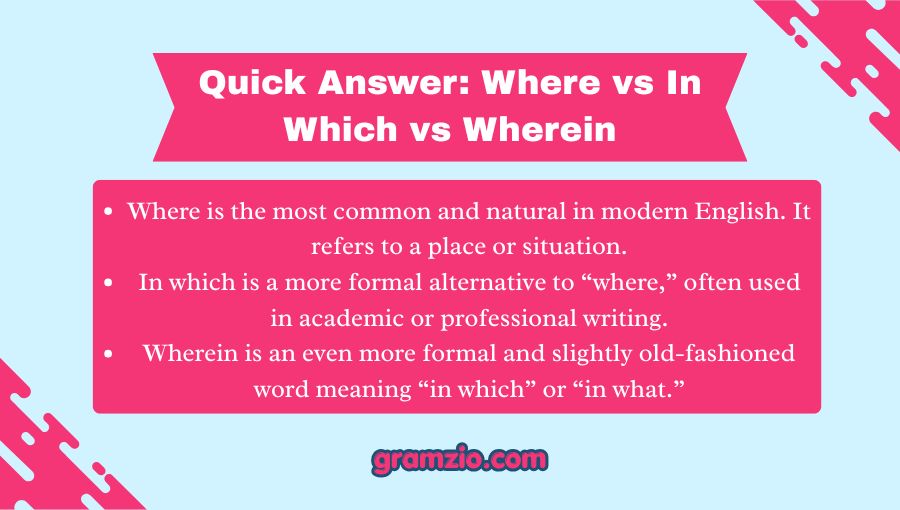
The difference between where, in which, and wherein lies mainly in formality and structure:
- Where is the most common and natural in modern English. It refers to a place or situation.
- In which is a more formal alternative to “where,” often used in academic or professional writing.
- Wherein is an even more formal and slightly old-fashioned word meaning “in which” or “in what.”
👉 In simple terms:
- Use where in everyday English.
- Use in which in formal writing.
- Use wherein in legal, literary, or highly formal contexts.
Understanding the Basics of Where vs In Which vs Wherein
To truly understand the difference, we must look at how each word functions grammatically.
1. WHERE
“Where” is a relative adverb used to describe a place or situation.
📌 Example:
- This is the café where we met.
👉 Meaning: This is the café at which we met.
✔ Natural, simple, and widely used in spoken English.
2. IN WHICH
“In which” is a prepositional phrase used instead of “where” in formal writing.
📌 Example:
- This is the café in which we met.
👉 Meaning: The same as above, but more formal.
✔ Preferred in academic writing and structured documents.
3. WHEREIN
“Wherein” is a formal or archaic term meaning “in which” or “within which.”
📌 Example:
- The agreement wherein both parties consented was signed yesterday.
👉 Meaning: The agreement in which both parties consented.
✔ Mostly used in legal, literary, or old-fashioned English.
Comparison Table: Where vs In Which vs Wherein
| Form | Type | Meaning | Example Sentence | Correct Usage |
|---|---|---|---|---|
| Where | Relative adverb | In/at a place | The room where I study is quiet. | ✔ Correct |
| In which | Prepositional | In the place/situation | The room in which I study is quiet. | ✔ Correct |
| Wherein | Formal/archaic | In which/within which | The contract wherein terms are stated. | ✔ Correct (formal only) |
Correct Meanings & Uses
H3: Using WHERE in Modern English 😊
“Where” is the most natural and commonly used form.
📌 Examples:
- This is the park where I jog every morning.
- Do you know the place where she works?
🔍 Sentence Breakdown:
- “where I jog” = describes location of action
💡 Test Tip:
If you can replace “where” with “at which,” the sentence is likely correct.
H3: Using IN WHICH in Formal Writing 📚
“In which” is used when you want a more precise or formal tone.
📌 Examples:
- This is the park in which I jog every morning.
- The situation in which he found himself was difficult.
🔍 Sentence Breakdown:
- “in which” = preposition + relative clause
💡 Test Tip:
Use “in which” when writing essays, reports, or academic content.
H3: Using WHEREIN in Advanced/Formal Contexts 🏛️
“Wherein” is rarely used in modern casual English.
📌 Examples:
- The document wherein all terms are listed must be signed.
- A system wherein fairness is guaranteed is essential.
🔍 Sentence Breakdown:
- “wherein” = replaces “in which” in formal structure
💡 Test Tip:
If your writing sounds like a legal document, “wherein” may be appropriate.
Case Study: Real-Life Usage Example 💼
Scenario: Workplace Email
❌ Informal:
This is the report where the data is explained.
✔ Better:
This is the report in which the data is explained.
✔ Most Natural:
This is the report where the data is explained.
Scenario: Legal Document
✔ Correct:
The contract wherein all obligations are defined shall remain valid.
👉 This shows how tone determines word choice.
Grammar Rules Explanation 📖
According to standard grammar authorities such as Merriam-Webster and modern usage guides:
- “Where” is a relative adverb and is preferred in spoken English.
- “In which” is a grammatically precise alternative used when prepositions are required.
- “Wherein” is a compound form historically used in legal and literary English.
🔍 Key Rule:
If a preposition is involved (in, at, on), formal English often prefers replacing “where” with “in which.”
Common Mistakes⚠️
Why People Get Confused
- Fast typing leads to shortcuts
- Autocorrect suggests incorrect usage
- Lack of grammar awareness
- Mixing formal and informal styles
Common Grammar Confusions Table
| Incorrect Pair | Correct Form |
|---|---|
| its / it’s | its = possession, it’s = it is |
| your / you’re | your = possession, you’re = you are |
| where / in which | depends on formality |
| who / whom | who = subject, whom = object |
Usage in Different Contexts
🗣️ Everyday Conversation
- Use where
- Example: That’s the shop where I buy groceries.
💼 Professional Writing
- Use in which
- Example: This is the case in which errors occurred.
✍️ Creative Writing
- Prefer where for readability
- Adds natural flow
📱 Social Media / Texting
- Always use where
- Short, simple, fast communication
Why It Matters (Important Section) 🎯
Correct usage of “where,” “in which,” and “wherein” matters because:
- It improves clarity in communication
- It shows professionalism in writing
- It enhances academic and business credibility
- It prevents misunderstandings in formal documents
📌 As writer George Orwell once emphasized:
“Clarity is the foundation of good writing.”
Quick Recap Checklist ✔️
| Question | If Yes → Use |
|---|---|
| Is it casual speech? | Where |
| Is it formal writing? | In which |
| Is it legal/old-style writing? | Wherein |
Practice Examples:
- The school ___ I studied was old.
- The contract ___ terms are listed is valid.
- This is the house ___ I grew up.
✔ Answers:
- where
- wherein / in which
- where
FAQs: Where vs In Which vs Wherein❓
Is “wherein” still used in modern English?
Yes, but very rarely. It is mostly found in legal or literary texts.
Can I always replace “in which” with “where”?
In informal English, yes. In formal writing, “in which” is preferred.
Is “wherein” more formal than “in which”?
Yes. “Wherein” is considered more formal and slightly archaic.
What is the easiest way to remember the difference?
Think:
- Where = casual
- In which = formal
- Wherein = very formal/old-style
Is it wrong to use “where” in academic writing?
Not always wrong, but “in which” is often preferred for precision.
Why does English have so many versions of the same meaning?
Because English evolved over time, blending old structures with modern simplicity.
Conclusion 🧾
Understanding the difference between where, in which, and wherein is essential for mastering English grammar and improving your writing style. While all three can express location or situation, they differ in tone, formality, and usage context.
- Where is simple, natural, and widely used.
- In which is formal and precise.
- Wherein is highly formal and mostly historical or legal.
Choosing the right one depends entirely on your audience and purpose. If you want clarity in everyday communication, go with “where.” If you want precision in formal writing, use “in which.” And if you ever encounter “wherein,” you’ll now know it belongs to a more traditional or legal style of English.
Mastering these subtle differences will instantly elevate your grammar skills and make your English sound more natural, polished, and professional. ✨
Also read: Rend vs Rent

Hi, I’m Dexter Rhodes. At gramzio.com, I apply my 10 years of experience in copy-editing to ensure every guide we publish is accurate, professional, and follows the highest editorial standards.