Expiry vs Expiration: Meaning, Difference, and Correct Usage in English Grammar
Have you ever looked at a medicine bottle, food package, or official document and wondered whether it says “expiry date” or “expiration date”—and if there is even a difference at all? 🤔 You are not alone. Many English learners, writers, and even native speakers get confused between expiry vs expiration because both words seem to point to the same idea: something becoming no longer valid or usable.
The confusion grows because both terms are widely used in different regions, industries, and contexts. For example, “expiry date” is commonly used in British English, while “expiration date” is more common in American English. But is it really that simple? Or is there more to it?
In this detailed guide, we will break down everything you need to know about expiry vs expiration, including their meanings, correct usage, grammar rules, real-life examples, common mistakes, and expert-level clarity tips. By the end, you’ll never mix them up again—and you’ll use them like a pro in writing and conversation. ✍️
Quick Answer: Expiry vs Expiration
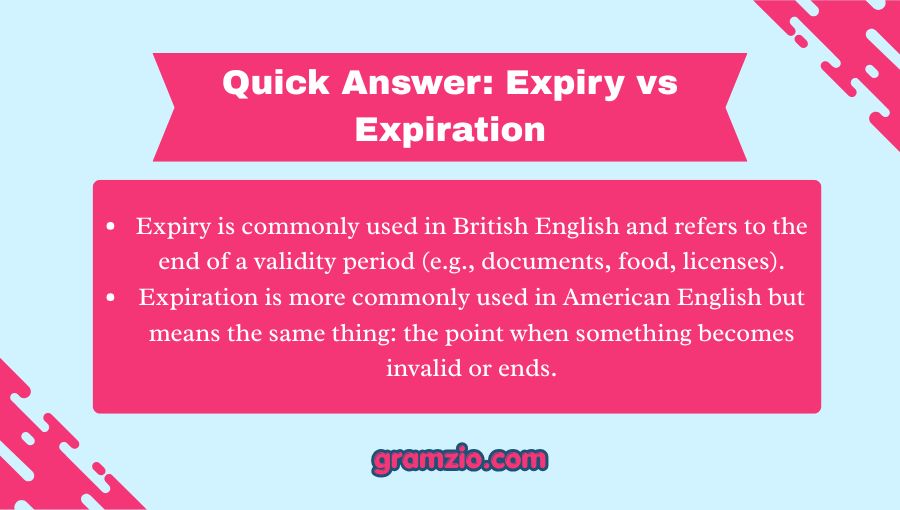
The difference between expiry and expiration is mainly regional and stylistic, not grammatical.
- Expiry is commonly used in British English and refers to the end of a validity period (e.g., documents, food, licenses).
- Expiration is more commonly used in American English but means the same thing: the point when something becomes invalid or ends.
👉 In simple terms:
Both words describe the end of validity, but usage depends on regional preference.
Understanding the Basics of Expiry vs Expiration
At their core, both expiry and expiration come from the verb “expire”, which means to come to an end.
🔹 Expiry
- Noun form used mainly in British English
- Refers to the ending point of validity
- Common in everyday labels and official documents
🔹 Expiration
- Noun form used mainly in American English
- Also refers to the ending point of validity
- More common in legal, medical, and formal American writing
Comparison Table: Expiry vs Expiration
| Form | Type | Meaning | Example Sentence | Correct Usage |
|---|---|---|---|---|
| Expiry | Noun (BrE) | End of validity or period | The expiry date is next month. | Correct (UK) |
| Expiration | Noun (AmE) | End of validity or period | The expiration date is next month. | Correct (US) |
👉 Both are grammatically correct—difference is usage preference only.
Correct Meanings & Uses
1. Expiry in Detail
In British English, expiry is widely used in everyday communication.
Example:
- The expiry date on this milk is tomorrow.
Breakdown:
- “Expiry” = noun
- “Date” = specific time reference
- Together = end of usability
📌 Test Tip:
If the sentence sounds natural in UK English contexts (like UK packaging or documents), “expiry” is correct.
2. Expiration in Detail
In American English, expiration is more formal and widely used.
Example:
- The expiration date on your passport is approaching.
Breakdown:
- “Expiration” = noun form of expire
- Common in legal/official American documents
📌 Test Tip:
If the context is US-based or legal/medical, “expiration” is preferred.
Case Study: Real-Life Usage Example
📧 Workplace Email Example
Subject: Document Expiration Notice
Dear Employee,
This is a reminder that your work visa is approaching its expiration date on May 15, 2026. Please submit renewal documents before the expiry of the validity period to avoid disruption.
Best regards,
HR Department
👉 Notice how both terms can appear in the same professional communication depending on region and tone preference.
Grammar Rules Explanation
From a grammar standpoint, both words are:
- Noun forms derived from the verb “expire”
- Synonyms in meaning
- Differentiated only by regional usage
According to Merriam-Webster, “expiration” is the standard American noun form, while “expiry” is recognized but less commonly used in American English.
Why both are correct:
- Language evolves regionally
- British English prefers shorter noun forms like “expiry”
- American English prefers extended noun forms like “expiration”
Common Mistakes with Expiry vs Expiration
Many learners confuse these terms due to:
- Regional differences 🌍
- Autocorrect suggestions 📱
- Fast typing without checking ⌨️
- Lack of exposure to formal usage
❌ Common Errors Table
| Mistake Type | Incorrect Example | Correct Example |
|---|---|---|
| Wrong region usage | The expiration date (UK doc) | The expiry date (UK doc) |
| Mixing styles | Expiry of passport (US doc) | Expiration of passport (US doc) |
| Informal confusion | Expire date | Expiry/Expiration date |
Similar Grammar Confusions
| Confusion Pair | Example 1 | Example 2 |
|---|---|---|
| it’s / its | It’s cold | The dog wagged its tail |
| your / you’re | Your book | You’re late |
| affect / effect | affect change | positive effect |
Usage in Different Contexts
1. Everyday Conversation 🗣️
- “Check the expiry date before eating this.”
- “When is your card’s expiration date?”
2. Professional Writing 💼
- Legal contracts prefer “expiration”
- Packaging in UK prefers “expiry”
3. Creative Writing ✍️
- “The expiry of hope felt sudden and silent.”
- “The expiration of time changed everything.”
4. Social Media 📱
- “Don’t ignore the expiration date on your coupon!”
Why It Matters (Important Section)
Understanding expiry vs expiration is important because it ensures:
- Clear communication
- Professional accuracy
- Avoiding misunderstandings in legal/medical contexts
- Better writing credibility
📌 As communication experts often say:
“Precision in language builds trust in writing.”
Special Exception
Some global brands and systems use both terms interchangeably depending on region:
- Banking systems (cards may show “expiry date” or “expiration date”)
- Airline tickets
- Government documents
There is no strict universal rule—only regional preference.
Quick Recap Checklist
| Question | If Yes → Use |
|---|---|
| Is it UK English context? | Expiry |
| Is it US English context? | Expiration |
| Is it formal/legal writing in US? | Expiration |
| Is it packaging/labels in UK? | Expiry |
Practice Examples
- The ___ date of the license is near.
- Check the ___ date on the medicine bottle.
- The contract will reach its ___ next month.
FAQs: Expiry vs Expiration
Are expiry and expiration the same?
Yes. Both mean the end of validity or a time period, but usage depends on region.
Which is correct: expiry date or expiration date?
Both are correct. “Expiry date” is British English, while “expiration date” is American English.
Is expiry used in American English?
Rarely. Americans mostly use “expiration.”
Can I use them interchangeably?
Yes, but it is better to match the regional style of your writing.
Which is more formal?
“Expiration” is considered more formal in American English legal and medical writing.
What is the verb form of expiry/expiration?
Both come from the verb “expire.”
Conclusion
The difference between expiry vs expiration is not about grammar correctness but about regional usage and style preference. Both terms describe the same concept—the end of validity of something such as documents, products, or agreements.
In British English, expiry is more commonly used, while in American English, expiration is preferred. Understanding this difference helps you write more clearly, professionally, and accurately depending on your audience.
So next time you see a date on a passport, food package, or contract, you’ll know exactly what it means—and which word fits the context perfectly. ✨
In short: it’s not about right or wrong—it’s about where you are and who you are writing for.
Also read: Where vs In Which vs Wherein

Hi, I’m Elara Quinn. Working at gramzio.com, I use my 8 years of experience in linguistics to simplify difficult English rules, making them accessible and easy to learn for our global community.