Reevaluation vs Re-evaluation: Which Spelling Is Correct? 🤔
Reevaluation vs Re-evaluation is a confusing grammar topic that often makes writers stop and double-check their spelling. Both versions appear correct, both are used online, and both can be found in different types of writing. That is why many students, bloggers, professionals, and even native English speakers struggle to decide whether the hyphen should stay or disappear. 🤔
English grammar changes over time, especially with words that use prefixes like re-. Some terms keep their hyphens for clarity, while others gradually lose them as they become more common in everyday language. The same thing has happened with reevaluation and re-evaluation.
The good news is that the rule is simpler than it looks. Once you understand modern hyphenation rules and how dictionaries treat these spellings, you can confidently use the correct form in emails, essays, business reports, academic writing, and social media posts. This guide will explain the difference clearly, provide real examples, and help you avoid common grammar mistakes with confidence. ✍️
Quick Answer: Reevaluation vs Re-evaluation ✅
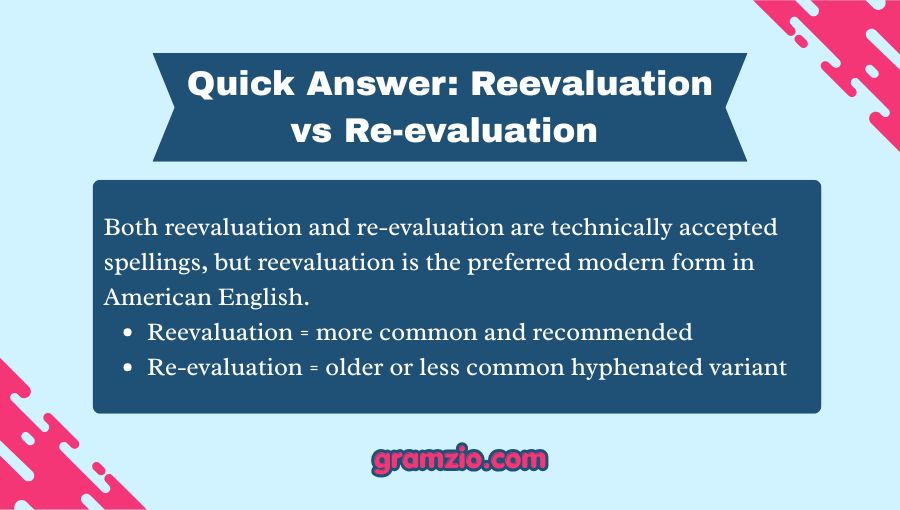
Both reevaluation and re-evaluation are technically accepted spellings, but reevaluation is the preferred modern form in American English.
- Reevaluation = more common and recommended
- Re-evaluation = older or less common hyphenated variant
Most style guides and dictionaries favor reevaluation because English tends to remove unnecessary hyphens over time.
Understanding the Basics of Reevaluation vs Re-evaluation
The confusion comes from the prefix re-, which means “again,” combined with the word evaluation.
- Evaluation = assessment or judgment
- Reevaluation/Re-evaluation = assessing something again
Comparison Table
| Form | Type | Meaning | Example | Correct/Incorrect |
|---|---|---|---|---|
| Reevaluation | Standard modern spelling | Assessing again | The company ordered a reevaluation of the project. | ✅ Correct |
| Re-evaluation | Older hyphenated variant | Assessing again | The teacher requested a re-evaluation of the test. | ✅ Acceptable but less preferred |
| Reevalution | Misspelling | Incorrect spelling | We need a reevalution. | ❌ Incorrect |
| Re evaluation | Incorrect spacing | Broken compound word | The re evaluation starts today. | ❌ Incorrect |
Correct Meanings & Uses
What Does “Reevaluation” Mean? 📘
The word reevaluation refers to reviewing, reassessing, or examining something again after new information appears.
Example Sentences
- The hospital ordered a reevaluation of the patient’s condition.
- After the budget cuts, the company began a reevaluation of its priorities.
- The coach called for a reevaluation of the team strategy.
Sentence Breakdown
Take this sentence:
“The company began a reevaluation of its hiring process.”
- company = subject
- began = action
- reevaluation = noun describing reassessment
- hiring process = object being reassessed
The sentence clearly shows that something is being reviewed again.
Test Tip 📝
If the meaning is “evaluate again,” then reevaluation is usually the correct choice.
What Does “Re-evaluation” Mean?
The hyphenated form means exactly the same thing. The only difference is stylistic.
Example
- The professor approved a re-evaluation of the research paper.
This form is still understandable and grammatically acceptable, but it appears less frequently in modern American English.
Why Some Writers Still Use It
Some people add the hyphen because:
- It improves readability
- It avoids seeing double vowels (“ee”)
- Older style guides preferred hyphenation
However, modern dictionaries increasingly remove such hyphens.
Test Tip 📝
If you are writing formal American English, choose reevaluation unless a style guide specifically prefers hyphenation.
Case Study Section 📂
Workplace Email Example
Imagine a manager sending this message:
“Due to recent customer feedback, we will begin a reevaluation of our service policies next week.”
This sentence looks professional, modern, and polished.
Now compare it with:
“Due to recent customer feedback, we will begin a re-evaluation of our service policies next week.”
This version is still correct, but many editors would simplify it by removing the hyphen.
Why the First Version Works Better
- Cleaner appearance
- Matches modern business writing
- Follows current dictionary preference
- Reduces unnecessary punctuation
In professional communication, simplicity often improves readability.
Grammar Rules Explanation 📖
Why Is “Reevaluation” Preferred?
Modern English grammar tends to eliminate hyphens from familiar compound words over time.
For example:
| Older Form | Modern Form |
|---|---|
| Re-enter | Reenter |
| Co-operate | Cooperate |
| Re-evaluation | Reevaluation |
This change happens because readers become comfortable recognizing the word without punctuation.
According to major dictionaries like Merriam-Webster and standard American usage guides, reevaluation is widely accepted as the preferred spelling.
Understanding Prefix Rules
The prefix re- usually joins directly to the base word without a hyphen.
Examples
- Rebuild
- Reconsider
- Reassess
- Reevaluate
When turned into a noun:
- Reevaluate → Reevaluation
When Is a Hyphen Sometimes Used?
A hyphen may appear when:
- Confusion could occur
- Pronunciation becomes awkward
- The style guide requires it
Example
- Re-sign (sign again)
- Resign (quit a job)
Here, the hyphen changes meaning, so it matters.
But with reevaluation, there is no confusion in meaning, so the hyphen is unnecessary.
Common Mistakes Section ❌
Why Do People Make This Mistake?
There are several reasons why writers struggle with reevaluation vs re-evaluation.
1. Double “E” Looks Strange
Many people are uncomfortable seeing “ree” at the beginning of a word.
Examples:
- Reelect
- Reenter
- Reevaluation
Because of this, writers instinctively add a hyphen.
2. Older Writing Habits
Older textbooks and newspapers often used more hyphens than modern publications.
As language evolved, many hyphens disappeared.
3. Fast Typing ⌨️
People typing quickly may accidentally separate the word:
- re evaluation ❌
4. Autocorrect Problems 📱
Some devices automatically insert or remove hyphens based on outdated dictionaries.
5. Lack of Grammar Knowledge
Many writers simply never learned modern hyphenation rules.
Similar Grammar Confusions Table
| Confusing Pair | Correct Usage |
|---|---|
| It’s / Its | “It’s” = it is, “its” = possession |
| Your / You’re | “You’re” = you are |
| Everyday / Every day | “Everyday” = common, “every day” = daily |
| Reevaluate / Re-evaluate | Reevaluate preferred |
| Email / E-mail | Email preferred |
| Online / On-line | Online preferred |
Usage in Different Contexts 🌎
Everyday Conversation
In casual communication, most people use reevaluation naturally.
Example
- “I think this situation needs a reevaluation.”
This sounds modern and smooth.
Professional Writing 💼
Business documents usually favor cleaner spelling without unnecessary hyphens.
Example
- “The board approved a reevaluation of company policies.”
Professional writing values consistency and readability.
Academic Writing 🎓
Academic institutions often follow style guides such as:
- APA
- MLA
- Chicago Style
Most modern academic writing accepts reevaluation without the hyphen.
Creative Writing ✍️
Creative writers may occasionally use re-evaluation for visual pacing or emphasis.
Example
- “The hero’s re-evaluation of his choices changed everything.”
This is more stylistic than grammatical.
Social Media & Texting 📱
On social platforms, people usually skip the hyphen because shorter forms feel faster and simpler.
Example
- “Time for a serious reevaluation 😂”
Why It Matters 🚨
You may wonder whether this tiny hyphen really matters. The answer is yes.
1. Clarity in Communication
Correct spelling helps readers understand your message quickly.
Clean writing reduces distractions.
2. Professionalism
Using modern standard spelling makes your writing appear polished and credible.
In resumes, emails, reports, and academic papers, details matter.
3. Writing Accuracy in Digital Communication
Search engines, grammar tools, and AI writing systems increasingly favor standardized spelling.
Using reevaluation helps maintain consistency across platforms.
4. Reader Trust
Small grammar mistakes can reduce confidence in your writing.
Correct usage creates authority.
“Good writing is clear thinking made visible.”
Special Exception Section ⚠️
Are There Any Exceptions?
Yes, but they are rare.
Some organizations, publishers, or style guides may intentionally use re-evaluation for branding or stylistic consistency.
For example:
- Older newspapers
- Traditional publishing houses
- Internal company style manuals
If you are writing for a specific organization, always follow its preferred style guide.
However, in general American English, reevaluation remains the dominant choice.
Quick Recap Checklist ✅
Which Form Should You Use?
| Question | If Yes → Use |
|---|---|
| Are you writing modern American English? | Reevaluation |
| Are you following a newer style guide? | Reevaluation |
| Are you writing professionally? | Reevaluation |
| Does your organization require hyphens? | Re-evaluation |
| Is meaning unclear without a hyphen? | Re-evaluation |
Practice Examples
Example 1
- Correct: The doctor ordered a reevaluation.
- Incorrect: The doctor ordered a re evaluation.
Example 2
- Correct: We need a reevaluation of the budget.
- Acceptable: We need a re-evaluation of the budget.
Example 3
- Correct: Her reevaluation changed the outcome.
- Incorrect: Her reevalution changed the outcome.
FAQs About Reevaluation vs Re-evaluation ❓
Is “reevaluation” one word?
Yes. In modern American English, reevaluation is commonly written as one word without a hyphen.
Is “re-evaluation” wrong?
No. It is still considered acceptable, but it is less common today.
Which spelling is more professional?
Reevaluation is generally viewed as more modern and professional in business and academic writing.
Why do some people still use the hyphen?
Some writers prefer the hyphen for readability or follow older grammar conventions.
Does Merriam-Webster accept “reevaluation”?
Yes. Merriam-Webster recognizes reevaluation as a valid spelling.
Should I use reevaluation in formal writing?
Yes. It is widely accepted in formal American English writing.
Conclusion
The debate over reevaluation vs re-evaluation is really about modern style versus older hyphenation habits. While both spellings are technically correct, reevaluation is the preferred form in today’s American English. It appears cleaner, more modern, and more consistent with current grammar trends.
The key rule is simple: when the prefix re- combines with a familiar word that remains easy to read, the hyphen is usually removed. That is why reevaluation has become the standard choice in professional, academic, and everyday writing.
Still, context matters. Some organizations or style guides may continue using re-evaluation, and that is perfectly acceptable when consistency is required.
In most situations, though, choosing reevaluation will keep your writing polished, clear, and grammatically strong. ✨
Remember this simple takeaway:
Modern English prefers simplicity — and that is why “reevaluation” wins.
Also read: Combating vs Combatting

Hi, I’m Dexter Rhodes. At gramzio.com, I apply my 10 years of experience in copy-editing to ensure every guide we publish is accurate, professional, and follows the highest editorial standards.