Combating vs Combatting: Which Spelling Is Correct? ⚔️
Have you ever typed combating in a document only to see your spell checker suggest combatting instead? 🤔 You are not alone. Many English writers get confused when choosing between combating vs combatting, especially because both versions appear online, in books, and even in professional writing.
The confusion mostly comes from English spelling rules related to doubling consonants before adding suffixes like -ing or -ed. Some words double the final consonant, while others do not. Because the word combat ends with “t,” many people assume the correct form must always be combatting. However, modern English usage is slightly more nuanced.
Understanding the difference matters because correct spelling improves professionalism, clarity, and credibility. Whether you are writing an email 📧, a school essay 📝, a social media caption 📱, or a business report 📊, using the right spelling helps your writing appear polished and trustworthy.
In this guide, you will learn the exact difference between combating vs combatting, when to use each form, why the confusion exists, and how major grammar authorities treat the word today.
Quick Answer: Combating vs Combatting ✅
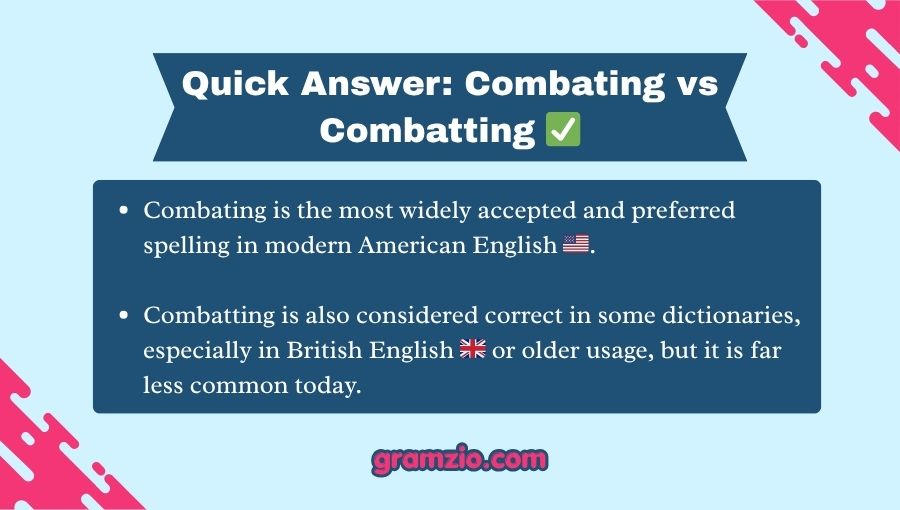
Combating is the most widely accepted and preferred spelling in modern American English 🇺🇸.
Combatting is also considered correct in some dictionaries, especially in British English 🇬🇧 or older usage, but it is far less common today.
If you write for US audiences, professional content, SEO articles, or business communication, use combating.
Understanding the Basics of Combating vs Combatting
The confusion comes from how English handles verbs ending in consonants before adding -ing.
The base word is:
- Combat = to fight against something
When adding -ing, writers may choose:
- Combating
- Combatting
Both forms exist, but one is more standard in modern usage.
Comparison Table
| Form | Type | Meaning | Example | Correct/Incorrect |
|---|---|---|---|---|
| Combating | Verb (preferred US spelling) | Fighting against something | The city is combating pollution. | ✅ Correct |
| Combatting | Alternative spelling | Same meaning | The team is combatting fraud. | ✅ Less common |
| Combatingg | Misspelling | No meaning | She is combatingg crime. | ❌ Incorrect |
| Combatin | Informal typo | No meaning | They are combatin issues. | ❌ Incorrect |
Correct Meanings & Uses
What Does “Combating” Mean? ⚔️
The word combating means actively fighting against, resisting, or trying to stop something.
It can refer to:
- Diseases 🦠
- Crime 🚔
- Poverty 💵
- Corruption 🏛️
- Stress 😓
- Climate change 🌍
Examples
- The government is combating inflation.
- Doctors are combating a new virus.
- Schools are combating bullying.
Sentence Breakdown
The company is combating cyber threats.
- The company = subject
- is combating = action happening now
- cyber threats = object being fought against
Test Tip ✅
If your audience is American or global online readers, choose combating for the safest and most professional option.
What Does “Combatting” Mean? 🛡️
Combatting has the same meaning as combating. The difference is mainly spelling style.
This version follows the traditional rule of doubling the final consonant before adding -ing.
Examples
- The agency is combatting illegal activity.
- Scientists are combatting disease outbreaks.
Although grammatically acceptable in some regions, this spelling appears much less frequently in modern American writing.
Test Tip ✅
If you are unsure which version to use, pick combating. It is cleaner, more common, and preferred by most style guides.
Why Does This Confusion Happen? 🤔
English spelling rules are not always consistent.
Normally, verbs with one syllable double the final consonant before adding -ing:
| Base Word | Correct Form |
|---|---|
| Run | Running |
| Sit | Sitting |
| Cut | Cutting |
But combat has two syllables:
- com-bat
Because stress patterns affect consonant doubling, writers become uncertain.
Some dictionaries allow both spellings because pronunciation differences and regional preferences influenced historical usage.
Grammar Rules Explanation 📚
According to major grammar references like Merriam-Webster and other modern dictionaries, combating is the dominant American English spelling.
The Doubling Rule
A final consonant is usually doubled when:
- The word has one syllable
- The final syllable is stressed
- The word ends in consonant-vowel-consonant pattern
Example:
- Begin → Beginning
- Admit → Admitting
However, English contains many exceptions.
The word combat historically produced both:
- Combating
- Combatting
Modern US usage simplified the spelling to combating.
Case Study Section 🧩
Workplace Email Example
Imagine a marketing manager writing this sentence:
“Our company is combating online fraud through stronger security systems.”
This version looks modern, polished, and professional.
Now compare:
“Our company is combatting online fraud through stronger security systems.”
While still understandable, some readers may think it is a typo because the double “t” version is less familiar in US English.
Practical Lesson
In business communication:
✅ Use combating for clarity and consistency.
Usage in Different Contexts 🌎
Everyday Conversation 🗣️
People rarely notice the spelling difference in casual writing.
Example:
- “We are combating stress by exercising more.”
Simple and natural.
Professional Writing 💼
Professional documents usually favor standard modern spelling.
Examples:
- combating cybercrime
- combating inflation
- combating corruption
Using the preferred spelling helps maintain credibility.
Creative Writing ✍️
Authors may intentionally choose combatting for stylistic or regional flavor.
Example:
- “The warriors were combatting darkness across the kingdom.”
This is not wrong, but it feels more traditional.
Social Media & Texting 📱
Fast typing often creates spelling inconsistency online.
You may see both:
- combating negativity ✨
- combatting hate 🚫
Most users do not notice the difference, but professional creators should stay consistent.
Common Mistakes Section ❌
Why Do People Make This Mistake?
Several reasons explain the confusion:
1. Fast Typing ⌨️
People type quickly and automatically double consonants.
2. Autocorrect 📲
Different devices use different dictionaries.
3. Lack of Grammar Knowledge 📖
Many writers never learn the consonant-doubling rule deeply.
4. Exposure to Mixed English Styles 🌍
British and American English sometimes differ.
Similar Grammar Confusions Table
| Confusing Pair | Correct Usage |
|---|---|
| It’s / Its | “It’s” = it is, “Its” = possession |
| Your / You’re | “You’re” = you are |
| Affect / Effect | Affect = verb, Effect = noun |
| Then / Than | Then = time, Than = comparison |
| Combating / Combatting | Combating preferred in US English |
Detailed Breakdown of Combating vs Combatting 🔍
Combating = Preferred Modern Form
Why It Wins
- More common in search engines
- Preferred in American English
- Cleaner visual appearance
- Common in journalism and business writing
Example Sentences
- The nonprofit is combating hunger.
- Researchers are combating misinformation.
- Police are combating organized crime.
Combatting = Alternative Variant
Why It Still Exists
- Older spelling traditions
- British influence
- Conservative style preferences
Example Sentences
- Authorities are combatting illegal trade.
- Citizens are combatting pollution.
Although accepted in some contexts, it appears less frequently today.
Why It Matters ✨
Correct spelling affects more than grammar.
It influences:
- Professionalism
- Reader confidence
- Search visibility
- Communication clarity
Imagine submitting a resume or business proposal with inconsistent spelling. Even minor errors can affect perception.
“Clear writing reflects clear thinking.”
When you use standard spelling, your message becomes easier to understand and more trustworthy.
Special Exceptions Section ⚠️
British English Differences
Some British publications may still use combatting more often than American sources.
Neither version changes the meaning.
However:
- 🇺🇸 American English → combating
- 🇬🇧 British English → combating or combatting
Style Guide Preferences
Different publishers may have internal style rules.
For example:
- News organizations often prefer simpler spellings
- Academic institutions may follow dictionary preferences
- Older publications may retain traditional forms
Always stay consistent within one document.
Quick Recap Checklist ✅
| Question | If Yes → Use |
|---|---|
| Writing for US readers? | Combating |
| Writing SEO content? | Combating |
| Need modern professional spelling? | Combating |
| Following older British style? | Combatting |
| Want safest universal choice? | Combating |
Practice Examples 📝
Example 1
The organization is _____ climate change.
✅ Correct: combating
Example 2
Doctors are _____ a dangerous infection.
✅ Correct: combating
Example 3
The agency is _____ online scams.
✅ Preferred: combating
✅ Alternative: combatting
Real-Life Examples From Different Industries 🏢
Healthcare 🏥
- Hospitals are combating antibiotic resistance.
- Scientists are combating infectious diseases.
Technology 💻
- Companies are combating cyber attacks.
- Developers are combating data theft.
Education 🎓
- Schools are combating misinformation.
- Teachers are combating cheating with new tools.
Environmental Issues 🌱
- Governments are combating climate change.
- Communities are combating pollution levels.
Memory Trick to Remember the Correct Form 🧠
Here is an easy trick:
👉 Think of combating as the “cleaner modern spelling.”
Since most modern American words avoid unnecessary doubled letters, remember:
- combating = simpler = preferred
This quick mental shortcut helps avoid confusion while typing.
How Dictionaries Treat the Word 📚
Major dictionaries acknowledge both spellings, but usage frequency matters.
General Trend
| Dictionary Trend | Preferred Form |
|---|---|
| Modern American English | Combating |
| Alternative Accepted Form | Combatting |
| Most Common Online Usage | Combating |
Language evolves over time, and simplified spellings often become dominant.
FAQs: Combating vs Combatting❓
Is combating or combatting correct?
Both spellings are technically correct, but combating is the preferred form in modern American English.
Why do some people spell it combatting?
Some writers follow older consonant-doubling rules or British English traditions, which allow combatting.
Which spelling should I use in professional writing?
Use combating for business documents, SEO writing, academic work, and online publishing.
Does combatting mean something different?
No. Both words have the same meaning: fighting against or trying to stop something.
Is combatting wrong in American English?
Not completely. It is still recognized, but it is much less common and may appear outdated.
Final Comparison Table 📊
| Feature | Combating | Combatting |
|---|---|---|
| Meaning | Fighting against | Fighting against |
| Grammar Status | Preferred | Alternative |
| US English | Common | Rare |
| British English | Common | Sometimes used |
| SEO-Friendly | Yes | Less ideal |
| Professional Appearance | Strong | Slightly old-fashioned |
Conclusion
The debate around combating vs combatting mainly comes down to modern spelling preferences and regional language styles. Both versions technically exist, but combating has become the dominant and preferred spelling in American English. It appears more frequently in professional writing, SEO content, journalism, and digital communication.
If your goal is clarity, professionalism, and modern usage, choosing combating is the smartest option. It looks cleaner, feels more familiar to readers, and aligns with current language trends.
Meanwhile, combatting is not entirely wrong. It survives as an alternative spelling in some dictionaries and regional styles, especially in older or British-influenced writing.
The easiest rule to remember is simple:
✅ When in doubt, use combating.
Clear grammar creates stronger communication — and strong communication always wins. 🚀
Also read: Dammit vs Damn It

Hi, I’m Elara Quinn. Working at gramzio.com, I use my 8 years of experience in linguistics to simplify difficult English rules, making them accessible and easy to learn for our global community.