Loose vs Lose: The Complete Grammar Guide You Need (Simple Explanation + Examples)
The confusion between loose vs lose is one of the most common grammar mistakes in English, and many learners struggle with it every day. Have you ever written a sentence and suddenly paused, wondering whether it should be “loose” or “lose”? You are not alone. These two words look similar, sound almost alike in fast speech, but they have completely different meanings and uses.
A small spelling difference—just one extra “o”—can completely change the meaning of your sentence and make your message incorrect or unclear. For example, saying “I don’t want to loose my keys” is wrong, while “I don’t want to lose my keys” is correct.
In this guide, you will clearly understand the difference between loose vs lose, learn correct usage with examples, avoid common mistakes, and master simple memory tricks so you never confuse them again.
Quick Answer: Loose vs Lose Meaning
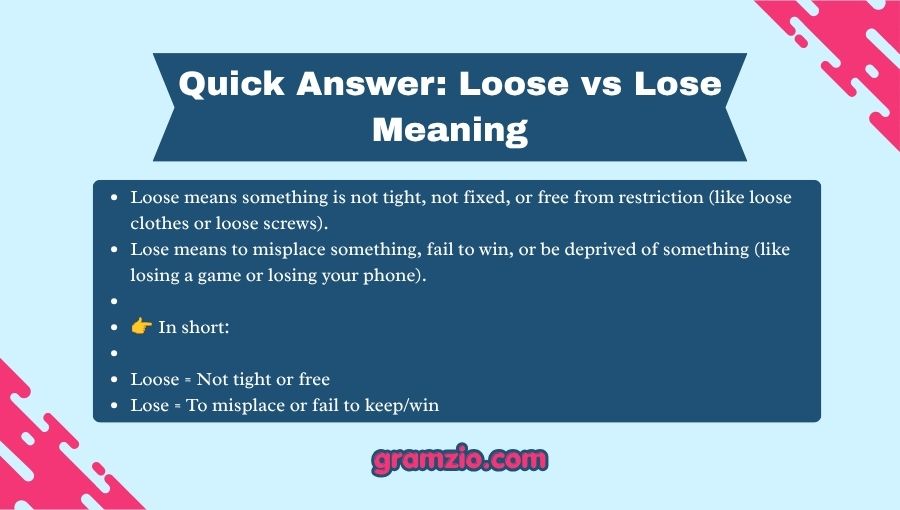
Loose means something is not tight, not fixed, or free from restriction (like loose clothes or loose screws).
Lose means to misplace something, fail to win, or be deprived of something (like losing a game or losing your phone).
👉 In short:
- Loose = Not tight or free
- Lose = To misplace or fail to keep/win
Understanding the Basics (Loose vs Lose)
The main confusion happens because loose and lose look almost identical in spelling, but they belong to different grammatical categories and meanings.
Key Difference
- Loose (adjective) → describes a noun
- Lose (verb) → shows an action
Comparison Table
| Form | Type | Meaning | Example Sentence | Correct/Incorrect |
|---|---|---|---|---|
| Loose | Adjective | Not tight, free, or not fixed | My shirt is loose. | Correct ✔️ |
| Lose | Verb | To misplace, fail, or be defeated | I don’t want to lose my phone. | Correct ✔️ |
| Loose | Verb usage | ❌ Incorrect for action | I loose my keys. | Incorrect ❌ |
| Lose | Adjective usage | ❌ Incorrect for description | My shirt is lose. | Incorrect ❌ |
Correct Meaning & Uses of “Loose”
1. Loose as an Adjective (Main Usage)
The word loose is most commonly used to describe something that is not tight or firmly attached.
Examples:
- My shoes feel loose after the hike.
- There is a loose wire behind the TV.
- She wore a loose dress for comfort.
Sentence Breakdown:
- “Loose dress” → describes the dress (adjective describing noun)
- “Loose wire” → wire is not fixed properly
💡 Test Tip:
If you can replace it with “not tight,” then “loose” is correct.
2. Loose in Physical Context
Used when something is not secure or attached properly.
Examples:
- A loose screw in the chair caused instability.
- The dog got loose from the leash.
3. Loose in Informal Usage
Sometimes used to describe behavior or structure.
- A loose plan (not strict or detailed)
- Loose rules (not strict regulations)
Correct Meaning & Uses of “Lose”
1. Lose as a Verb (Main Usage)
The word lose refers to the action of misplacing something or failing.
Examples:
- I don’t want to lose my wallet.
- We might lose the match today.
- Try not to lose focus during the lecture.
Sentence Breakdown:
- “Lose keys” → action of not being able to find keys
- “Lose game” → fail to win
💡 Test Tip:
If you can replace it with “fail to keep” or “misplace,” then “lose” is correct.
2. Lose in Competitive Context
Used when talking about winning or failing.
- Our team might lose the match.
- He hates to lose arguments.
3. Lose in Emotional or Abstract Meaning
- Don’t lose hope.
- She didn’t want to lose confidence.
Case Study (Real-Life Example)
Workplace Email Example:
❌ Incorrect:
I don’t want to loose the client’s trust.
✔️ Correct:
I don’t want to lose the client’s trust.
Why?
Because “lose” is an action (verb) meaning to fail to keep trust. “Loose” would incorrectly describe something not tight, which makes no sense in this context.
Grammar Rules Explanation
According to standard English grammar references like Merriam-Webster, the distinction is clear:
- Loose → adjective meaning “not firmly fixed; free from restraint”
- Lose → verb meaning “to be unable to find, keep, or win”
Why Confusion Happens
- Similar spelling
- Fast typing errors
- Autocorrect mistakes
- Pronunciation similarity in casual speech
📌 Important Rule:
- If it describes something → use loose
- If it shows action → use lose
Common Mistakes
Why People Mix Them Up
- Typing quickly on phones
- Lack of grammar awareness
- Auto-correct interference
- Similar pronunciation in fast speech
Similar Grammar Confusion Table
| Word Pair | Correct Form | Meaning Difference |
|---|---|---|
| It’s / Its | It’s = it is, Its = possession | |
| Your / You’re | Your = possession, You’re = you are | |
| Loose / Lose | Loose = not tight, Lose = misplace/fail | |
| Affect / Effect | Affect = verb, Effect = noun |
Usage in Different Contexts
1. Everyday Conversation
- My jeans are too loose.
- Don’t lose your phone again.
2. Professional Writing
- We cannot afford to lose this opportunity.
- The machine has a loose part.
3. Creative Writing
- Her loose hair flowed in the wind.
- He feared to lose his memories.
4. Social Media/Texting
- “I can’t lose this vibe 😎”
- “My hoodie is so loose lol”
Why It Matters (Important)
Using the correct form of loose vs lose is important because:
- It improves communication clarity
- It shows professionalism in writing
- It avoids misunderstandings
- It enhances credibility in academic and business communication
📌 “Good grammar is the foundation of clear communication.”
Special Exception
There are no major exceptions in standard English usage for loose vs lose, but in slang or informal writing, people sometimes intentionally misspell words for humor or style (especially online), such as:
- “I don’t wanna loose it 😂” (informal/slang, but still incorrect grammatically)
However, in formal writing, this is always considered incorrect.
Quick Recap Checklist
| Question | If Yes → Use |
|---|---|
| Is it describing something not tight? | Loose |
| Is it an action like failing or misplacing? | Lose |
Practice Examples
- I might ___ my keys again. → Lose
- This shirt is too ___. → Loose
- Don’t ___ hope. → Lose
FAQs: Loose vs Lose
1. What is the main difference between loose and lose?
Loose is an adjective meaning not tight, while lose is a verb meaning to misplace or fail.
2. Why do people confuse loose and lose?
Because they look and sound similar, especially in fast typing or casual speech.
3. Can loose ever be used as a verb?
Yes, but rarely. Example: “to loose arrows” (meaning to release). However, this is old or formal usage.
4. Is it correct to say “I loose my phone”?
No. The correct form is “I lose my phone.”
5. How can I remember the difference easily?
Think:
- Loose = extra “o” → something is “out of tightness”
- Lose = action (no extra “o”)
6. Is lose only used for failure?
No. It can also mean misplacing something or losing emotional states like hope or confidence.
Conclusion
The confusion between loose vs lose is extremely common, but once you understand the difference, it becomes very easy to use correctly. Remember, loose describes something that is not tight or firmly fixed, while lose refers to the action of misplacing, failing, or being deprived of something.
This small spelling difference changes the entire meaning of a sentence, so using the correct form is essential for clear communication, especially in professional and academic writing.
With practice, you will naturally start identifying the correct word without hesitation. Keep the simple rule in mind: loose = not tight, lose = action of losing.
Mastering this difference is a small step, but it makes a big impact on your English accuracy and confidence.
Also read: Their vs There vs They’re

Hi, I’m Grayson Finch. I’m part of the gramzio.com team with 9 years of experience in grammar education. I am dedicated to teaching professional communication and helping you master the art of writing.