Flew vs Flown: Understanding the Difference Once and for All ✈️
Have you ever written a sentence like “I have flew to New York before” and paused for a second because something felt wrong? 🤔 You are not alone. Many English learners and even native speakers get confused about Flew vs Flown because both words come from the same verb: fly. Since they look similar and relate to past actions, people often mix them up.
English verb forms can be tricky, especially irregular verbs. Unlike regular verbs that simply add -ed, words like fly change forms entirely. That is where confusion starts. Should you say “The bird has flew away” or “The bird has flown away”? Why does one sentence sound natural while the other feels awkward?
Understanding Flew vs Flown is important because using the wrong verb form can affect your writing, speech, and professionalism. Whether you are sending emails, writing essays, posting on social media, or simply having a conversation, mastering this grammar rule helps you communicate clearly and confidently.
Let’s break it down in a simple and practical way. 🚀
Quick Answer: Flew vs Flown
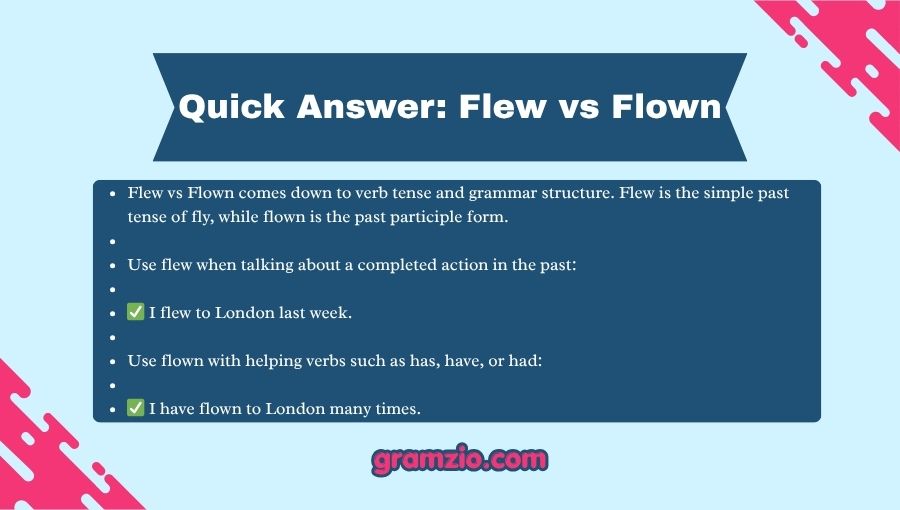
Flew vs Flown comes down to verb tense and grammar structure. Flew is the simple past tense of fly, while flown is the past participle form.
Use flew when talking about a completed action in the past:
✅ I flew to London last week.
Use flown with helping verbs such as has, have, or had:
✅ I have flown to London many times.
Understanding the Basics: Flew vs Flown
The verb fly is irregular. Its forms are:
- Present: fly
- Past: flew
- Past participle: flown
Here is a simple comparison table:
| Form | Type | Meaning | Example | Correct/Incorrect |
|---|---|---|---|---|
| Fly | Base verb | Move through air | Birds fly south. | ✅ Correct |
| Flew | Simple past | Action happened in the past | I flew yesterday. | ✅ Correct |
| Flown | Past participle | Used with helping verbs | I have flown before. | ✅ Correct |
| Flown without helper | Wrong structure | Missing auxiliary verb | I flown yesterday. | ❌ Incorrect |
| Flew with helper | Wrong structure | Wrong participle use | I have flew before. | ❌ Incorrect |
The easiest way to remember:
Flew stands alone. Flown needs help. ✨
Correct Meanings & Uses
Using “Flew” Correctly
Flew describes an action that already happened and finished in the past.
Structure:
Subject + flew + rest of sentence
Examples:
✅ Sarah flew to California last summer.
Sentence breakdown:
- Subject: Sarah
- Verb: flew
- Time indicator: last summer
Another example:
✅ The airplane flew over the mountains.
The action happened at a specific time and ended.
Test Tip 🎯
Ask yourself:
Did the action happen at a specific point in the past?
If yes, use flew.
Using “Flown” Correctly
Flown cannot usually stand alone. It needs helping verbs like:
- has
- have
- had
- was
- were
- has been
Structure:
Subject + helping verb + flown
Examples:
✅ She has flown internationally many times.
Breakdown:
- Subject: She
- Helping verb: has
- Past participle: flown
More examples:
✅ They had flown before the storm arrived.
✅ The kite has flown away.
Test Tip 🎯
Check whether your sentence includes:
- have
- has
- had
If yes, use flown, not flew.
Case Study Section 📧
Imagine a workplace email:
Incorrect:
“I have flew to Chicago several times for meetings.”
A manager reading this may immediately notice the grammar issue.
Correct:
“I have flown to Chicago several times for meetings.”
Why?
The sentence uses have, so it requires the past participle flown.
This small correction makes writing sound more polished and professional.
Grammar Rules Explanation
According to standard grammar references such as dictionaries and style guides, fly is an irregular verb.
Verb pattern:
| Verb Form | Word |
|---|---|
| Base | Fly |
| Simple Past | Flew |
| Past Participle | Flown |
The simple past works independently:
✅ I flew home.
Past participles need auxiliary verbs:
✅ I have flown home.
The reason I have flew is wrong is that English present perfect tense requires:
have/has + past participle
Not:
have/has + simple past
This grammar pattern applies to many irregular verbs:
- go → went → gone
- write → wrote → written
- eat → ate → eaten
Common Mistakes 🚫
People often confuse Flew vs Flown because English irregular verbs do not follow predictable patterns.
Common reasons include:
Fast typing
People type quickly and choose the wrong form.
Autocorrect
Technology sometimes misses grammar context.
Lack of knowledge
Many learners memorize vocabulary but not verb structures.
Examples of mistakes:
❌ I have flew before.
❌ She flown to Paris.
❌ We had flew yesterday.
Correct versions:
✅ I have flown before.
✅ She has flown to Paris.
✅ We flew yesterday.
Similar Grammar Confusions
| Confusion | Correct Use |
|---|---|
| It’s vs Its | Contraction vs possession |
| Your vs You’re | Ownership vs “you are” |
| Their vs There | Possession vs place |
| Affect vs Effect | Verb vs noun |
| Flew vs Flown | Past tense vs participle |
These mistakes happen because words sound similar but follow different grammar rules.
Usage in Different Contexts
Everyday Conversation 🗣️
People often use flew when talking casually:
“I flew to Dubai last month.”
For experiences:
“I have flown there before.”
Professional Writing 💼
Business communication values accuracy.
Example:
“Our team has flown to multiple locations for conferences.”
Professional writing should avoid:
“Our team has flew…”
Creative Writing ✍️
Writers use these forms to create vivid imagery.
Example:
“The dragon flew over the kingdom at sunset.”
Or:
“The dragon had flown across many lands.”
Social Media and Texting 📱
Online users often shorten sentences and accidentally create errors.
Example:
❌ Just have flew into Miami!
Correct:
✅ Just landed. I have flown into Miami again.
Why It Matters 🌟
Grammar affects how people understand you.
Using Flew vs Flown correctly improves:
Clarity in communication
Readers instantly understand your message.
Professionalism
Correct grammar creates a strong impression.
Writing accuracy
Small details build credibility.
Consider this quote:
“Good communication begins with good grammar.”
While grammar may seem small, it strongly influences how people view your writing.
In digital communication today, details matter more than ever.
Special Exception
There are no major brand-name exceptions for Flew vs Flown, but there are unusual uses involving figurative language.
Example:
“Time has flown.”
No physical flying happened here.
Instead, flown means time passed quickly.
Likewise:
“Rumors flew around the office.”
Here flew means information spread rapidly.
English often uses fly metaphorically.
Quick Recap Checklist ✅
| Question | If Yes → Use |
|---|---|
| Did the action happen at a specific time in the past? | Flew |
| Do you see has, have, or had? | Flown |
| Is there a helping verb? | Flown |
| Is the verb standing alone? | Flew |
Practice:
- I _____ to Texas last year.
Answer: flew - She has _____ overseas twice.
Answer: flown - They had _____ before sunset.
Answer: flown
FAQs
Is “I have flew” grammatically correct?
No. The correct sentence is:
✅ I have flown.
Present perfect tense requires a past participle.
Why is “flown” called a past participle?
A past participle works with helping verbs such as has, have, and had.
Example:
She has flown before.
Can “flown” be used without helping verbs?
Usually no.
Incorrect:
❌ I flown yesterday.
Correct:
✅ I have flown before.
Which is correct: “flew yesterday” or “flown yesterday”?
Flew yesterday is correct because yesterday refers to a completed past action.
Why do English learners confuse Flew vs Flown?
Because irregular verbs do not follow normal patterns and require memorization.
Is “time has flown” correct?
Yes. It is a common expression meaning time passed quickly.
Conclusion
Understanding Flew vs Flown becomes much easier once you remember one key rule: flew is simple past, and flown is a past participle that needs a helping verb. ✈️
If the action happened at a specific time in the past, use flew. If your sentence includes words like has, have, or had, choose flown. This simple rule prevents common mistakes and instantly improves your grammar.
Small grammar choices can create a big impact. Whether you are writing emails, speaking professionally, posting online, or completing school assignments, correct verb usage helps you sound more confident and polished.
Remember this line:
Flew works alone. Flown needs a partner.
Once you learn that, you will never mix them up again. 🚀
Also read: My Wife and I or My Wife and Me

Hi, I’m Willa Sterling. I work at gramzio.com as a senior editor. With 15 years of experience in academic and formal grammar, I provide the expert insights you need to make your writing flawless.