Much Needed or Much-needed: Which One Is Correct?
When it comes to much needed or much-needed, many writers are unsure which form is correct. Have you ever written a sentence like “This vacation was much needed” and then wondered whether it should be “much-needed” instead? 🤔 If so, you are not alone. Many English speakers and writers get confused about when to use much needed and when to use much-needed.
The confusion comes from the fact that both forms are correct, but they are used in different grammatical situations. A small hyphen can completely change how a phrase functions within a sentence. Understanding the difference is important because proper usage improves clarity, professionalism, and overall writing quality.
Whether you are writing an email, a school assignment, a social media post, or a business report, knowing when to use much needed or much-needed will help you communicate more effectively.
In this guide, we will break down the grammar rules, provide practical examples, explain common mistakes, and show you exactly how to use each form with confidence. By the end, you will never have to guess again.
Quick Answer: Much Needed or Much-needed?
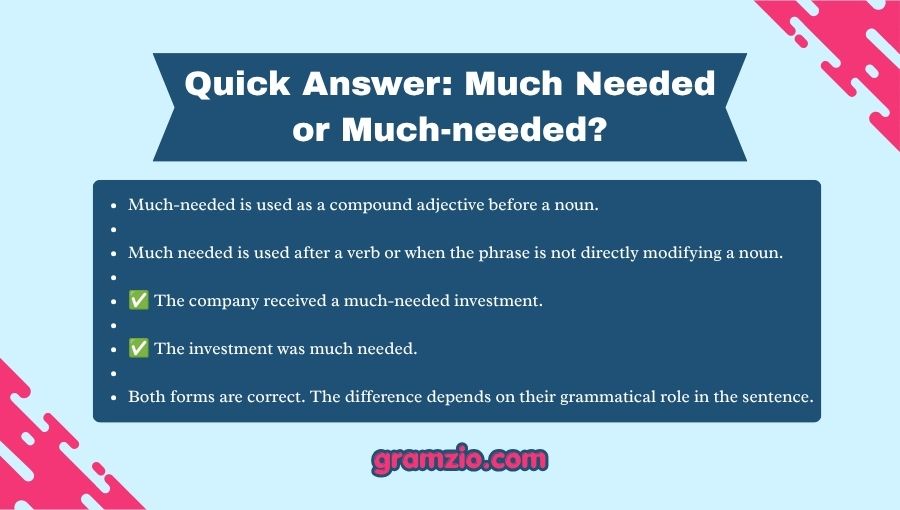
Much-needed is used as a compound adjective before a noun.
Much needed is used after a verb or when the phrase is not directly modifying a noun.
✅ The company received a much-needed investment.
✅ The investment was much needed.
Both forms are correct. The difference depends on their grammatical role in the sentence.
Understanding the Basics of Much Needed or Much-needed
The easiest way to understand the difference is to identify whether the phrase comes before a noun or after a verb.
| Form | Type | Meaning | Example | Correct/Incorrect |
|---|---|---|---|---|
| Much-needed | Compound adjective | Very necessary | A much-needed break | ✅ Correct |
| Much needed | Adjective phrase | Very necessary | The break was much needed | ✅ Correct |
| Much needed break | Missing required hyphen before noun | Incorrect adjective form | A much needed break | ❌ Usually Incorrect |
| Much-needed was | Incorrect placement | Wrong grammar structure | The break was much-needed | ❌ Usually Incorrect |
Simple Rule
- Before a noun → use much-needed
- After a verb → use much needed
Think of the hyphen as glue that joins two words into one adjective.
Correct Meanings and Uses
Using “Much-needed” Before a Noun
When the phrase directly describes a noun, use a hyphen.
Examples
✅ A much-needed vacation
✅ A much-needed solution
✅ A much-needed change
Sentence Breakdown
In the sentence:
We took a much-needed vacation.
The phrase much-needed describes the noun vacation.
Because it functions as a single adjective, the hyphen is required.
Test Tip 📝
If the phrase appears directly before a noun, use the hyphen.
Using “Much Needed” After a Verb
When the phrase appears after a linking verb such as:
- is
- was
- were
- seems
- feels
- became
the hyphen is usually unnecessary.
Examples
✅ The vacation was much needed.
✅ The support was much needed.
✅ Her advice was much needed.
Sentence Breakdown
In the sentence:
The support was much needed.
The phrase describes the support after the verb was.
Since it is not directly modifying a noun, no hyphen is required.
Test Tip 📝
If you can place the phrase after “was,” “is,” or “were,” remove the hyphen.
Comparing Both Forms Side by Side
| Sentence | Correct? |
|---|---|
| We enjoyed a much-needed vacation. | ✅ |
| The vacation was much needed. | ✅ |
| We enjoyed a much needed vacation. | ❌ |
| The vacation was much-needed. | Usually ❌ |
Case Study Section
Workplace Email Example
Imagine an employee has completed a difficult project after months of work.
Incorrect
“The team received a much needed break after finishing the project.”
Correct
“The team received a much-needed break after finishing the project.”
Why?
The phrase appears directly before the noun break, so it acts as a compound adjective.
Another Example
“The break was much needed after months of overtime.”
This version is also correct because the phrase follows the verb was.
Real-Life Takeaway
Professional writing often requires attention to details like hyphenation. Using the correct form can make your writing look polished and credible.
Grammar Rules Explanation
According to standard English grammar and usage guides such as Merriam-Webster, compound modifiers that appear before a noun are often hyphenated to avoid confusion.
Examples include:
- well-known author
- full-time employee
- long-term plan
- much-needed support
The hyphen signals that multiple words work together as a single modifier.
When the phrase appears after the noun, hyphenation is generally dropped.
Compare:
✅ A well-known actor
✅ The actor is well known
The same principle applies to:
✅ A much-needed improvement
✅ The improvement was much needed
This pattern is widely accepted in American English.
Common Mistakes
Many people make errors with much needed or much-needed because they are unsure when a hyphen is required.
Why These Mistakes Happen
Fast Typing ⌨️
Writers often skip punctuation while typing quickly.
Autocorrect 📱
Some devices inconsistently handle hyphenated compounds.
Lack of Grammar Knowledge 📚
Many people know both versions exist but do not understand when each should be used.
Similar Grammar Confusions
| Confusion | Correct Usage |
|---|---|
| It’s vs Its | It’s = it is, Its = possession |
| Your vs You’re | Your = possession, You’re = you are |
| Affect vs Effect | Affect = influence, Effect = result |
| Everyday vs Every Day | Everyday = adjective, Every day = phrase |
| Much-needed vs Much needed | Depends on position in sentence |
Usage in Different Contexts
Everyday Conversation
People commonly use both forms in speech.
Examples:
- That nap was much needed.
- We all need a much-needed holiday.
Both sound natural when used correctly.
Professional Writing
Business communication values grammatical accuracy.
Examples:
- The company received much-needed funding.
- Employee feedback was much needed.
Correct hyphenation creates a professional impression.
Creative Writing
Writers use the phrase to add emphasis.
Example:
“After years of struggle, the family finally enjoyed a much-needed moment of peace.”
The hyphen improves readability and flow.
Social Media and Texting
People often omit hyphens online.
Example:
“That coffee was much needed today!”
Although informal writing may ignore strict rules, proper grammar remains preferable.
Why It Matters
Many people wonder whether this small grammar detail is truly important.
The answer is yes. ✅
Clarity in Communication
Hyphens prevent confusion and help readers understand relationships between words.
Professionalism
Correct grammar reflects attention to detail and competence.
Writing Accuracy
In digital communication, even small punctuation marks can improve readability.
Quote
“Good writing is clear thinking made visible.”
When you use grammar correctly, your message becomes clearer and more effective.
Special Exception
There are very few exceptions to this rule.
Sometimes publishers, organizations, or brands follow their own style guides. A publication may choose to hyphenate or not hyphenate certain compound modifiers based on internal preferences.
However, in standard American English:
- Before a noun → much-needed
- After a verb → much needed
This remains the safest and most widely accepted rule.
Quick Recap Checklist
Which Form Should You Use?
| Question | If Yes → Use |
|---|---|
| Is the phrase directly before a noun? | Much-needed |
| Is it describing a noun as a compound adjective? | Much-needed |
| Is it after a linking verb? | Much needed |
| Does it come after was, is, or were? | Much needed |
Practice Examples
Example 1
The team received a ______ promotion.
✅ much-needed
Example 2
The promotion was ______.
✅ much needed
Example 3
After months of stress, she took a ______ vacation.
✅ much-needed
Frequently Asked Questions (FAQs)
Is “much-needed” grammatically correct?
Yes. Much-needed is grammatically correct when it appears before a noun and functions as a compound adjective.
Is “much needed” grammatically correct?
Yes. Much needed is correct when it appears after a verb and does not directly modify a noun.
Why does “much-needed” require a hyphen?
The hyphen joins the words into a single compound adjective that modifies a noun.
Example:
✅ a much-needed solution
Can I write “a much needed break”?
Most grammar experts recommend a much-needed break because the phrase comes before the noun break.
Which form is more common in professional writing?
Professional writing typically follows standard grammar rules:
- Much-needed before nouns
- Much needed after verbs
Does American English require the hyphen?
Yes, standard American English generally uses a hyphen when the phrase functions as a compound adjective before a noun.
Final Examples
| Correct Sentence | Reason |
|---|---|
| We enjoyed a much-needed vacation. | Before noun |
| The vacation was much needed. | After verb |
| The school received much-needed funding. | Before noun |
| The funding was much needed. | After verb |
| She welcomed a much-needed opportunity. | Before noun |
Conclusion
Understanding the difference between much needed or much-needed is easier than it first appears. The key is identifying how the phrase functions in a sentence. When it comes directly before a noun, use much-needed with a hyphen because it acts as a compound adjective. When it follows a verb such as is, was, or were, use much needed without a hyphen.
This simple rule can improve your writing, enhance professionalism, and eliminate a common grammar mistake. Whether you are composing emails, articles, reports, or social media posts, applying the correct form will make your communication clearer and more polished.
Remember this easy formula:
✅ Before a noun → much-needed
✅ After a verb → much needed
Master this distinction once, and you will never second-guess it again.
Also read: Simpler or More Simple

Hi, I’m Dexter Rhodes. At gramzio.com, I apply my 10 years of experience in copy-editing to ensure every guide we publish is accurate, professional, and follows the highest editorial standards.