Extensible vs Extendible: Meaning, Difference, Usage, and Examples (Complete Guide)
The difference between Extensible vs Extendible is one of the most common grammar confusions in English writing, especially for students, writers, and professionals working with technical or formal content. 🤔 Although both words come from the root “extend,” they are not used in the same way, and choosing the wrong one can make your writing sound unclear or incorrect.
Many people assume these words are interchangeable, but in reality, extensible vs extendible have subtle yet important differences in meaning and usage. This confusion often appears in software development, academic writing, and even everyday communication when describing objects, systems, or time limits.
In this complete guide, we will clearly break down Extensible vs Extendible in the simplest way possible. You’ll learn their meanings, differences, correct usage, grammar rules, real-life examples, and common mistakes to avoid. By the end, you’ll be confident in choosing the right word every time. ✍️
Quick Answer: Extensible vs Extendible
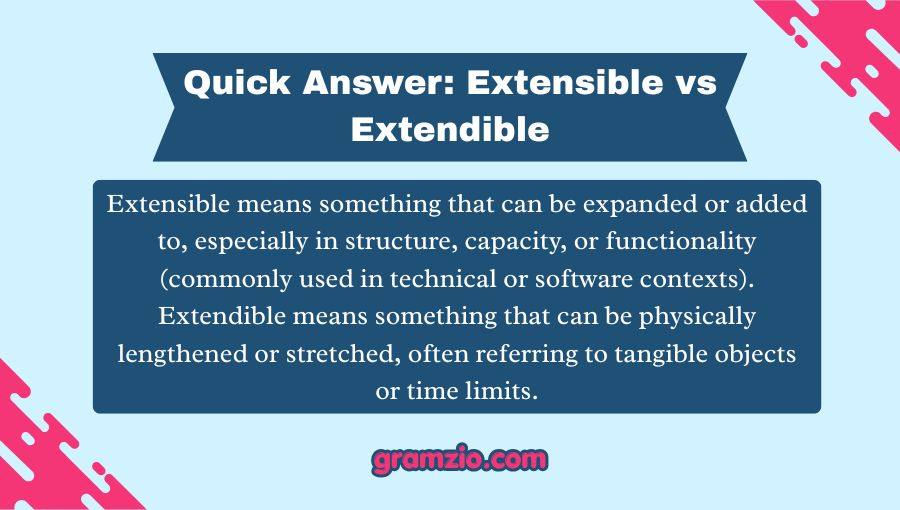
Extensible means something that can be expanded or added to, especially in structure, capacity, or functionality (commonly used in technical or software contexts).
Extendible means something that can be physically lengthened or stretched, often referring to tangible objects or time limits.
👉 In short:
- Extensible = expandable in structure or capability
- Extendible = able to be physically or temporally extended
Understanding the Basics: Extensible vs Extendible
Although both words come from “extend,” they are not always interchangeable. The key difference lies in how the extension happens.
🔹 Extensible
Form: Adjective
Type: Technical / Functional / Abstract
Meaning: Capable of being expanded in scope, structure, or capability.
📌 Example:
- A software system is extensible, meaning new features can be added easily.
🔹 Extendible
Form: Adjective
Type: Physical / Temporal
Meaning: Capable of being physically lengthened or stretched, or having duration increased.
📌 Example:
- A dining table is extendible, meaning it can be made longer.
📊 Comparison Table
| Feature | Extensible | Extendible |
|---|---|---|
| Form | Adjective | Adjective |
| Type | Functional / Technical | Physical / Temporal |
| Meaning | Can be expanded in structure | Can be physically lengthened |
| Common Usage | Software, systems, design | Furniture, time, objects |
| Example | Extensible programming system | Extendible dining table |
| Correct Usage | More common in tech writing | More common in physical use |
Correct Meanings & Uses
🔹 Extensible Meaning and Usage
“Extensible” is commonly used when something can grow in capability or structure without changing its core design.
📌 Examples:
- A cloud-based system is extensible, allowing developers to add new modules.
- The platform is designed to be extensible, so users can integrate plugins easily.
💡 Sentence Breakdown:
- “Extensible system” → system can grow
- “Extensible architecture” → structure can expand
🧠 Test Tip:
If you are talking about software, technology, or abstract systems, “extensible” is almost always correct.
🔹 Extendible Meaning and Usage
“Extendible” is used when something physically stretches or increases in length, or when time can be increased.
📌 Examples:
- The extendible table can seat more guests.
- The contract is extendible by one year.
💡 Sentence Breakdown:
- “Extendible table” → physical change in size
- “Extendible deadline” → time extension
🧠 Test Tip:
If you can see or physically measure the extension, use “extendible.”
Case Study Section 📘
Let’s look at a real-life workplace example:
📧 Email Situation:
Subject: Project System Update
“Our current platform is highly extensible, allowing the development team to add new features without redesigning the entire system. However, the deployment deadline is also extendible by two weeks if required.”
✔ Here:
- “Extensible” refers to software capability.
- “Extendible” refers to time extension.
This shows how both words can appear in the same context but serve different meanings.
Grammar Rules Explanation 📚
Both words are grammatically correct and listed in major dictionaries, including Merriam-Webster, but usage depends on context.
Key Grammar Insight:
- “Extensible” = emphasizes functionality and adaptability
- “Extendible” = emphasizes physical or temporal extension
Why confusion happens:
- Both come from the verb extend
- Both end with “-ible”
- Both are adjectives
However, English usage has evolved:
- “Extensible” is preferred in technical English
- “Extendible” is more traditional and physical
Common Mistakes Section ⚠️
Many learners mix these words due to similarity. Let’s see why:
❌ Why mistakes happen:
- Fast typing ⌨️
- Autocorrect errors 📱
- Lack of grammar awareness 📖
- Similar spelling confusion
📊 Similar Grammar Confusions
| Incorrect Pair | Correct Usage Tip |
|---|---|
| Its / It’s | Possession vs contraction |
| Affect / Effect | Verb vs noun distinction |
| Extendible / Extensible | Physical vs functional extension |
| Complement / Compliment | Complete vs praise |
Usage in Different Contexts 🌍
🗣️ Everyday Conversation
- “Is this table extendible?”
- “This system looks very extensible.”
💼 Professional Writing
- “The architecture is designed to be extensible.”
- “The contract includes an extendible clause.”
✍️ Creative Writing
- “The extendible bridge stretched across the river.”
- “An extensible world of imagination opened up.”
📱 Social Media / Texting
- “This app is so extensible 😍”
- “My dining table is extendible 😂”
Why It Matters 💡
Using the correct term improves clarity, professionalism, and communication accuracy.
✔ Clear writing builds trust
✔ Professional tone improves credibility
✔ Avoids misunderstanding in technical contexts
As writer George Orwell once emphasized:
“Good writing is clear thinking made visible.”
Choosing between extensible and extendible is a small detail—but it makes a big difference in clarity.
Special Exception ⚠️
In some rare cases, both words are accepted interchangeably in informal writing. However:
- Technical fields strongly prefer extensible
- Furniture and physical descriptions prefer extendible
There is no strict legal or brand restriction, but industry usage matters more than dictionary flexibility.
Quick Recap Checklist ✔️
| Question | If Yes → Use |
|---|---|
| Is it software or system-based? | Extensible |
| Is it physical or tangible? | Extendible |
| Can it be expanded in function? | Extensible |
| Can it be stretched or lengthened? | Extendible |
Practice Examples:
- A modular app is ______ (extensible)
- A sofa bed is ______ (extendible)
- A plugin system is ______ (extensible)
FAQs ❓
1. What is the main difference between extensible and extendible?
Extensible refers to expanding functionality or structure, while extendible refers to physical or time-based extension.
2. Is extensible a real English word?
Yes, “extensible” is a valid and widely used English adjective, especially in technical fields.
3. Can extendible and extensible be used interchangeably?
In most cases, no. They depend on context—technical vs physical usage.
4. Which is more common in modern English?
“Extensible” is more common in technology and professional writing, while “extendible” is less frequently used.
5. Is extendible correct in British English?
Yes, both words exist in British English, but usage still depends on context.
6. What is an example of extensible software?
A plugin-based system like a web browser that allows extensions is an example of extensible software.
Conclusion
Understanding the difference between Extensible vs Extendible helps you write with clarity and confidence. While both words come from the same root, they serve different purposes. “Extensible” is best used for systems, software, and abstract expansion, while “extendible” is reserved for physical objects and time extensions.
By mastering this small but important distinction, your writing becomes more precise and professional. Whether you’re writing emails, technical documents, or everyday content, choosing the correct word ensures your message is understood exactly as intended.
👉 In short: Think functionality for extensible, and physical stretching for extendible—and you’ll never get them wrong again.
Also read: Tomatoes or Tomatos

Hi, I’m Dexter Rhodes. At gramzio.com, I apply my 10 years of experience in copy-editing to ensure every guide we publish is accurate, professional, and follows the highest editorial standards.