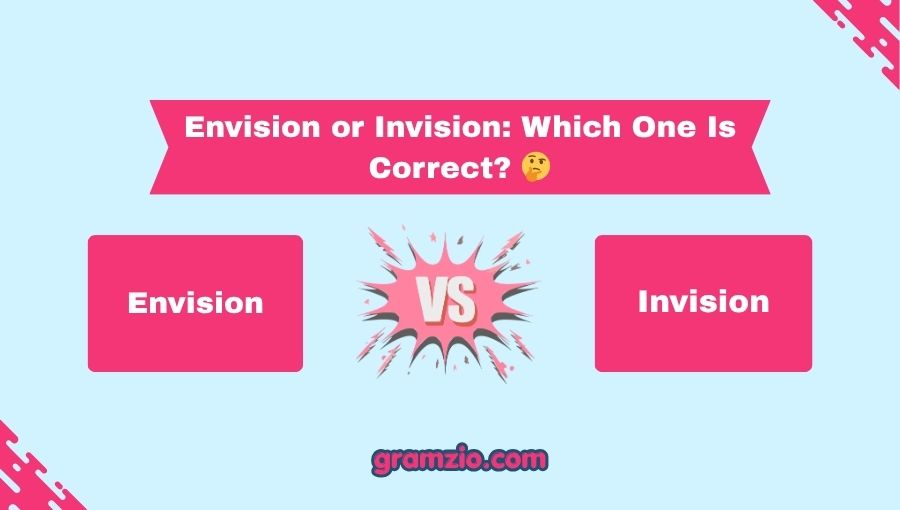
Envision or Invision: Which One Is Correct? 🤔
If you’ve ever wondered whether to use “envision or invision,” you’re not alone. This common spelling confusion appears frequently in emails, essays, and even professional writing. Many people assume both words are acceptable because they sound nearly identical. However, only one of them is actually correct in standard English.
The confusion between “envision or invision” usually comes from pronunciation and fast typing. Since both forms seem logical, writers often don’t realize they are making a mistake. Unfortunately, using the wrong version can affect clarity and make your writing look less polished.
In this guide, we will break down everything about “envision or invision,” including the correct spelling, meanings, grammar rules, and real-life usage. By the end, you will clearly understand which word to use and why it matters. 🚀
Quick Answer: Envision or Invision ✅
The correct word is “envision.”
It means to imagine or picture something clearly in your mind, especially something in the future.
👉 “Invision” is not a standard English word and should be avoided in formal and correct writing.
Understanding the Basics: Envision or Invision
Let’s simplify the difference:
- Envision = Correct spelling ✔️
- Invision = Incorrect spelling ❌
Here’s a quick comparison table to make it crystal clear:
| Form | Type | Meaning | Example Sentence | Correct/Incorrect |
|---|---|---|---|---|
| Envision | Verb | To imagine or visualize something clearly | I envision a world with clean energy. 🌱 | ✅ Correct |
| Invision | — | Not a recognized English word | I invision a better life. | ❌ Incorrect |
💡 Key takeaway: If you are talking about imagining something, always use “envision.”
Correct Meanings & Uses
What Does “Envision” Mean? 👁️
The verb “envision” means to mentally picture or imagine something that is not currently real.
Example 1:
👉 She envisions herself as a successful entrepreneur.
- She = subject
- envisions = verb (imagines clearly)
- herself as a successful entrepreneur = imagined outcome
Example 2:
👉 We envision a future with advanced technology. 🤖
- The speaker imagines a future scenario
Test Tip 🧠
If you can replace the word with “imagine” or “visualize,” then “envision” is correct.
👉 Example:
“I imagine a better tomorrow” → “I envision a better tomorrow” ✔️
Case Study Section: Real-Life Usage
Workplace Email Example 📧
❌ Incorrect:
“I invision our company growing rapidly next year.”
✅ Correct:
“I envision our company growing rapidly next year.”
Why this matters:
- The incorrect version looks unprofessional
- The correct version reflects strong language skills
In professional communication, even small spelling mistakes can affect credibility.
Grammar Rules Explanation 📘
The word “envision” comes from:
- Prefix “en-” = to cause or put into
- Root “vision” = seeing or imagining
So, “envision” literally means “to cause to see in the mind.”
According to Merriam-Webster, envision is defined as:
👉 “to picture to oneself; imagine.”
Why “Invision” Is Incorrect
- The prefix “in-” does not form a valid word with “vision” in this context
- It is likely a spelling error influenced by pronunciation
Common Mistakes Section ⚠️
Why Do People Write “Invision”?
- Fast typing ⌨️
- Autocorrect mistakes 📱
- Lack of vocabulary knowledge 📖
- Mishearing the word 👂
Similar Grammar Confusions
| Confusing Pair | Correct Usage Example |
|---|---|
| It’s / Its | It’s raining. / Its color is blue. |
| Your / You’re | Your book / You’re amazing! |
| Affect / Effect | This affects me / The effect is clear |
| Then / Than | First this, then that / Better than you |
💡 These mistakes happen for similar reasons—sound similarity and habit.
Usage in Different Contexts 🌍
1. Everyday Conversation
👉 I envision a relaxing weekend ahead. 😊
2. Professional Writing
👉 The CEO envisions global expansion by 2030.
3. Creative Writing
👉 He envisioned a magical kingdom beyond the mountains. 🏰
4. Social Media/Texting
👉 I envision my dream life ✨
⚠️ Avoid “invision” everywhere—it is always incorrect.
Why It Matters 💡
Using the correct word “envision” matters because:
- It improves clarity in communication
- It shows professionalism
- It ensures accuracy in writing
- It builds credibility in digital communication
📌 Quote:
“Good communication is the bridge between confusion and clarity.”
Special Exception Section 🚨
There is one important exception:
👉 InVision
- “InVision” (capitalized) is a brand name, not a standard English word
- It refers to a popular digital design platform
✅ Example:
- We use InVision for UI design collaboration.
❌ But:
- I invision success. (still incorrect)
Quick Recap Checklist ✅
| Question | If Yes → Use |
|---|---|
| Are you imagining or visualizing something? | Envision |
| Are you writing formal English? | Envision |
| Are you referring to a brand name? | InVision |
Practice Examples
- I ______ a peaceful life.
- She ______ her goals clearly.
- We use ______ for design tools.
✅ Answers:
- envision
- envisions
- InVision
FAQs: Envision or Invision❓
1. Is “invision” ever correct?
No, “invision” is not correct in standard English. The only exception is when referring to the brand InVision.
2. What does “envision” mean?
It means to imagine or picture something clearly in your mind, especially a future scenario.
3. Why do people confuse envision and invision?
Because they sound similar, and fast typing or autocorrect often leads to spelling errors.
4. Can I use “envision” in formal writing?
Yes, “envision” is completely appropriate for formal, academic, and professional writing.
5. Is “envision” the same as “imagine”?
They are very similar. However, “envision” often implies a clearer, more detailed mental picture.
6. What is the easiest way to remember the correct spelling?
Think of “envision” = “enable vision in your mind.” The prefix en- helps you remember the correct form.
Conclusion 🏁
To wrap it up, the confusion between “envision or invision” is simple once you know the rule. The correct word is always “envision,” which means to imagine or visualize something clearly. The spelling “invision” is incorrect and should be avoided in all forms of writing—except when referring to the brand name InVision.
Mastering small details like this can make a big difference in your communication. It helps you write with clarity, confidence, and professionalism. So next time you want to express a future idea or dream, don’t hesitate—envision it, don’t “invision” it. ✨
Also read: Recurring vs Reoccurring

Hi, I’m Axton Vane. I work at gramzio.com and bring over 11 years of experience in professional grammar. I specialize in refining complex syntax to help writers achieve perfect clarity in every sentence.