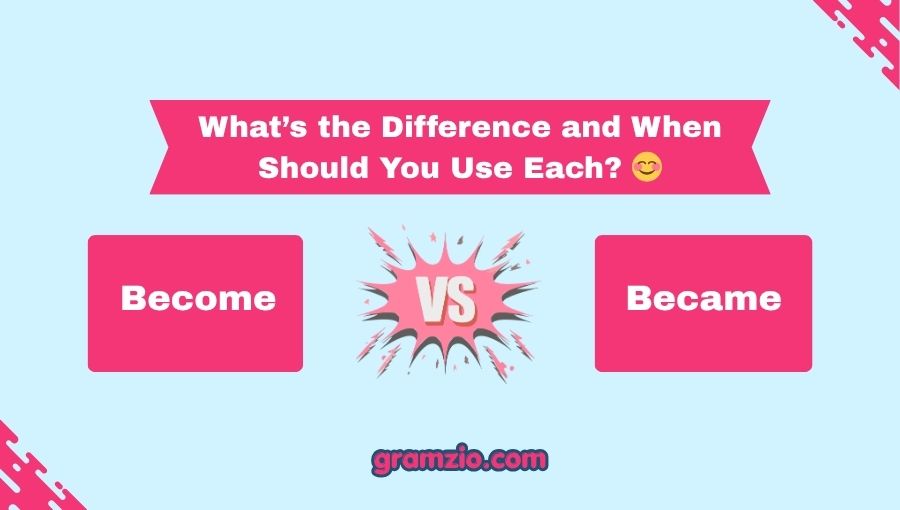
Become vs Became: What’s the Difference and When Should You Use Each? 😊
Have you ever typed a sentence like “I became happy every day” and paused because it sounded wrong? Or maybe you wrote “Yesterday I become tired after work” and wondered if it should be became instead. You are not alone. Many English learners—and even native speakers when typing quickly—get confused about become vs became.
These two words come from the same verb, but they are used in different tenses. That means choosing the wrong one can make your sentence sound unnatural or grammatically incorrect. The good news? Once you understand one simple grammar rule, this confusion becomes easy to fix.
In this guide, you will learn the exact difference between become vs became, when to use each one, common mistakes to avoid, and practical examples from real life. We will also cover grammar rules, usage tips, FAQs, and a simple checklist to help you remember the correct form every time.
If you want to improve your English writing and speak more confidently, this article will make the topic clear and easy. Let’s begin! 🚀
Quick Answer: Become vs Became
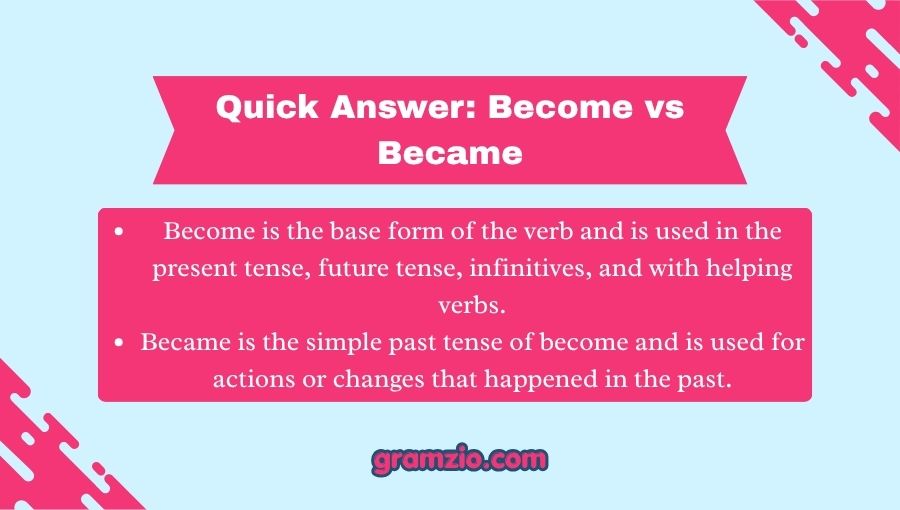
Become is the base form of the verb and is used in the present tense, future tense, infinitives, and with helping verbs.
Became is the simple past tense of become and is used for actions or changes that happened in the past.
Example:
- I want to become a doctor. ✅
- She became a doctor last year. ✅
Understanding the Basics: Become vs Became
The main difference between become vs became is time.
- Become = present, future, or after helping verbs
- Became = past
Comparison Table
| Form | Type | Meaning | Example | Correct/Incorrect |
|---|---|---|---|---|
| Become | Base Verb | To change into something | I want to become stronger. | Correct |
| Became | Past Tense Verb | Changed into something in the past | He became famous quickly. | Correct |
| Become | Used incorrectly in past | Wrong past form | Yesterday I become tired. | Incorrect |
| Became | Used incorrectly after “will” | Wrong future form | I will became rich. | Incorrect |
Correct Meanings & Uses
When to Use “Become”
Use become when talking about:
- Present habits
- Future goals
- After modal verbs (will, can, should, may)
- Infinitives (to become)
- Present perfect with helping verbs
Examples
- I want to become a teacher.
- She will become manager next month.
- You can become better with practice.
- They have become friends.
Sentence Breakdown
I want to become a teacher.
- I = subject
- want = main verb
- to become = infinitive phrase
- a teacher = result/change
Test Tip ✅
If the sentence includes to, will, can, should, or have, use become.
When to Use “Became”
Use became when something changed in the past and is complete.
Examples
- She became angry after the call.
- He became rich at age 30.
- The sky became dark suddenly.
- I became interested in coding last year.
Sentence Breakdown
He became rich at age 30.
- He = subject
- became = past tense verb
- rich = result/state
- at age 30 = time reference
Test Tip ✅
If the sentence includes words like yesterday, last year, ago, or another past time marker, use became.
Case Study Section
Workplace Email Example
Incorrect Email:
I become team leader last month.
Correct Email:
I became team leader last month.
Why?
“Last month” shows a completed past action, so became is required.
Another Example:
I hope to become team leader next year.
This refers to the future goal, so become is correct.
This shows how one small word choice can affect professional communication.
Grammar Rules Explanation
According to standard English grammar and dictionary usage such as Merriam-Webster, become is an irregular verb.
Verb Forms of Become
| Verb Form | Word |
|---|---|
| Base Form | become |
| Past Tense | became |
| Past Participle | become |
| Present Participle | becoming |
Examples
- Present: I become nervous easily.
- Past: I became nervous yesterday.
- Present Perfect: I have become more patient.
- Progressive: She is becoming stronger.
Why One Is Correct and the Other Is Incorrect
English verbs change form depending on tense. Since become is irregular, it does not simply add -ed.
Wrong: becomed ❌
Correct: became ✅
Common Mistakes Section
People confuse become vs became for several reasons:
- Fast typing
- Autocorrect errors
- Forgetting tense rules
- Translating directly from another language
- Lack of grammar knowledge
Common Errors
| Incorrect | Correct | Why |
|---|---|---|
| Yesterday I become tired. | Yesterday I became tired. | Past time |
| I will became better. | I will become better. | After “will” use base form |
| She has became famous. | She has become famous. | Past participle needed |
Similar Grammar Confusions
| Wrong Pair | Correct Difference |
|---|---|
| it’s / its | it is / possession |
| your / you’re | possession / you are |
| then / than | time / comparison |
| affect / effect | verb / noun |
| become / became | base form / past tense |
Usage in Different Contexts
Everyday Conversation
- I want to become healthier.
- He became upset.
Professional Writing
- Our company hopes to become a market leader.
- The startup became profitable in 2025.
Creative Writing
- The prince became a legend.
- She dreamed to become a star.
Social Media / Texting
- One day I’ll become unstoppable 😎
- Coffee became my best friend today ☕😂
Why It Matters (Important Section)
Using become vs became correctly improves:
Clarity in Communication
Your message becomes easier to understand.
Professionalism
Correct grammar builds trust in emails, resumes, and reports.
Writing Accuracy in Digital Communication
Small grammar mistakes can change tone or meaning online.
Quote
“Clear writing reflects clear thinking.”
When you choose the right tense, you sound smarter, more confident, and more polished.
Special Exception Section
There are no major brand-name exceptions for become vs became, but there is one important grammar note:
Past Participle Alert
Many learners use became after has/have/had. That is incorrect.
- She has become successful. ✅
- She has became successful. ❌
Remember:
- Simple past = became
- Past participle = become
Quick Recap Checklist
| Question | If Yes → Use |
|---|---|
| Is it about the past? | Became |
| Is there “yesterday,” “last year,” or “ago”? | Became |
| Is there “will,” “can,” or “should”? | Become |
| Is there “to” before the verb? | Become |
| Is there “has/have/had”? | Become |
Practice Examples
- She ___ famous after the movie.
✅ became - I want to ___ better at English.
✅ become - They have ___ close friends.
✅ become
FAQs: Become vs Became
1. What is the difference between become and became?
Become is the base form of the verb. Became is the past tense form.
2. Is “I became happy” correct?
Yes, if you mean it happened in the past.
Example: I became happy after hearing the news.
3. Is “I have became” correct?
No. The correct phrase is I have become.
4. Can I say “will became”?
No. After will, always use the base verb: will become.
5. Why is become used twice in verb forms?
Because become is an irregular verb:
- become
- became
- become
Base form and past participle are the same.
6. How can I remember became?
Think: came is inside became, and both refer to the past.
Conclusion
Understanding become vs became is simpler than it first appears. The rule comes down to tense. Use become for the present, future, infinitives, and after helping verbs. Use became for completed actions in the past. Also remember that with has, have, or had, the correct form returns to become.
Mistakes happen because English has irregular verbs, fast typing habits, and tense confusion. But once you practice a few examples, the right choice becomes automatic.
Whenever you write a sentence, ask yourself one quick question: Is this happening now/future, or did it happen in the past? That answer tells you which word to use.
Master this small grammar point, and your English will instantly sound sharper, cleaner, and more natural. ✨
Also read: Steer vs Stear

Hi, I’m Dexter Rhodes. At gramzio.com, I apply my 10 years of experience in copy-editing to ensure every guide we publish is accurate, professional, and follows the highest editorial standards.