Their vs There vs They’re — The Complete Grammar Guide (2026)
The confusion around Their vs There vs They’re is one of the most common grammar mistakes in English writing. Have you ever paused while writing a sentence and thought, “Should I use their, there, or they’re?” 🤔 You are not alone. These three words confuse even native English speakers because they sound exactly the same but have completely different meanings and functions.
Whether you’re writing emails, school essays, social media captions, or professional documents, using the wrong form can instantly change the meaning of your sentence—or make it unclear.
For example:
- “They left their bag.” ✔️
- “The bag is over there.” ✔️
- “They’re going home.” ✔️
In this article, you will learn the exact difference between these three words in a simple, clear, and memorable way. We will break down meanings, usage rules, real-life examples, common mistakes, and practical tips so you never get confused again. Let’s master this grammar rule once and for all! 🚀
Quick Answer: Their vs There vs They’re
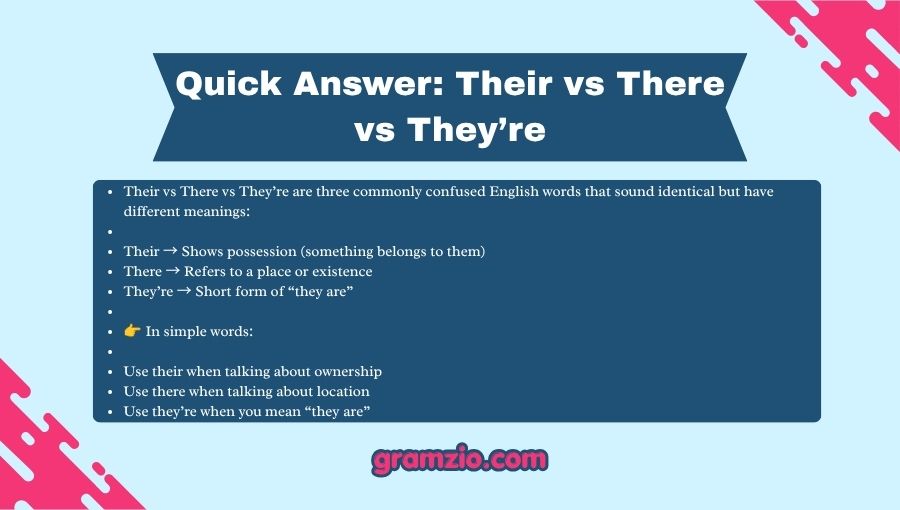
Their vs There vs They’re are three commonly confused English words that sound identical but have different meanings:
- Their → Shows possession (something belongs to them)
- There → Refers to a place or existence
- They’re → Short form of “they are”
👉 In simple words:
- Use their when talking about ownership
- Use there when talking about location
- Use they’re when you mean “they are”
Understanding the Basics (Their vs There vs They’re)
To fully understand Their vs There vs They’re, you must know that these words are homophones—words that sound the same but have different meanings.
Comparison Table
| Form | Type | Meaning | Example | Correct/Incorrect |
|---|---|---|---|---|
| Their | Possessive | Belonging to someone | Their house is big. | Correct usage ✔️ |
| There | Adverb | Place or existence | The book is over there. | Correct usage ✔️ |
| They’re | Contraction | They are | They’re going to school. | Correct usage ✔️ |
Correct Meanings & Uses
1. Meaning of “Their” (Possession) 🧑🤝🧑
Their is a possessive adjective. It shows that something belongs to a group of people.
Examples:
- Their car is new.
- I like their idea.
- The students submitted their homework.
Sentence Breakdown:
- “Their car is new.”
→ Car belongs to them (a group of people).
Test Tip 🧠:
If you can replace the word with “belonging to them,” then their is correct.
2. Meaning of “There” (Place or Existence) 📍
There is used to show location or to introduce something.
Examples:
- The shop is over there.
- There is a problem in the system.
- There are many books on the table.
Sentence Breakdown:
- “There is a problem.”
→ Shows existence of a problem.
Test Tip 🧠:
If you can point to a place or say “here/that place,” use there.
3. Meaning of “They’re” (They Are) ⚡
They’re is a contraction of “they are.”
Examples:
- They’re playing football.
- They’re very happy today.
- They’re coming to the party.
Sentence Breakdown:
- “They’re playing football.”
→ They are playing football.
Test Tip 🧠:
If you can expand the word into “they are,” then use they’re.
Case Study Section (Real-Life Example) 💼
Imagine you are writing an email at work:
❌ Incorrect:
- Their going to submit the report soon.
- Put the file over they’re.
✔️ Correct:
- They’re going to submit the report soon.
- Put the file over there.
- Check their report before submission.
Analysis:
In professional communication, mixing these words can confuse meaning and reduce credibility. A single mistake can make your writing look careless.
Grammar Rules Explanation 📘
According to standard English grammar rules (as explained by sources like Merriam-Webster and Oxford English guidelines):
- Their = possessive adjective (shows ownership)
- There = adverb (shows place or introduces sentence)
- They’re = contraction (they + are)
Why Confusion Happens:
- They sound identical (homophones)
- Fast typing leads to errors
- Autocorrect sometimes chooses wrong form
- Lack of grammar awareness
Understanding parts of speech is the key to mastering this rule.
Common Mistakes ⚠️
Why People Get Confused:
- Fast typing on mobile 📱
- Auto-correct mistakes
- Similar pronunciation
- Not knowing grammar rules
Common Grammar Confusions Table
| Wrong Form | Correct Form | Reason |
|---|---|---|
| Their going home | They’re going home | Missing contraction |
| Put it over their | Put it over there | Wrong location word |
| There book is nice | Their book is nice | Wrong possession form |
Usage in Different Contexts 🌍
1. Everyday Conversation 🗣️
- They’re coming soon.
- Their house is nearby.
- The store is over there.
2. Professional Writing 💼
- Their proposal was approved.
- The meeting will be held there.
- They’re responsible for the project.
3. Creative Writing ✍️
- Their dreams shaped their future.
- There was silence in the room.
- They’re lost in imagination.
4. Social Media/Texting 📱
- They’re so funny 😂
- Love their style ❤️
- Wish I was there!
Why It Matters (Important) ⭐
Using Their vs There vs They’re correctly is important because:
- Improves clarity in communication
- Enhances professional writing quality
- Prevents misunderstandings
- Builds credibility in academic and business writing
“Clear writing leads to clear thinking.”
Even a small grammar mistake can change the meaning of a sentence completely.
Special Exception ⚡
There are no major exceptions to these rules. However, informal texting sometimes ignores grammar rules, which is not recommended in professional writing.
Quick Recap Checklist ✔️
| Question | If Yes → Use |
|---|---|
| Does it show ownership? | Their |
| Does it show place? | There |
| Does it mean “they are”? | They’re |
Practice Examples:
- ___ going to the park.
- The bag is over ___.
- This is ___ house.
✔️ Answers:
- They’re
- There
- Their
FAQs: Their vs There vs They’re ❓
1. What is the easiest way to remember their, there, and they’re?
Think like this:
- Their = ownership
- There = place
- They’re = they are
2. Why do people confuse their, there, and they’re?
Because all three words sound the same when spoken, but have different meanings.
3. Is “they’re” formal or informal?
It is acceptable in both formal and informal writing, but avoid it in very formal academic writing if contractions are discouraged.
4. Can I replace “they’re” with “they are”?
Yes. They are the same meaning:
- They’re happy = They are happy
5. What happens if I use the wrong word?
It can change your sentence meaning and make your writing unclear or unprofessional.
6. Is “their” always about people?
Mostly yes, but it can also refer to animals or entities when showing possession.
Conclusion
Understanding Their vs There vs They’re is essential for mastering English grammar. Although these three words sound identical, they serve completely different purposes in writing and communication. “Their” shows possession, “there” refers to a place or existence, and “they’re” is simply a shortened form of “they are.”
By learning these differences with examples and practice, you can avoid one of the most common grammar mistakes in English. Whether you are writing emails, essays, or social media posts, using the correct form will improve your clarity and professionalism.
Remember this simple rule:
👉 Possession = their
👉 Place = there
👉 They are = they’re
Once you master this, your writing becomes clearer, more accurate, and more confident. Keep practicing, and soon you’ll never confuse these three words again. 🚀
Also read: Lay vs Lie

Hi, I’m Willa Sterling. I work at gramzio.com as a senior editor. With 15 years of experience in academic and formal grammar, I provide the expert insights you need to make your writing flawless.