Lay vs Lie: The Complete Grammar Guide You Need (with Simple Rules, Examples & Tips)
If you’ve ever written a sentence like “I am going to lay down” and then paused, wondering if it sounds right, you are not alone. The confusion between lay vs lie is one of the most common grammar struggles in the English language—even native speakers mix them up regularly. 😅
The reason this confusion happens is simple: both words are related to positioning something or someone down, and they sound similar. However, their grammar rules are completely different. One is a transitive verb (needs an object), and the other is an intransitive verb (does not need an object). That small difference changes everything.
Understanding lay vs lie is important not just for exams, but also for professional writing, emails, and everyday communication. Using the wrong form can make your English sound incorrect or less polished.
In this guide, you will learn the clear difference between lay vs lie, how to use each word correctly, common mistakes, real-life examples, and simple tricks to never get confused again. Let’s break it down step by step. 🚀
Quick Answer: Lay vs Lie (Focus Keyword Explained)
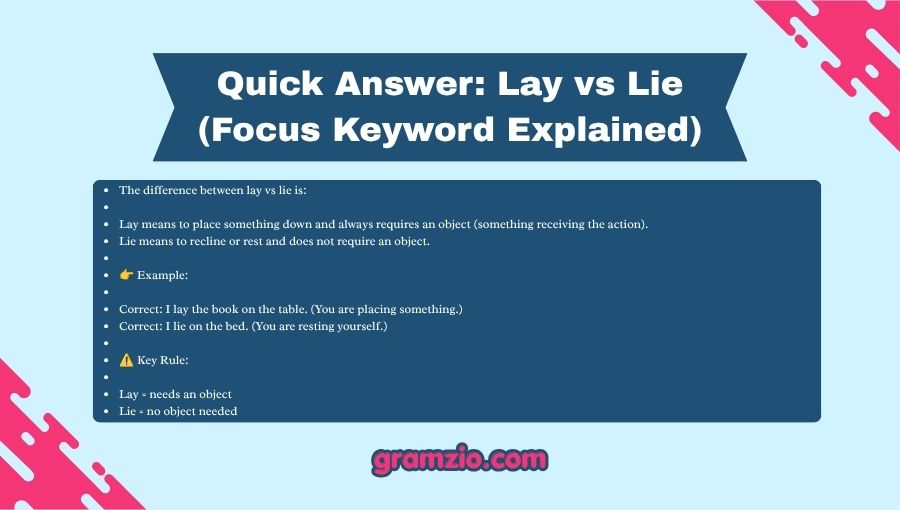
The difference between lay vs lie is:
- Lay means to place something down and always requires an object (something receiving the action).
- Lie means to recline or rest and does not require an object.
👉 Example:
- Correct: I lay the book on the table. (You are placing something.)
- Correct: I lie on the bed. (You are resting yourself.)
⚠️ Key Rule:
- Lay = needs an object
- Lie = no object needed
Understanding the Basics of Lay vs Lie
To fully understand lay vs lie, we must first understand their grammatical nature.
1. Lay (Transitive Verb)
- Meaning: To put or place something down
- Always requires an object
👉 Example:
- She lays the phone on the desk.
- He laid the baby in the crib.
2. Lie (Intransitive Verb)
- Meaning: To rest or recline
- Does NOT require an object
👉 Example:
- I lie on the sofa every evening.
- The cat lies in the sun.
Lay vs Lie Comparison Table 📊
| Form | Type | Meaning | Example | Correct/Incorrect |
|---|---|---|---|---|
| Lay | Transitive | To place something down | I lay the book on the table | Correct |
| Lie | Intransitive | To rest or recline | I lie on the bed | Correct |
| Lay | Incorrect use (when no object) | Wrong usage | I lay on the bed (❌) | Incorrect |
| Lie | Incorrect use (with object) | Wrong usage | I lie the book down (❌) | Incorrect |
Correct Meanings & Uses of Lay vs Lie
H3: How to Use “Lay” Correctly ✋
“Lay” always involves doing something to an object.
Examples:
- I lay the clothes on the bed.
- She lays the keys on the table.
- They laid the foundation of the house.
Sentence Breakdown:
- Subject: I / She / They
- Verb: lay / lays / laid
- Object: clothes / keys / foundation
👉 Without an object, “lay” becomes incorrect.
Test Tip 🧠:
Ask yourself: Am I placing something?
If YES → Use lay
H3: How to Use “Lie” Correctly 🛌
“Lie” means to rest or be in a horizontal position.
Examples:
- I lie down after work.
- She lies on the couch every afternoon.
- He lay on the beach yesterday.
Important Note:
“Lie” changes completely in past tense:
- Lie → Lay → Lain
Test Tip 🧠:
Ask yourself: Is someone resting themselves?
If YES → Use lie
Case Study: Lay vs Lie in Real Life 💼
Imagine this workplace email:
❌ Incorrect:
“I will lie the documents on your desk.”
This is wrong because documents are an object.
✔ Correct:
“I will lay the documents on your desk.”
Now a personal example:
❌ Incorrect:
“I am going to lay down for a while.”
✔ Correct:
“I am going to lie down for a while.”
👉 This small correction makes your communication sound professional and accurate.
Grammar Rules Behind Lay vs Lie 📚
The confusion between lay vs lie comes from their grammatical structure:
1. Lay = Transitive Verb
- Requires an object
- Example: She lays the baby down.
2. Lie = Intransitive Verb
- No object needed
- Example: She lies down.
Why It’s Confusing
According to grammar references like Merriam-Webster, the past tense forms overlap:
- Lie → Lay (past tense)
- Lay → Laid (past tense)
This overlap causes most mistakes.
Common Mistakes in Lay vs Lie ❌
People often mix up these verbs because of:
- Fast typing ⌨️
- Autocorrect errors 📱
- Lack of grammar awareness 📖
Common Confusion Table
| Confused Words | Wrong Example | Correct Form |
|---|---|---|
| lay vs lie | I lay down on bed | I lie down |
| lay vs lie | I lie the book down | I lay the book down |
| sit vs set | I set here | I sit here |
Usage in Different Contexts 🌍
1. Everyday Conversation 🗣️
- I lie down after lunch.
- Please lay the bag on the chair.
2. Professional Writing 💼
- The manager laid the report on the desk.
- The employee lies down during break time.
3. Creative Writing ✍️
- She lay beneath the stars, dreaming quietly.
- He laid his sword on the ground.
4. Social Media/Texting 📱
- “I’m gonna lie down, tired 😴”
- “Just laid my phone down lol 😂”
Why Lay vs Lie Matters 🎯
Using lay vs lie correctly improves:
- ✔ Communication clarity
- ✔ Professional writing quality
- ✔ Academic accuracy
- ✔ Confidence in English usage
“Clear grammar builds clear thinking.”
When you use grammar correctly, your message becomes more powerful and trustworthy.
Special Exception ⚠️
There are no major exceptions in modern English usage, but poetic or old English texts may use “lie” differently in past tense forms like “lay” in literary contexts.
Example:
- “He lay still in the grass.” (correct past tense of lie)
Quick Recap Checklist ✔️
| Question | If Yes → Use |
|---|---|
| Are you placing something? | Lay |
| Are you resting yourself? | Lie |
Practice Examples 🧠
- I ___ the phone on the table.
✔ Answer: lay - I want to ___ down now.
✔ Answer: lie - She ___ the baby in bed.
✔ Answer: laid
FAQs: Lay vs Lie (Most Asked Questions)
1. What is the main difference between lay vs lie?
“Lay” requires an object and means to place something down. “Lie” does not require an object and means to rest or recline.
2. Is it correct to say “I lay down”?
No, in present tense you should say “I lie down.” “Lay” is incorrect without an object.
3. What is the past tense of lie?
The past tense of “lie” is “lay.”
Example: I lie down today → I lay down yesterday.
4. What is the past tense of lay?
The past tense of “lay” is “laid.”
Example: I lay the book down → I laid the book down.
5. Why do people confuse lay and lie?
Because their past tense forms overlap and sound similar, causing frequent grammar mistakes in speaking and writing.
6. How can I easily remember lay vs lie?
Think:
- Lay = Place it (needs object)
- Lie = Recline yourself (no object)
Conclusion 🧾
The confusion between lay vs lie is one of the most common grammar challenges, but once you understand the rule, it becomes very simple. The key difference is that lay requires an object, while lie does not require an object.
By practicing daily examples like “I lie down” and “I lay the book down,” you can quickly master this grammar rule. Remember that mistakes often happen due to similar spelling and irregular verb forms, but consistent practice eliminates confusion.
Mastering lay vs lie will improve your writing, speaking, and professional communication. It’s a small grammar rule—but it makes a big difference in clarity and confidence. 🌟
Also read: Its vs It’s

Hi, I’m Axton Vane. I work at gramzio.com and bring over 11 years of experience in professional grammar. I specialize in refining complex syntax to help writers achieve perfect clarity in every sentence.