Hanged vs Hung: The Complete Grammar Guide You Need to Master 🎯
The confusion between hanged vs hung is one of the most common grammar problems in English writing, and many learners struggle to know which form is correct. At first glance, both words look similar because they come from the same verb “hang,” but their meanings and usage rules are actually very different. Using the wrong one can completely change the meaning of a sentence, especially in formal or historical contexts.
Have you ever paused while writing and wondered whether to use hanged or hung? You are not alone. Even native English speakers often get confused because both forms seem grammatically correct—but they are not always interchangeable. One is used in a very specific legal context, while the other is used for everyday situations like objects, clothes, or decorations.
In this article, you will clearly understand the difference between hanged vs hung, when to use each one, why the distinction exists, and how to avoid common mistakes. By the end, you will confidently use both forms correctly in writing, speaking, and exams. Let’s clear up this grammar confusion once and for all 😊
Quick Answer: Hanged vs Hung
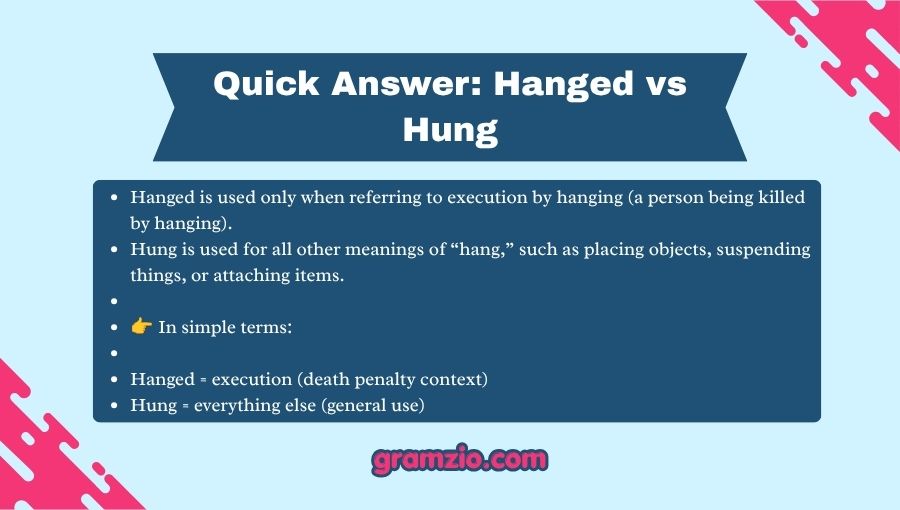
Hanged is used only when referring to execution by hanging (a person being killed by hanging).
Hung is used for all other meanings of “hang,” such as placing objects, suspending things, or attaching items.
👉 In simple terms:
- Hanged = execution (death penalty context)
- Hung = everything else (general use)
Understanding the Basics: Hanged vs Hung
To fully understand hanged vs hung, we must first look at the verb “hang.” The verb has two past tense forms depending on context:
- Hang → Hung (general use)
- Hang → Hanged (execution only)
📊 Comparison Table
| Form | Type | Meaning | Example Sentence | Correct/Incorrect |
|---|---|---|---|---|
| Hung | Verb (past tense) | To suspend or attach something | She hung the clothes on the line. | Correct (general use) |
| Hung | Verb (past participle) | Same general meaning | He has hung the picture on the wall. | Correct |
| Hanged | Verb (past tense) | To execute a person by hanging | The criminal was hanged at dawn. | Correct (execution only) |
| Hanged | General object use | Hanging clothes or items | ❌ “I hanged the shirt” | Incorrect |
Correct Meanings & Uses
1. When to Use “Hung” 🖼️
The word hung is the most commonly used past tense of “hang.” It applies to objects, decorations, clothes, and almost everything except execution.
Examples:
- I hung my jacket on the chair.
- She hung the painting in the living room.
- They have hung fairy lights for the party.
Sentence Breakdown:
- “She hung the painting in the living room.”
- Subject: She
- Verb: hung
- Object: painting
- Meaning: She placed the painting on the wall
👉 Test Tip: If the sentence involves objects, things, or decorations, always use hung.
2. When to Use “Hanged” ⚖️
The word hanged is very specific. It is only used when referring to execution by hanging.
Examples:
- The prisoner was hanged for his crimes.
- In historical times, criminals were hanged publicly.
- The traitor was hanged at sunrise.
Sentence Breakdown:
- “The prisoner was hanged for his crimes.”
- Subject: prisoner
- Verb: hanged
- Meaning: execution by hanging
👉 Test Tip: If the sentence involves law, punishment, or execution, use hanged.
Case Study: Real-Life Usage Example 🧠
Workplace Email Example
❌ Incorrect:
The manager hanged the new policy notice on the board.
✔ Correct:
The manager hung the new policy notice on the board.
Historical Article Example
✔ Correct:
The spy was hanged for treason during wartime.
Explanation:
- “Policy notice” = object → use hung
- “Spy executed” = death penalty → use hanged
This shows how context completely changes the correct word choice.
Grammar Rules Explanation 📚
The difference between hanged vs hung is based on historical grammar development in English.
According to standard English grammar rules (including references like Merriam-Webster usage notes), the verb “hang” has two distinct past forms:
- Hung → general physical placement or suspension
- Hanged → legal execution by hanging
Why the difference exists:
- English developed separate forms to distinguish ordinary hanging from judicial execution
- This avoids confusion in legal and historical writing
👉 Important rule:
Always consider meaning, not just tense, when choosing between hanged and hung.
Common Mistakes ⚠️
Many learners confuse hanged vs hung because both sound natural in past tense. Let’s look at why mistakes happen:
Why People Get Confused:
- Fast typing ⌨️
- Autocorrect errors 📱
- Lack of grammar awareness 📖
- Overgeneralization of “-ed” past tense rules
Common Grammar Confusions Table
| Confusion Pair | Correct Usage Example | Incorrect Example |
|---|---|---|
| It’s / Its | It’s raining today | Its raining today |
| Your / You’re | You’re amazing | Your amazing |
| Hung / Hanged | She hung the dress | She hanged the dress |
| There / Their | Their car is new | There car is new |
Usage in Different Contexts 🌍
1. Everyday Conversation 🗣️
- I hung my bag on the chair.
- The picture was hung crooked.
2. Professional Writing 💼
- The documents were hung on the notice board.
- The criminal was hanged for war crimes (historical/legal writing).
3. Creative Writing ✍️
- The lanterns hung softly in the night breeze.
- The villain was hanged as justice prevailed.
4. Social Media/Texting 📱
- Hung my new poster today 😍
- Old stories say he was hanged… dark history 😶
Why It Matters (Important) 🚨
Using hanged vs hung correctly is important because:
- It improves clarity in communication
- It shows professional grammar skills
- It avoids misunderstanding in sensitive topics
- It enhances writing accuracy in academic and digital content
📌 As English linguist Randolph Quirk once emphasized:
“Precision in language reflects precision in thought.”
Special Exception ⚠️
There are no major exceptions to the rule, but informal speech sometimes ignores the distinction. In casual conversation, many people mistakenly use “hung” for everything.
However, in formal writing, journalism, law, and academics, the distinction must always be maintained.
Quick Recap Checklist ✅
| Question | If Yes → Use |
|---|---|
| Is it about execution or legal hanging? | Use hanged |
| Is it about objects, clothes, or items? | Use hung |
| Is it general past tense of hang? | Use hung |
Practice Examples:
- The painting was ___ on the wall. → hung
- The criminal was ___ at dawn. → hanged
- She has ___ the curtains beautifully. → hung
FAQs: Hanged vs Hung ❓
1. What is the main difference between hanged and hung?
Hanged is used for execution by hanging, while hung is used for all other meanings like placing or suspending objects.
2. Can I use “hanged” for clothes or pictures?
No. It is incorrect. You should always use hung for objects like clothes, pictures, or decorations.
3. Why does English have two different forms?
To clearly distinguish between execution (hanged) and general hanging actions (hung), avoiding confusion.
4. Is “hung” always past tense?
Hung is both the past tense and past participle of “hang” in general usage.
5. Is it correct to say “hunged”?
No. “Hunged” is not a word in English grammar.
6. Which is more common in daily English?
Hung is far more common because it applies to everyday actions.
Conclusion
The confusion between hanged vs hung is common, but the rule is actually simple once understood. Use hung for objects, clothes, decorations, and general actions. Use hanged only when referring to execution by hanging.
Remembering this distinction will improve your grammar accuracy, enhance your writing clarity, and make your English sound more professional. Whether you are writing an essay, email, or social media post, choosing the correct form will always make your communication stronger.
So next time you write the word “hang” in the past tense, pause for a second and ask: Is this about execution or objects? That one question will always guide you to the correct answer 😊
Also read: Fewer vs Less

Hi, I’m Grayson Finch. I’m part of the gramzio.com team with 9 years of experience in grammar education. I am dedicated to teaching professional communication and helping you master the art of writing.