Among vs Between: The Complete Grammar Guide You Need (With Easy Examples) 📘✨
Have you ever wondered whether to say “between friends” or “among friends”? Or maybe you’ve paused while writing an email, unsure if you should use among vs between in a sentence? You’re not alone. This is one of the most commonly confused grammar topics in English.
The confusion happens because both words deal with relationships, separation, or connection. However, they are not interchangeable. Each word has a specific grammatical purpose that depends on the number of things or people involved and the nature of the relationship between them.
Understanding among vs between is important for clear communication, especially in academic, professional, and everyday writing. Using the wrong word can make sentences sound unnatural or even incorrect.
In this detailed guide, you’ll learn the real difference between among vs between, when to use each one, common mistakes, real-life examples, and expert grammar rules. By the end, you’ll never feel confused again. Let’s make English grammar simple, practical, and easy to remember 😊
Quick Answer: Among vs Between
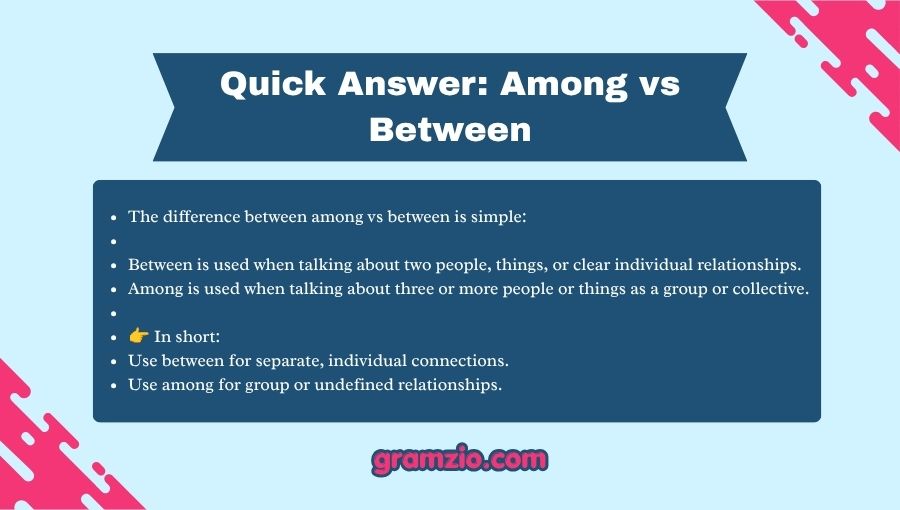
The difference between among vs between is simple:
- Between is used when talking about two people, things, or clear individual relationships.
- Among is used when talking about three or more people or things as a group or collective.
👉 In short:
Use between for separate, individual connections.
Use among for group or undefined relationships.
Understanding the Basics of Among vs Between
To fully understand among vs between, we need to break them down logically.
What “Between” Means
“Between” is used when you are referring to:
- Two distinct items or people
- Or multiple items that are individually connected
👉 Example:
- The money was divided between Ali and Sara.
Even if there are more than two things, “between” is still correct when relationships are individual.
👉 Example:
- The negotiations between the three companies were confidential.
What “Among” Means
“Among” is used when:
- Things are part of a group
- The relationship is not individually separated
- You are talking about a collective group
👉 Example:
- She shared sweets among the children.
Comparison Table: Among vs Between
| Feature | Between | Among |
|---|---|---|
| Form | Preposition | Preposition |
| Type | Individual relationships | Group relationships |
| Meaning | Separation or connection of distinct items | Belonging within a group |
| Example | The deal between A and B | She sat among friends |
| Correct/Incorrect | Correct for 2 or clear relations | Correct for 3+ group contexts |
Correct Meanings & Uses
1. Using “Between” in Detail
“Between” focuses on clear, separate relationships.
✔ Example 1:
The discussion between the teacher and student was serious.
👉 Breakdown:
- Teacher → Student = two distinct individuals
- Relationship is direct
✔ Example 2:
The chocolate was shared between Ahmed, Bilal, and Hamza.
Even though there are three people, the chocolate is divided individually.
Test Tip 🧠
Ask yourself:
👉 “Can I see individual connections?”
If YES → Use between
2. Using “Among” in Detail
“Among” focuses on group-based relationships.
✔ Example 1:
He felt comfortable among his classmates.
👉 Breakdown:
- Group = classmates
- No individual separation
✔ Example 2:
The secret spread among the villagers.
👉 The group acts as a whole.
Test Tip 🧠
Ask yourself:
👉 “Is it a group without clear separation?”
If YES → Use among
Case Study Section (Real-Life Usage)
📧 Workplace Email Example
❌ Incorrect:
We need to distribute tasks among John and Sarah.
✔ Correct:
We need to distribute tasks between John and Sarah.
👉 Why?
Because there are only two individuals with clear division.
💬 Conversation Example
A: How was the food shared?
B: It was shared among all the guests.
👉 Why “among”?
Because guests form a group.
🏫 Classroom Example
The prize was divided between the top three students.
👉 Correct because each student receives a separate share.
Grammar Rules Explanation
According to standard grammar references like Merriam-Webster Dictionary and widely accepted English usage guides:
- Between = used for distinct, individual relationships, even with more than two items.
- Among = used for collective or undefined group relationships.
🧾 Key Rule:
- If items are clearly separated → Between
- If items are part of a group → Among
Common Mistakes
❌ Why People Get Confused
- Fast typing ⌨️ leads to mistakes
- Autocorrect may change words incorrectly
- Lack of grammar understanding
📊 Common Grammar Confusion Table
| Incorrect Pair | Correct Usage | Reason |
|---|---|---|
| among you and me | between you and me | two people |
| between students in class | among students in class | group context |
| among A and B | between A and B | individual relationship |
Usage in Different Contexts
🗣 Everyday Conversation
- Between you and me, it’s a secret.
- He stood among strangers.
💼 Professional Writing
- Agreement between two companies.
- Collaboration among departments.
✍ Creative Writing
- A hero lost between light and darkness.
- A voice among the silence.
📱 Social Media/Texting
- Between us, don’t tell anyone 🤫
- Feeling happy among friends ❤️
Why It Matters (Important)
Correct usage of among vs between improves:
- Clarity in communication
- Professional writing quality
- Academic accuracy
- Confidence in English usage
📢 As George Orwell once emphasized:
“Good writing is clear thinking made visible.”
Using the right preposition ensures your message is understood exactly as intended.
Special Exception
Some traditional grammar “rules” are flexible in modern English:
✔ “Between” is often used even with more than two items when relationships are individual.
✔ “Among” is always used for general grouping.
There are no brand-specific exceptions, but modern usage allows flexibility when clarity remains intact.
Quick Recap Checklist
| Question | If Yes → Use |
|---|---|
| Are there only two people/items? | Between |
| Are items individually connected? | Between |
| Is it a group situation? | Among |
| Is separation unclear or collective? | Among |
🧪 Practice Examples
- The agreement was signed ___ the two countries.
✔ Between - She distributed chocolates ___ the children.
✔ Among - The secret is ___ you and me.
✔ Between
FAQs (Among vs Between)
1. What is the main difference between among and between?
Between is used for distinct or individual relationships, while among is used for group-based or collective relationships.
2. Can “between” be used for more than two things?
Yes. If each item has a clear, individual relationship, “between” is correct.
3. Is “among friends” correct?
Yes. “Among friends” is correct because friends form a group.
4. Which is more formal: among or between?
Both are equally formal. The choice depends on context, not formality.
5. What is a simple trick to remember the difference?
- Between = “two or clear separation”
- Among = “group or collective”
6. Can they ever be interchangeable?
Rarely. In most cases, swapping them changes meaning or sounds incorrect.
Conclusion
Understanding among vs between is essential for mastering English grammar and improving communication clarity. While both words relate to relationships, their usage depends on structure and context. Between is used for clear, individual connections, even if there are more than two items. On the other hand, among is used when referring to groups or collective relationships without distinct separation.
Once you learn this simple rule, your writing becomes more accurate, professional, and natural. Whether you’re writing emails, essays, or social media posts, choosing the correct word helps you express ideas clearly and confidently.
Always remember the golden rule:
👉 Use between for individual relationships.
👉 Use among for group relationships.
With practice, this distinction becomes automatic. So next time you write, pause for a second and choose wisely—because small grammar choices can make a big difference in how your message is understood ✨.
Also read: Allusion vs Illusion

Hi, I’m Willa Sterling. I work at gramzio.com as a senior editor. With 15 years of experience in academic and formal grammar, I provide the expert insights you need to make your writing flawless.