To Fast Or Too Fast: Which One Is Correct? 🚦
To Fast Or Too Fast is a grammar question that confuses many English writers. Have you ever typed a sentence like “You’re going to fast” and paused to wonder whether it should actually be “too fast”? 🤔 Since to and too sound exactly alike, it is easy to mix them up, especially when writing quickly in emails, text messages, social media posts, or workplace communication.
This confusion is extremely common because both words are legitimate parts of English grammar, yet they serve completely different purposes. Using the wrong form can change the meaning of a sentence or make your writing appear less polished.
Understanding the difference between To Fast Or Too Fast is essential for clear, professional, and accurate communication. In this guide, you’ll learn the correct meanings, grammar rules, real-world examples, common mistakes, and simple memory tricks that will help you choose the right expression every time. ✅
Quick Answer: To Fast Or Too Fast
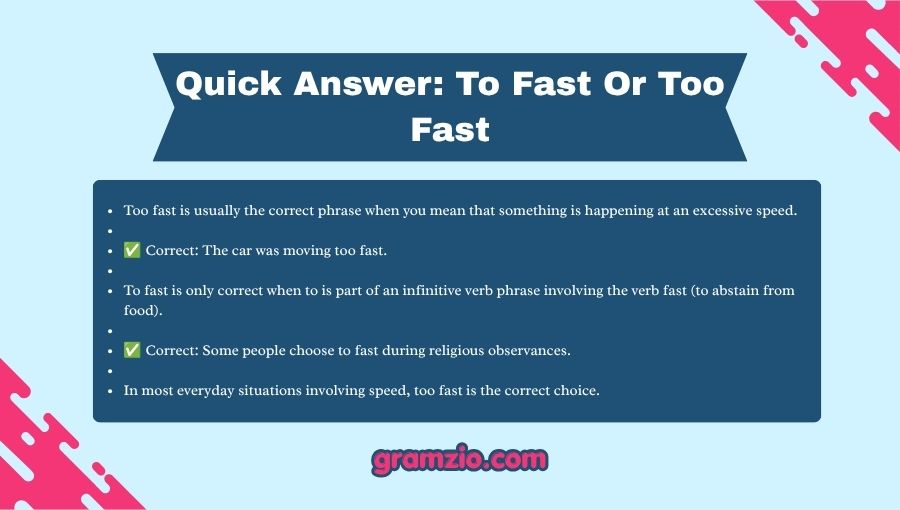
Too fast is usually the correct phrase when you mean that something is happening at an excessive speed.
✅ Correct: The car was moving too fast.
To fast is only correct when to is part of an infinitive verb phrase involving the verb fast (to abstain from food).
✅ Correct: Some people choose to fast during religious observances.
In most everyday situations involving speed, too fast is the correct choice.
Understanding the Basics of To Fast Or Too Fast
The confusion comes from the fact that to and too are homophones. They sound alike but have different meanings and grammatical functions.
| Form | Type | Meaning | Example | Correct/Incorrect |
|---|---|---|---|---|
| To fast | Infinitive phrase | To abstain from eating | I decided to fast for a day. | ✅ Correct |
| Too fast | Adverb phrase | Excessively fast | You are driving too fast. | ✅ Correct |
| To fast | Used instead of too fast | Incorrect when discussing speed | The car is going to fast. | ❌ Incorrect |
| Too fast | Describing excessive speed | Correct usage | The runner started too fast. | ✅ Correct |
Simple Rule
If you mean excessively quick, use too fast.
If you mean abstaining from food, use to fast.
Correct Meanings and Uses
What Does “Too Fast” Mean?
The word too means more than necessary, excessively, or beyond an acceptable limit.
When paired with fast, it means something is moving, happening, or progressing at an excessive speed.
Examples
✅ The train was moving too fast.
Breakdown:
- Too = excessively
- Fast = quick
Meaning: The train’s speed exceeded what was appropriate.
✅ She talks too fast for me to understand.
Meaning: Her speaking speed is excessive.
✅ The project moved too fast and mistakes were made.
Meaning: The pace was quicker than ideal.
Test Tip 💡
Replace too with excessively.
If the sentence still makes sense, too fast is correct.
Example:
- The car is excessively fast.
- The car is too fast.
Both make sense.
What Does “To Fast” Mean?
The phrase to fast uses to as part of an infinitive verb construction.
Here, fast is a verb meaning to abstain from eating or drinking for a period of time.
Examples
✅ Many people choose to fast during Ramadan.
Breakdown:
- To = infinitive marker
- Fast = verb
Meaning: They choose not to eat for a certain period.
✅ The doctor advised him to fast before surgery.
Meaning: Refrain from eating before the procedure.
✅ She plans to fast tomorrow.
Meaning: She intends to avoid food temporarily.
Test Tip 💡
Replace fast with another verb.
Example:
- She plans to run tomorrow.
- She plans to fast tomorrow.
If the structure works, to fast is correct.
Comparing To Fast and Too Fast
| Phrase | Meaning | Example |
|---|---|---|
| To fast | To refrain from eating | They decided to fast. |
| Too fast | Excessively quick | The bike was moving too fast. |
| To fast | Verb phrase | Patients must fast before surgery. |
| Too fast | Adverb phrase | He spoke too fast. |
The difference is not about spelling preference. It is a completely different meaning.
Case Study Section
Workplace Email Example
Imagine an employee sends this email:
❌ Incorrect:
The software update is moving to fast and employees cannot keep up.
Readers may immediately notice the mistake.
✅ Correct:
The software update is moving too fast and employees cannot keep up.
Now the sentence clearly communicates that the pace of the update is excessive.
Why It Matters
In professional communication:
- Grammar mistakes can reduce credibility.
- Messages become less clear.
- Readers may focus on errors instead of content.
Using too fast correctly helps maintain professionalism.
Grammar Rules Explanation
According to standard English grammar references such as the dictionary and usage guidance found in resources like Merriam-Webster, too functions as an adverb meaning also or excessively.
Examples:
- Too expensive
- Too loud
- Too fast
The word to, on the other hand, is typically:
- A preposition
- An infinitive marker
Examples:
- To school
- To work
- To eat
- To fast
Why “Too Fast” Is Usually Correct
When discussing speed, pace, or rate, you are describing a degree of quickness.
The adverb too modifies fast.
Example:
The motorcycle is too fast.
Here, too means “excessively.”
Why “To Fast” Is Usually Incorrect
In a sentence like:
❌ The motorcycle is to fast.
The word to does not have a grammatical function that fits the sentence.
Therefore, the phrase is incorrect.
Common Mistakes
Many people confuse these expressions because they sound identical when spoken.
Why the Mistakes Happen
Fast Typing ⌨️
People often type quickly and accidentally select the wrong spelling.
Autocorrect Issues 📱
Autocorrect may not catch the error because both words are legitimate English words.
Lack of Grammar Knowledge 📚
Many writers know how the phrase sounds but have never learned the grammatical difference.
Similar Grammar Confusions
| Incorrect Pair | Correct Distinction |
|---|---|
| Its / It’s | Possession vs contraction |
| Your / You’re | Possession vs you are |
| There / Their / They’re | Location, possession, contraction |
| To / Too / Two | Preposition, excess, number |
| Then / Than | Time vs comparison |
| Affect / Effect | Verb vs noun |
| To fast / Too fast | Infinitive verb vs excessive speed |
Usage in Different Contexts
Everyday Conversation
People commonly use too fast when talking about speed.
Examples:
- You are walking too fast.
- The movie moved too fast.
- Slow down. You are talking too fast.
These are natural everyday expressions.
Professional Writing
In workplaces, accuracy matters.
Examples:
- The implementation schedule is progressing too fast.
- The team expanded too fast without proper planning.
- Sales increased too fast for our inventory system.
Professional documents should always use the correct form.
Creative Writing
Authors frequently use too fast to create tension.
Example:
Her heart raced too fast as she approached the dark doorway.
The phrase helps readers feel urgency and excitement.
Social Media and Texting
Social media often contains grammar mistakes.
Common error:
❌ You’re going to fast.
Correct version:
✅ You’re going too fast.
Although casual communication allows some flexibility, correct grammar still improves clarity.
Why It Matters
Many people think this is a minor spelling issue, but the distinction matters more than you might realize.
Clarity in Communication
Grammar helps readers understand your intended meaning immediately.
Correct:
The train is moving too fast.
Incorrect:
The train is moving to fast.
The correct version eliminates confusion.
Professionalism
Employers, teachers, and clients often notice grammar mistakes.
Using correct grammar demonstrates:
- Attention to detail
- Writing competence
- Professional communication skills
Digital Communication Accuracy
Today, much communication happens online.
Whether you are sending:
- Emails
- Text messages
- Social media posts
- Blog articles
Correct grammar improves readability and credibility.
Quote ✨
“Clear writing reflects clear thinking.”
This simple principle applies to every form of communication.
Special Exception
There are very few exceptions regarding to fast or too fast.
Religious Contexts
In religious discussions, to fast is frequently correct.
Examples:
- Muslims may choose to fast during Ramadan.
- Some Christians fast before certain holidays.
- He decided to fast for spiritual reasons.
Medical Contexts
Doctors may instruct patients:
- To fast before surgery.
- To fast before a blood test.
In these situations, to fast is perfectly correct because fast functions as a verb.
Outside these contexts, too fast is usually the intended phrase.
Quick Recap Checklist
Which One Should You Use?
| Question | If Yes → Use |
|---|---|
| Are you talking about excessive speed? | Too Fast |
| Do you mean quicker than desired? | Too Fast |
| Are you describing something moving rapidly? | Too Fast |
| Are you talking about abstaining from food? | To Fast |
| Is “fast” functioning as a verb? | To Fast |
Practice Examples
Example 1
Sentence:
The car is moving _____.
Answer:
✅ Too fast
Example 2
Sentence:
The doctor told me _____ before surgery.
Answer:
✅ To fast
Example 3
Sentence:
She spoke _____ for the audience to follow.
Answer:
✅ Too fast
FAQs About To Fast Or Too Fast
Is it “to fast” or “too fast” when talking about speed?
Too fast is correct because too means excessively or more than desired.
Example:
The bus was traveling too fast.
Can “to fast” ever be correct?
Yes. It is correct when fast is used as a verb meaning to abstain from food.
Example:
Patients are required to fast before surgery.
Why do people confuse to and too?
They are homophones, meaning they sound identical but have different meanings and spellings.
How can I remember the difference?
Remember that too contains an extra “o.”
That extra letter can remind you of “extra” or “excessive.”
Therefore:
- Too fast = excessively fast
Is “going to fast” grammatically correct?
Usually no.
Correct:
Going too fast
However, if discussing fasting, a sentence like:
I am going to fast tomorrow.
is correct.
Does autocorrect always catch this mistake?
No. Since both to and too are valid English words, many spell-check systems will not identify the error.
Conclusion
The difference between to fast or too fast is simple once you understand the grammar behind each phrase. Too fast is the correct choice when something is happening at an excessive speed, while to fast is only correct when referring to the act of abstaining from food.
A useful memory trick is to remember that too has an extra “o,” which can represent something extra or excessive. If the sentence involves speed, pace, or quickness beyond what is desirable, too fast is almost certainly the right answer. If the sentence involves fasting for medical, religious, or personal reasons, then to fast is correct.
Mastering small grammar distinctions like this improves clarity, strengthens professionalism, and helps your writing communicate exactly what you mean. 🚀
Remember: If it means “excessively quick,” write too fast. If it means “abstain from eating,” write to fast. That’s the rule worth remembering every time you write. ✅
Also read: Maximal vs Maximum

Hi, I’m Elara Quinn. Working at gramzio.com, I use my 8 years of experience in linguistics to simplify difficult English rules, making them accessible and easy to learn for our global community.