Here Is or Here Are: What’s the Difference and When to Use Each Correctly? 🤔
Many English learners and even native speakers get confused about here is or here are when writing or speaking. Have you ever paused in the middle of a sentence and wondered which one sounds correct? You are not alone. This is one of the most common grammar questions in English, especially for students, professionals, and non-native speakers. Even fluent English users sometimes mix them up during fast conversations or while typing quickly online. ✍️
The confusion usually happens because both phrases introduce something that follows. However, choosing the wrong one can make your sentence sound awkward or grammatically incorrect. For example, should you say, “Here is the books” or “Here are the books”? Only one is correct.
Understanding the difference between here is or here are is actually very simple once you know the basic grammar rule behind them. The key is identifying whether the noun is singular or plural.
In this guide, you will learn the exact difference between these two phrases, when to use each one, common mistakes to avoid, grammar rules, practical examples, and professional writing tips. By the end, you will use both confidently in everyday communication. 😊
Quick Answer: Here Is or Here Are
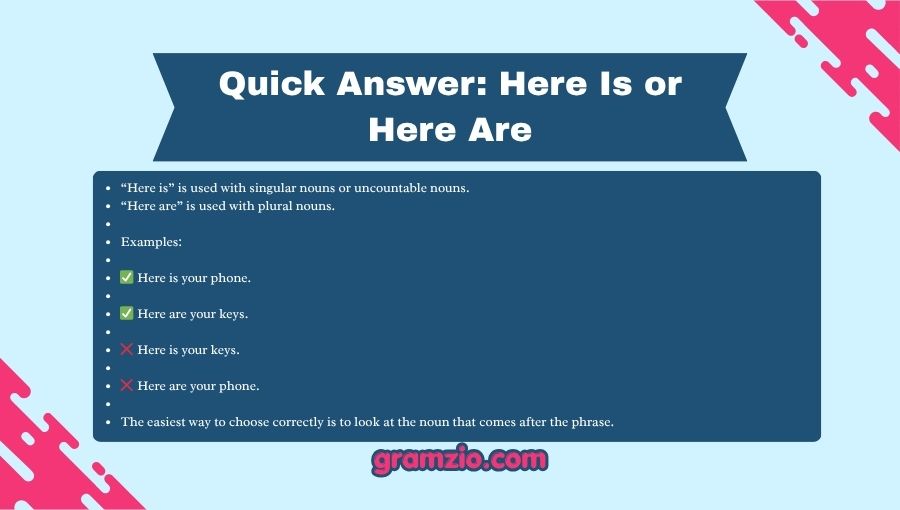
“Here is” is used with singular nouns or uncountable nouns.
“Here are” is used with plural nouns.
Examples:
- ✅ Here is your phone.
- ✅ Here are your keys.
- ❌ Here is your keys.
- ❌ Here are your phone.
The easiest way to choose correctly is to look at the noun that comes after the phrase.
Understanding the Basics of Here Is or Here Are
The phrases “here is” and “here are” are used to introduce or present something. The word “here” points to a location or indicates that something is being presented.
The real difference comes from the verb:
- Is = singular
- Are = plural
Comparison Table
| Form | Type | Meaning | Example | Correct/Incorrect |
|---|---|---|---|---|
| Here is | Singular | Used for one item | Here is your bag. | ✅ Correct |
| Here are | Plural | Used for multiple items | Here are your bags. | ✅ Correct |
| Here is | Incorrect plural use | Wrong with plural nouns | Here is your books. | ❌ Incorrect |
| Here are | Incorrect singular use | Wrong with singular nouns | Here are your laptop. | ❌ Incorrect |
Correct Meanings and Uses
Using “Here Is” Correctly
Use “here is” when talking about:
- One person
- One object
- One idea
- Uncountable nouns
Examples:
- Here is my notebook.
- Here is the answer you wanted.
- Here is some water.
Sentence Breakdown
In the sentence “Here is my notebook”:
- Notebook is singular.
- Therefore, is is the correct verb.
Test Tip ✅
Replace the noun with it.
- If it is sounds correct, use here is.
Example:
- It is my notebook.
- Therefore: Here is my notebook.
Using “Here Are” Correctly
Use “here are” when talking about:
- Multiple people
- Multiple objects
- Countable plural nouns
Examples:
- Here are your shoes.
- Here are the documents.
- Here are my friends.
Sentence Breakdown
In the sentence “Here are your shoes”:
- Shoes is plural.
- Therefore, are is the correct verb.
Test Tip ✅
Replace the noun with they.
- If they are sounds correct, use here are.
Example:
- They are your shoes.
- Therefore: Here are your shoes.
Why People Get Confused 😵
Many people struggle with here is or here are because English speakers often shorten phrases in casual speech.
For example:
- “Here’s your keys.”
- “Here’s the files.”
Technically, these are grammatically incorrect because “here’s” means “here is.” However, native speakers sometimes use it informally in conversation.
In formal writing, though, grammar rules matter.
Case Study Section
Workplace Email Example
Imagine an employee sending files to a manager.
Incorrect Email ❌
Here is the reports you requested.
Why is this wrong?
- “Reports” is plural.
- The writer should use “are.”
Correct Email ✅
Here are the reports you requested.
This version sounds professional and grammatically accurate.
Real-Life Conversation Example
Incorrect
Person A: “Do you have my sunglasses?”
Person B: “Yes, here is your sunglasses.”
Correct
Person B: “Yes, here are your sunglasses.”
Because “sunglasses” is treated as a plural noun.
Grammar Rules Explanation
According to standard English grammar authorities like Merriam-Webster, verbs must agree with their subjects in number. This is called subject-verb agreement.
That means:
- Singular subject → singular verb
- Plural subject → plural verb
Rule Formula
Singular
Here + is + singular noun
Example:
- Here is the book.
Plural
Here + are + plural noun
Example:
- Here are the books.
Special Note About “Here’s”
The contraction “here’s” only means:
- Here is
It does NOT mean:
- Here are
Correct
- Here’s the package.
Incorrect
- Here’s the packages.
Even though native speakers sometimes say it casually, avoid it in professional or academic writing.
Common Mistakes
Common Errors People Make
| Incorrect Sentence | Correct Sentence | Reason |
|---|---|---|
| Here is my friends. | Here are my friends. | Friends is plural |
| Here are the answer. | Here is the answer. | Answer is singular |
| Here’s the books. | Here are the books. | “Here’s” = “Here is” |
| Here are my laptop. | Here is my laptop. | Laptop is singular |
Why These Mistakes Happen
1. Fast Typing ⌨️
People often type quickly and forget subject-verb agreement rules.
2. Autocorrect
Some devices automatically shorten “here is” to “here’s.”
3. Informal Speech Habits
Native speakers sometimes ignore grammar rules in casual conversations.
4. Lack of Grammar Knowledge
Many learners simply do not know the singular/plural rule.
Similar Grammar Confusions
| Confusing Pair | Correct Usage |
|---|---|
| It’s / Its | It’s = it is, Its = possession |
| Your / You’re | Your = possession, You’re = you are |
| There / Their / They’re | Location, possession, contraction |
| Was / Were | Singular vs plural past tense |
| Here is / Here are | Singular vs plural presentation |
Usage in Different Contexts
Everyday Conversation 🗣️
People use these phrases constantly in daily life.
Examples:
- Here is your coffee.
- Here are your groceries.
- Here is the movie ticket.
- Here are the kids.
In casual speech, people may bend grammar rules slightly, but correct usage still improves communication.
Professional Writing 💼
In business communication, grammar accuracy matters.
Correct Professional Examples:
- Here are the files you requested.
- Here is the updated contract.
- Here are the meeting notes.
Using the wrong phrase can make writing appear careless or unprofessional.
Creative Writing ✍️
Authors use these expressions to introduce scenes or objects.
Example:
Here is the old house that everyone feared.
Example:
Here are the memories she could never forget.
Correct grammar keeps creative writing smooth and natural.
Social Media and Texting 📱
Social media users often shorten everything.
Informal:
- Here’s the pics.
Grammatically Correct:
- Here are the pictures.
While informal mistakes are common online, proper grammar still creates a better impression.
Why It Matters ⭐
Many people think small grammar rules are unimportant, but using here is or here are correctly improves communication in several ways.
1. Clarity in Communication
Correct grammar helps readers understand your message immediately.
Clear:
- Here are the instructions.
Confusing:
- Here is the instructions.
2. Professionalism
Grammar mistakes can damage credibility in:
- Emails
- Reports
- Academic papers
- Job applications
Good grammar shows attention to detail.
3. Better Digital Communication
Today, much communication happens online. Clear writing helps avoid misunderstandings.
Whether you are:
- texting,
- emailing,
- posting online,
- or writing professionally,
correct grammar matters more than ever.
Inspirational Quote ✨
“Good grammar is the foundation of clear communication.”
Special Exceptions
Informal Spoken English
Native speakers sometimes say:
- “Here’s your keys.”
- “Here’s the files.”
Even though these are technically incorrect, they are common in casual spoken English.
However:
- Avoid them in formal writing.
- Avoid them in academic settings.
- Avoid them in professional communication.
Uncountable Nouns
Use “here is” with uncountable nouns.
Examples:
- Here is some milk.
- Here is the information.
- Here is your advice.
Even though these nouns may refer to large amounts, they are grammatically singular.
Quick Recap Checklist ✅
| Question | If Yes → Use |
|---|---|
| Is the noun singular? | Here is |
| Is the noun plural? | Here are |
| Is it uncountable? | Here is |
| Are you using “here’s”? | Only for singular nouns |
Practice Examples
Choose the Correct Form
1.
___ the keys you wanted.
✅ Answer: Here are
2.
___ your jacket.
✅ Answer: Here is
3.
___ the photos from vacation.
✅ Answer: Here are
Advanced Grammar Insight
Sometimes the noun comes later in the sentence, which can confuse writers.
Example:
- Here are the reasons.
- Here is the problem.
Always focus on the noun after the verb.
Here Is vs Here Are in Questions
These phrases can also appear in questions or responses.
Example:
“Where are my books?”
“Here are your books.”
Example:
“Where is my wallet?”
“Here is your wallet.”
Mini Memory Trick 🧠
Remember this simple rule:
- One thing = is
- Many things = are
That is the easiest way to avoid mistakes.
FAQs About Here Is or Here Are
1. Is “Here’s your keys” grammatically correct?
No. “Here’s” means “here is,” which should only be used with singular nouns. The correct sentence is:
- “Here are your keys.”
2. When should I use “here is”?
Use “here is” with:
- singular nouns,
- uncountable nouns,
- or one person/object.
Example:
- Here is my phone.
3. When should I use “here are”?
Use “here are” with plural nouns.
Example:
- Here are my shoes.
4. Is “here are the information” correct?
No. “Information” is an uncountable noun, so the correct sentence is:
- Here is the information.
5. Why do native speakers say “here’s” with plural nouns?
In casual speech, many native speakers shorten phrases naturally. However, it is still considered grammatically incorrect in formal English.
6. Is this rule important in professional writing?
Yes. Correct grammar improves professionalism, clarity, and credibility in emails, reports, and business communication.
Conclusion
Understanding the difference between here is or here are is much easier once you remember one simple grammar rule: singular nouns use “is,” while plural nouns use “are.” Although casual speech sometimes bends the rules, proper grammar is essential in professional, academic, and formal communication.
Whenever you feel unsure, simply identify whether the noun is singular or plural. If it refers to one thing, use “here is.” If it refers to multiple things, use “here are.”
Small grammar improvements can make a big difference in how clearly and confidently you communicate. ✨
So next time you write or speak, pause for a second and ask yourself:
One thing or many things?
That quick check will help you choose the correct phrase every time.
Also read: Flew vs Flown

Hi, I’m Grayson Finch. I’m part of the gramzio.com team with 9 years of experience in grammar education. I am dedicated to teaching professional communication and helping you master the art of writing.